South Korea Offers 500m Won for Exam Cheating Tips
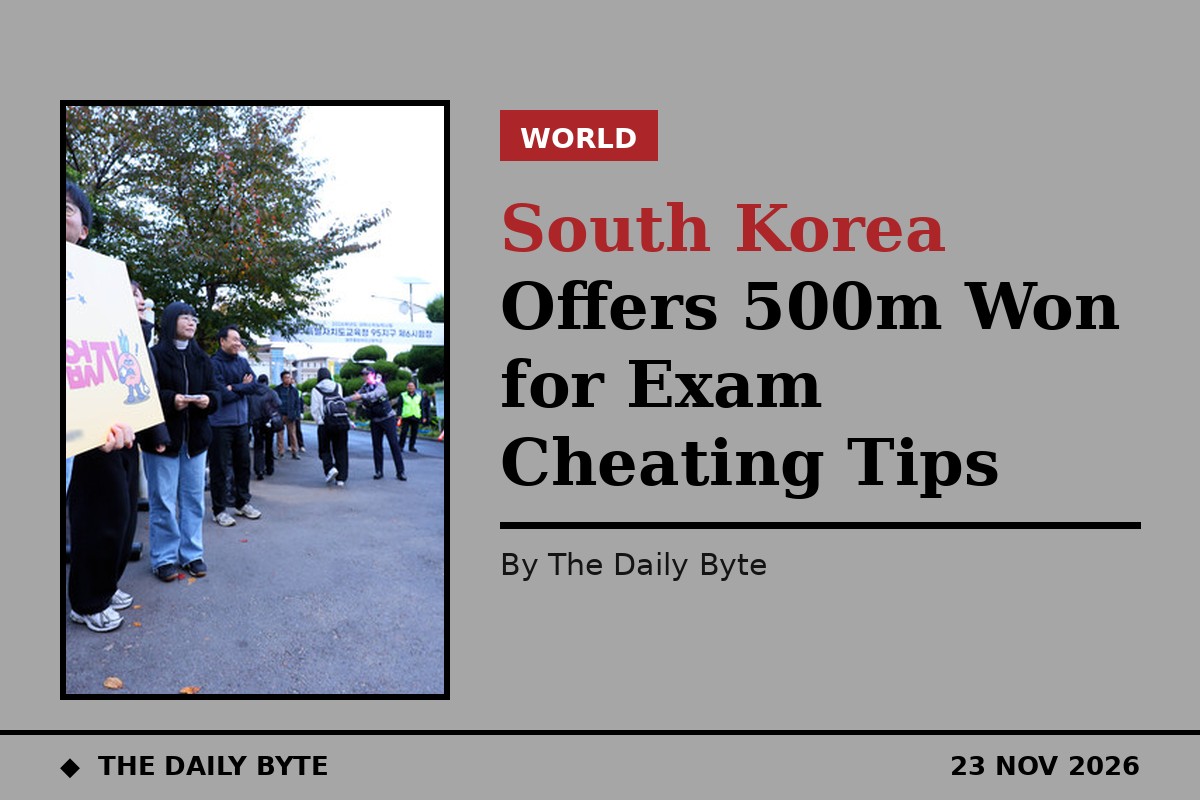
South Korea will pay whistleblowers up to 500 million won (about $371,000) for tips that expose cheating on the national college entrance exam, the Anti-Corruption and Civil Rights Commission announced on Monday, 23 November, as the government steps up its crackdown on cheating aided by artificial intelligence.
Under the revised rules, each verified report earns at least 100 million won, rising by a further 100 million won for every additional offender uncovered, up to the 500 million won cap per report. People who confess to cheating and report their accomplices can receive the full reward alongside reduced penalties, the commission said. The measure was announced by the Anti-Corruption and Civil Rights Commission on 23 November, and was also reported by the Korea Times the same day.
Tips can be submitted through the commission's Clean Portal, in person, or by post, as part of a two-month intensive reporting drive that runs from 20 November 2026 to 19 January 2027. Whistleblowers who want complete anonymity can report through a lawyer listed on the commission's website, and the Public Interest Whistleblower Protection Act guarantees confidentiality and protection against retaliation.
A presidential order, twice corrected
President Lee Jae-myung first ordered rewards starting at 100 million won per case on 17 November, while attending summits linked to the Association of Southeast Asian Nations in the Philippines, where he chaired an emergency exam review by video conference. But the Prime Minister's Office and the anticorruption commission then announced on 18 and 19 November that payments would be capped at 100 million won.
Lee corrected that cap at a meeting of senior aides on 20 November and again on social media on 21 November, insisting the 100 million won figure was a minimum, not a maximum, and that payouts must rise with the number of offenders caught. “Cheating on the CSAT is as serious a crime as corruption by public officials,” he said, adding that the government would pursue every case to the end because cheating steals the lifetime efforts of hundreds of thousands of test takers.
Five examinees face criminal complaints
The exam at the centre of the crackdown is the College Scholastic Ability Test, known in Korean as the Suneung, which was held on 19 November. More than 550,000 candidates sat the eight-hour test at 1,312 centres across the country, and officials recorded 111 smart-device violations. Of those, 106 candidates were penalised simply for carrying banned electronics they had failed to hand in, while five examinees actively used devices during the test.
The Education Ministry said at a morning briefing on 23 November that it was filing formal criminal complaints against all five. Police have already opened investigations into four of the five cases: two candidates who hid mobile phones in their shoes and clothing, one carrying a camera and wireless Bluetooth earphones, and one who brought smart glasses into a test room. Investigators are also checking 19 online posts discussing exam fraud.
The scandal behind the crackdown
Public alarm surged on 15 November, when Han Won-seok, aged 34, confessed on his lawyer's YouTube channel that he had cheated his way to first place on the 63rd certified tax accountant exam. Han scored 397.5 out of 400 points in April by using a miniature camera, generative AI and a smartphone. Investigators had already uncovered similar tactics in other tests, including two TOEIC English tests in May, a gas engineer certification exam and several school assessments.
The turmoil also cost the education minister his job. Choi Kyo-jin resigned on Sunday, 22 November, over public confusion caused by last-minute rule changes before the test, and President Lee accepted his departure within the hour, placing Prime Minister Han Sung-sook in charge of the follow-up measures.
Confirmed cheaters have their exam scores invalidated and currently face a one-year ban from retaking the test. The ruling party and the government are advancing bills in the National Assembly to extend that ban to 10 years, applied retroactively from the 19 November exam, alongside a 10-year ban on university admission. Offenders who use smart devices also face criminal prosecution for obstructing official duties by fraudulent means, which carries up to five years in prison.
What happens next
Jung Il-yeon, chairperson of the Anti-Corruption and Civil Rights Commission, said the commission would back informants who step forward during the two-month drive. “We will provide sufficient reward money to courageous whistleblowers who correct cheating and protect them to the very end,” she said. Whether the higher rewards produce convictions will depend on the quality of the tips: reports must lead to a confirmed case before any money is paid. The Korea Times reported the same reward terms on 23 November, including the reduced penalties for cheaters who confess and implicate accomplices.


