South Korea Air Raid Alert as Russian Jets Near Island
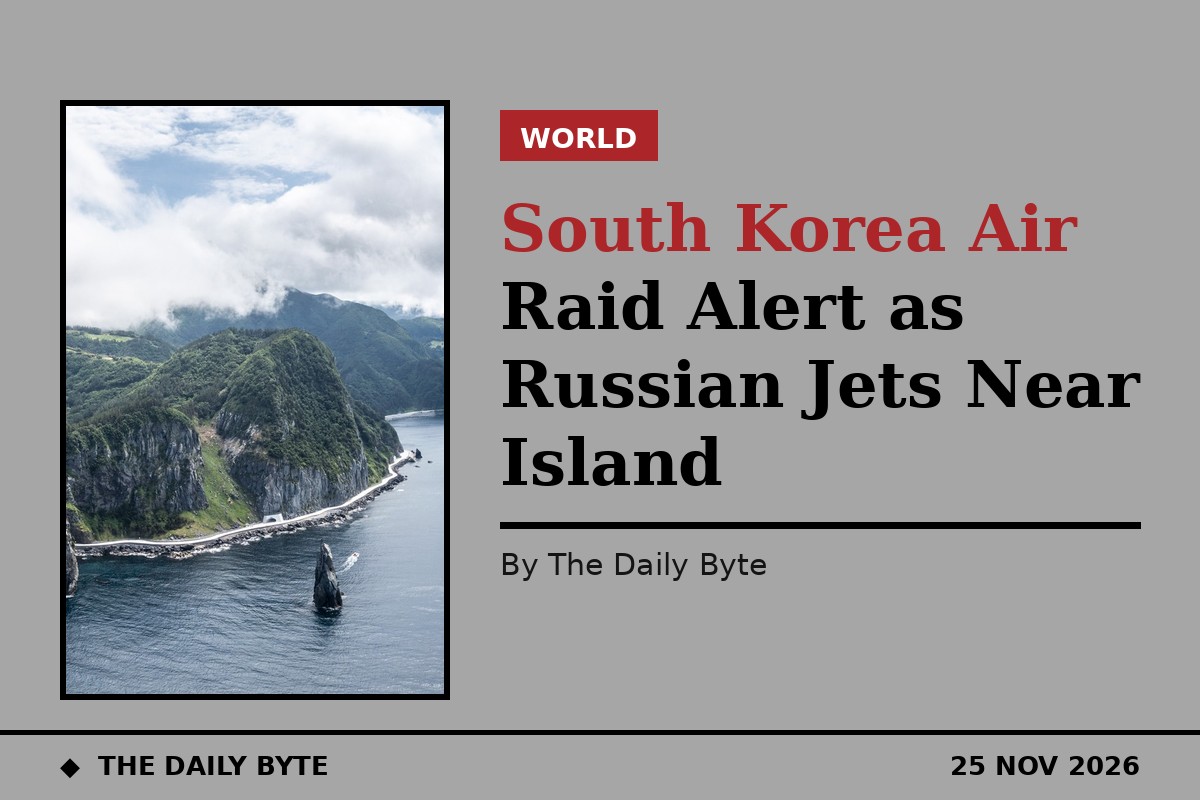
South Korea scrambled fighter jets on Tuesday after Russian military aircraft entered the country's air defence identification zone and approached the eastern island of Ulleungdo, prompting an air raid alert for residents that was lifted within minutes.
The Joint Chiefs of Staff said several Russian military aircraft entered the Korea Air Defense Identification Zone (KADIZ) over the waters between the Korean Peninsula and Japan and flew close to Ulleungdo's airspace. Yonhap news agency, citing the Joint Chiefs, put the number of aircraft at about five. South Korean media reported that F-15K fighter jets were among those scrambled.
The military said the aircraft turned away without violating South Korean territorial airspace. An air defence identification zone is a buffer extending beyond a country's sovereign airspace, giving its military more time to identify and respond to approaching aircraft. Entering such a zone does not in itself violate national airspace or international law.
At 7:52 a.m. local time, the interior ministry sent an emergency text message to residents of Ulleungdo, a volcanic island of about 8,700 people lying 120 kilometres off South Korea's east coast, instructing them to take shelter underground or inside a building. The English portion of the message read: "EVACUATION, AIR RAID." The warning was lifted three minutes later, once the aircraft had left the area.
The alert itself became part of the story. An earlier statement from the interior ministry, which relays military information for public alerts, had wrongly said the Russian aircraft had violated South Korean airspace. A follow-up all-clear message from the provincial government then wrongly described the intruder as a suspected North Korean aircraft. Provincial authorities later said they had mistakenly reused a template from a civil defence drill.
Joint Chiefs spokesperson Captain Jang Do-young told a briefing that the military had judged an airspace violation to be imminent and issued the warning pre-emptively to protect the public. According to Yonhap, it was the first time South Korea's military had issued a precautionary air raid alert over a possible airspace intrusion by Russian aircraft.
South Korea's defence ministry said it would summon the Russian military attache to lodge a strong protest. Reports said the attache, Colonel Nikolai Marchenko, was summoned on Tuesday afternoon. Russia's defence ministry said its Tu-160 strategic bombers had completed a planned flight of about 10 hours over international waters of the Sea of Japan, escorted by Su-35S and Su-30SM fighters.
Tuesday's incident was the fourth known entry by Russian military aircraft into South Korea's air defence identification zone this year, and the second in a week. A similar entry on 17 November also drew a scramble of South Korean fighters, and Japan protested the same day after saying two suspected Russian aircraft had entered its airspace off its south-western coast.
There is precedent for sharper encounters. In 2019, South Korean fighter jets fired warning shots after a Russian A-50 airborne early warning aircraft, flying alongside Russian and Chinese bombers on a joint patrol, entered South Korean territorial airspace near the island of Dokdo. Moscow denied violating the airspace. Ulleungdo itself had a major scare in 2022, when North Korea fired more than 20 missiles into the sea and one headed toward the island, setting off air raid sirens and prompting residents to evacuate.
No major disruptions were reported on Ulleungdo on Tuesday, and the island's residents returned to normal life within minutes of the alert being lifted. The confusion in the official messages, however, has raised questions in Seoul about how the alert system is coordinated between the military and the ministries that relay its warnings to the public.


