South Korea and China Conclude Services Trade Deal in Boost for Tourism and K-Content
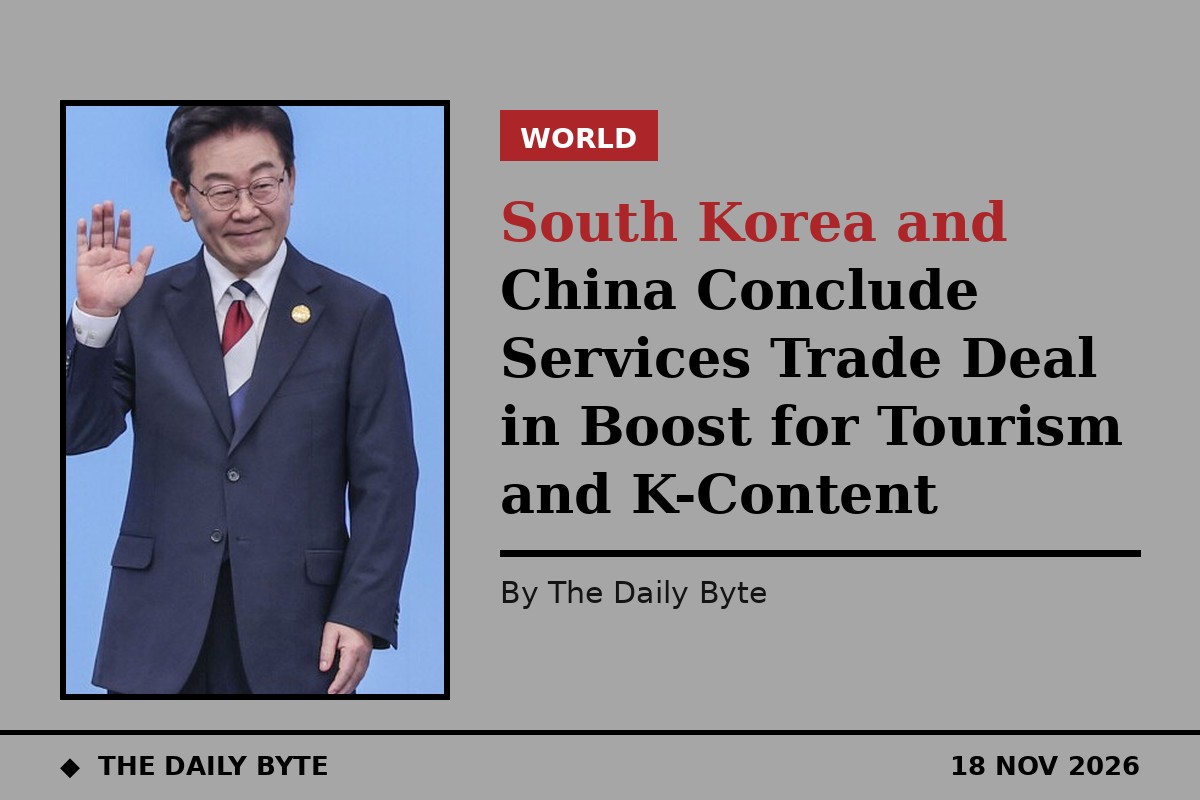
South Korea and China have reached a substantive conclusion on follow-up negotiations covering services and investment under their bilateral free trade agreement, opening the way for expanded tourism, Korean cultural content and business access in China. The deal was announced on Wednesday 18 November after President Lee Jae Myung and Chinese President Xi Jinping held their third summit on the sidelines of the Asia-Pacific Economic Cooperation (APEC) gathering in Shenzhen.
The agreement is the second phase of the Korea-China free trade agreement, which took effect for goods in December 2015. Follow-up talks on services and investment began in March 2018 and had made little progress for years, stalling for more than four years after China asked in October 2020 to exclude cultural content from the negotiations entirely. Their conclusion, eight years after they began, was announced by Lee at the summit with Xi at Qilin Villa in Shenzhen.
What the deal covers
The most closely watched part of the agreement concerns Korean cultural content. China has pledged to grant most-favoured-nation treatment to Korean content, including films and games, meaning Korean companies cannot be treated less favourably than those of any third country. It has also agreed to apply the principle of non-discrimination in pre-screening reviews of films and online games. South Korea's Ministry of Trade, Industry and Energy said this was the first time China had included such provisions in a trade agreement.
The two countries also signed an annex expanding audiovisual co-productions beyond film — the only category covered by the original agreement — to dramas, animation, variety programmes and documentaries. Co-productions that meet the requirements will be treated as domestic works in both countries, allowing them to benefit from China's quotas for local programming.
Tourism, retail and business access
In tourism, Korean travel agencies established in 23 regions across China, including Beijing, Shanghai, Chongqing and Hainan, will be allowed to organise outbound travel for Chinese citizens and foreign nationals living in China. That lets them recruit Chinese group tourists directly and sell a range of travel packages to South Korea.
In retail, Korean companies seeking to operate 30 or more stores in China will no longer need a joint venture with a Chinese partner, opening a path for Korean fashion and other brands to enter the market under their own names. In construction, restrictions on the types of projects Korean firms can take part in have been lifted, opening access to a Chinese construction market worth about $4 trillion a year. Korean law firms will also be able to expand their offices and take on joint cases with Chinese firms, and in finance, Korean firms will be entitled to the same benefits if China opens its financial markets further to third countries. Bilateral trade in goods between the two countries stands at about $270 billion, while services trade is worth around $38.8 billion.
Is this the end of the Hallyu ban?
Not formally. China's unofficial ban on Korean cultural content — known as the Hallyu ban — has restricted exchanges in film, music and tourism for close to a decade, since Seoul deployed the US Terminal High Altitude Area Defense (THAAD) antimissile system in 2016. The ban was not specifically mentioned in the talks, and China's pre-release content reviews and game licence system will remain in place. No quotas have been set for the number of films imported or games approved, so it remains to be seen how much conditions will actually improve in practice.
Even so, the agreement is widely seen as laying the groundwork for a genuine restoration of ties. President Xi said China wanted to continue promoting people-to-people exchanges and gradually develop sound and mutually beneficial cultural exchanges, and he signalled that the visa-free entry policy for tourists, which had been due to expire at the end of this year, would likely be extended. People-to-people exchanges between the two countries are expected to pass 10 million this year, and Lee called for measures to restore the level to 13 million, the figure reached in 2016.
What else the leaders discussed
During their 35-minute meeting, Lee said he hoped the two countries could work together to create an era of peaceful coexistence on the Korean Peninsula, and asked China to play a constructive role. Xi updated Lee on recent developments in North Korea-China relations and expressed support for efforts to ease tensions on the peninsula, including dialogue between Pyongyang and Washington. Lee also proposed expanding cultural and content exchanges in phases, and the two sides discussed bringing a pair of giant pandas to South Korea.
The agreement still needs to be finalised: working-level tasks remain, including refining the wording of the text and checking for legal gaps, and it will take effect only once both sides sign the text and it is ratified by South Korea's National Assembly and by the Standing Committee of China's National People's Congress.
Frequently asked questions
Has China lifted the Hallyu ban on Korean content? Not formally. The deal grants Korean films and games most-favoured-nation treatment and non-discriminatory pre-screening, but China's content reviews and game licence system remain, and no import quotas have been set.
What does the deal mean for Korean tourists and travellers? Korean travel agencies in 23 Chinese regions can now organise outbound travel for Chinese visitors, and the visa-free entry policy for tourists is likely to be extended beyond the end of this year.
Sources: Korea JoongAng Daily; Reuters.


