South Korea Readies Market Fund After Kospi Plunge
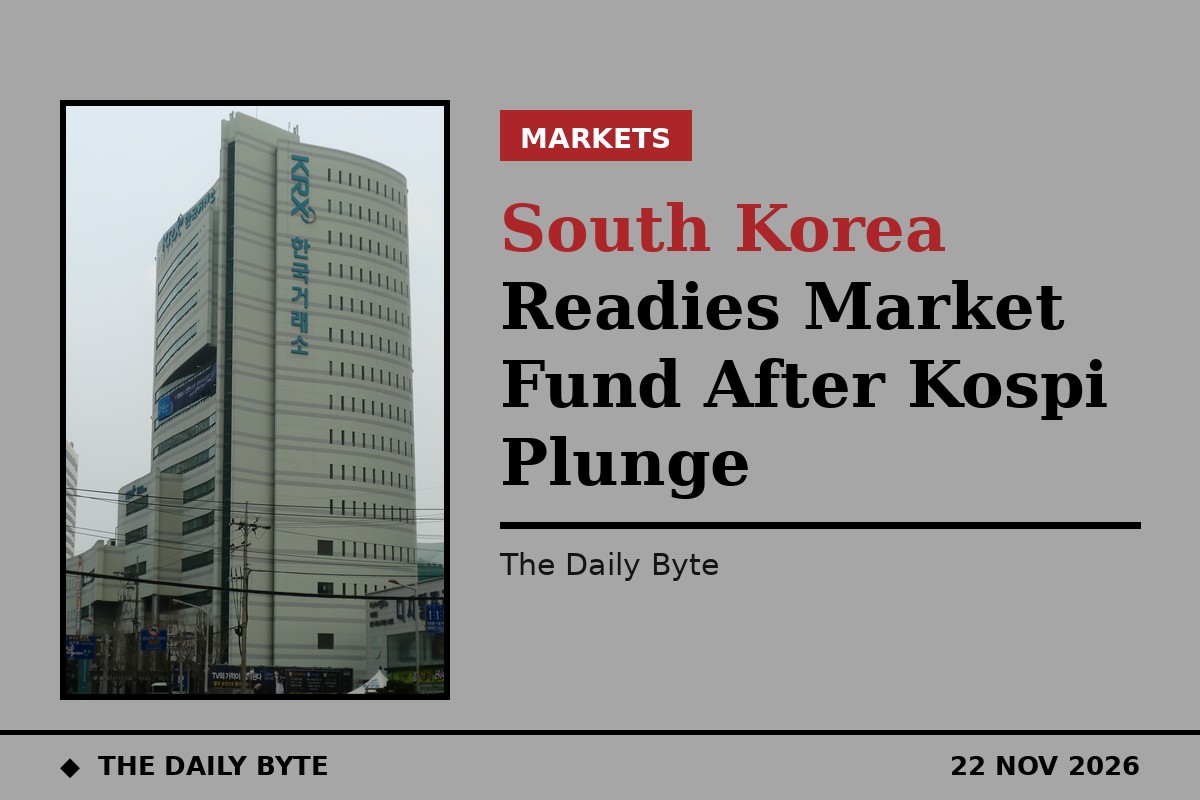
South Korea's government unveiled emergency measures to steady its stock market on Sunday, preparing a state-backed stabilisation fund for use if needed, after the Kospi index fell more than 5% on Friday and US chip stocks tumbled after the Seoul close.
Deputy Prime Minister and Finance Minister Lee Hyoung-il chaired an emergency market review meeting on Sunday afternoon at the Government Complex Seoul, alongside Bank of Korea Governor Shin Hyun-song, Financial Services Commission Chairman Lee Eok-won and Financial Supervisory Service Governor Lee Chan-jin. Officials said they wanted a response in place before the market reopened on Monday, amid fears of a further sharp fall.
Friday's falls forced the weekend meeting
On Friday 20 November the Kospi closed at 4,869.96, down 267.93 points or 5.21% on the day, giving up the 5,000 level. Its weekly decline reached 7.95%. The Kosdaq fell 5.71% to 645.68, a weekly drop of 7.72%. In New York the same day, the Dow Jones fell 1.93%, the S&P 500 dropped 3.70% and the Nasdaq Composite slid 5.28%, while the Philadelphia Semiconductor Index crashed 10.73%, with Nvidia down 14.01%, AMD down 13.25%, Broadcom down 12.19% and Micron down 13.89%. Kospi 200 night futures fell a further 6.99% after the US close, heightening concern about Monday's open.
Officials traced the turmoil to growing uncertainty around artificial intelligence and semiconductors, compounded by worries about US interest rate increases, US data centre regulation and tighter semiconductor export controls. They said concerns over AI profitability and funding had been building, but added that many assessments still saw medium- to long-term growth potential in the AI industry, and warned against excessive anxiety and panic selling.
A fund readied, not yet spent
The centrepiece is the Securities Market Stabilization Fund, an emergency tool that buys stocks and exchange-traded funds with capital contributed by financial companies and securities-related institutions. The government said it would immediately begin preparations — including the trigger framework and ways to improve the fund's effectiveness — so it can be deployed at once if market conditions require it.
No capital has been committed yet. The fund was pledged at about 10.7 trillion won, roughly $8.0 billion, during the Covid-19 outbreak in 2020, and its reactivation was pushed for in 2022, but neither occasion led to large-scale deployment of funds. The decision now is to be ready, with deployment judged against market volatility, investor sentiment and the overall level of risk.
The package has two other tracks. The daily limit on share buyback orders by listed companies will be eased for three months from 24 November, after a Financial Services Commission vote on Monday 23 November, to expand companies' capacity to buy back shares during a downturn. And the Financial Supervisory Service and the Korea Exchange will run a three-month intensive monitoring period on illegal short selling, including naked short selling, while tracking margin loans, unsettled trades and forced liquidations to prevent cascading selling.
What happens next
The move marks a shift from just nine days earlier, when at a capital market policy meeting chaired by President Lee Jae-myung on 13 November, the financial investment industry proposed deploying the fund and the Financial Services Commission chairman took a cautious stance, saying it should be used only in urgent and exceptional situations where systemic risk was rising. The government had already held an emergency meeting on 6 November and exempted securities firms from margin loan collateral ratio obligations for three months from 9 November.
Officials also said they would launch a capital market reform task force as soon as possible and asked the National Assembly to cooperate on bills and budget plans covering tax treatment of listed shares, a productive-finance individual savings account, a children's asset-building fund and stronger retirement pensions.
Whether the measures calm the market will be tested at Monday's open, with Tokyo closed for a public holiday and US stock futures reopening on Sunday evening. The Bank of Korea is also due to hold its policy meeting on Thursday 26 November.
Sources: Seoul Economic Daily and BigGo Finance.