South Korea Expands Cheonghae Unit Near Hormuz
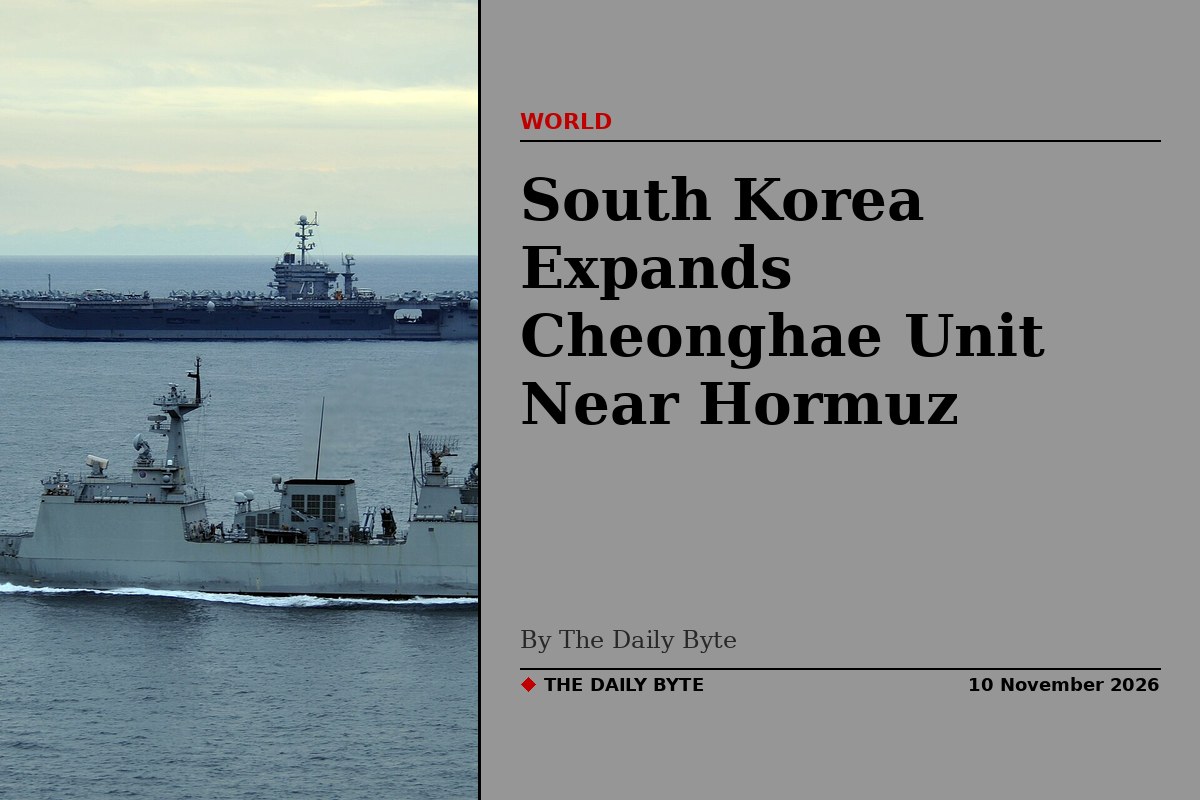
South Korea's Cabinet has approved a plan to expand its Cheonghae naval unit towards the Strait of Hormuz, adding a maritime patrol aircraft and mine-clearance capabilities to the anti-piracy mission it has run in the Gulf of Aden since 2009. The decision was taken on Tuesday 10 November 2026, at a National Security Council meeting chaired by President Lee Jae-myung, and then cleared by the Cabinet the same day.
The revised deployment agreement extends the unit's operating area from the Gulf of Aden to waters off southern Oman, near the port of Duqm, about 650 kilometres from the Strait of Hormuz. The move roughly doubles the area the unit patrols, from a radius of about 600 nautical miles to about 1,200 nautical miles, and it is aimed at protecting South Korean vessels and shipping routes while tensions in the Middle East remain high.
What is being added to the mission
Alongside the destroyer that forms the core of the unit, South Korea will deploy one P-8A Poseidon maritime patrol aircraft, an explosive ordnance disposal team and unmanned mine-clearance systems. The personnel ceiling for the deployment will rise by 75, from 320 to 395, and the mission is to run through 31 December 2027, subject to approval by the National Assembly.
The mission will also take on a new task: supporting freedom of navigation on international shipping routes, in addition to its existing duties of responding to piracy and protecting commercial vessels. The destroyer currently serving with the unit's 49th rotation is the 4,400-ton ROKS Chungmugong Yi Sun-sin, which left the naval base in Busan on 9 October.
Seoul stresses a non-combat role
The Ministry of National Defense has stressed that the expanded mission will remain strictly non-combat and that South Korea will not take part in the war with Iran. Operations will be confined to international waters south of Oman, and the patrol aircraft will not target or monitor Iranian territory, Iranian territorial waters or the inside of the Strait of Hormuz itself.
Officials have also described the mine-clearance element as preparation for possible international mine-clearance work in the strait after hostilities end, rather than as an immediate operation. Any direct military operation such as mine clearance inside the strait would need separate approval from the National Assembly, the government has said.
Concerns raised at home
Some lawmakers and civil society groups have raised concerns that the expansion amounts to an indirect deployment in support of military operations around the strait, at a time when the United States has pressed allies to contribute to efforts linked to the war with Iran. President Lee has previously said Seoul will not deploy troops in a way that could lead to military intervention.
The Cheonghae Unit was first deployed in March 2009 to escort South Korean and other commercial vessels through the Gulf of Aden, one of the world's busiest shipping lanes. It has also carried out rescue operations, including for crews of hijacked vessels. The revised agreement approved on Tuesday will now go through final approval procedures after being submitted to the National Assembly following the President's endorsement. A separate agreement to extend the deployment of the Akh unit, which supports training for the United Arab Emirates military, was also passed at the same National Security Council meeting.
The decision comes as shipping through the Strait of Hormuz, the narrow waterway through which a large share of the world's seaborne oil passes, has been disrupted by the war between the United States and Israel and Iran that began in February 2026. For South Korea, which imports almost all of its oil by sea, keeping the route open is a direct economic interest, and the government has framed the Cheonghae expansion as a way to protect its citizens and its trade without joining the fighting.


