South Korea Exports Pass $1 Trillion on AI Chip Boom
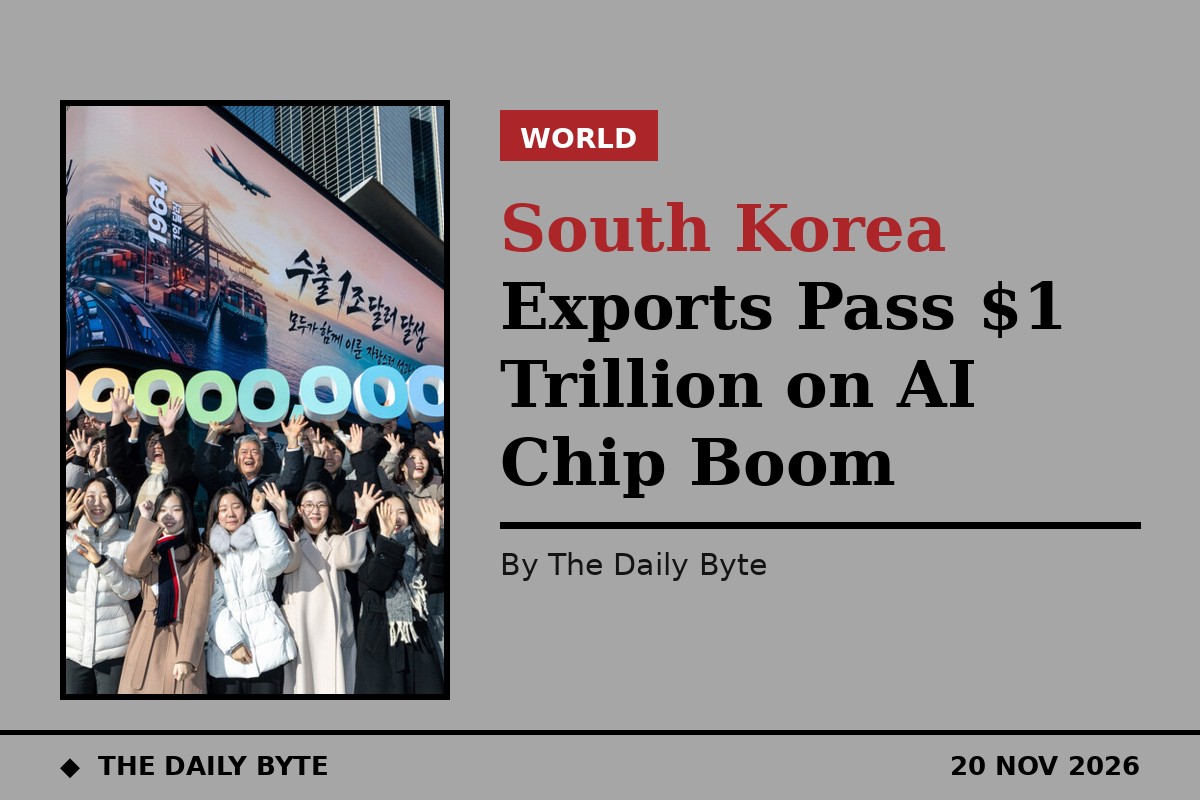
South Korea's exports passed $1 trillion in a single year for the first time on Thursday, making it only the fourth country ever to reach the milestone, after the United States, Germany and China.
The Korea Customs Service's electronic clearance screen showed cumulative exports for 2026 passing $1 trillion at 2:09:38 p.m. on 19 November, the Ministry of Trade, Industry and Resources said. South Korea is the first country in 19 years to join the $1 trillion export club: the United States and Germany first passed the mark in 2006, followed by China in 2007.
Chips powered the milestone
Semiconductors were by far the main driver of the record. Chip exports reached $396.8 billion in the first 10 months of the year, up from $135.4 billion in the same period last year, and accounted for 74.5 percent of the $351.1 billion increase in total exports. The ministry said semiconductors made up about 43 percent of shipments through October.
Refined petroleum products such as jet fuel also set a record at $57.2 billion, a striking result for a country with no crude oil of its own but formidable refining capacity. Computer exports soared to $45.1 billion, easily eclipsing the previous record of $14.6 billion.
Exports for the year so far are up 62.7 percent from $614.8 billion in the same period last year, and the ministry projects full-year exports of $1.17 trillion, with a trade surplus of about $390 billion. Shipments to the United States posted the steepest gain, climbing to $176.8 billion from January through October, while exports to China rose to an all-time high of $198.5 billion.
From wigs to chips
The milestone caps a transformation that began with light manufacturing. In the 1960s, Korea's exports included squid, iron ore, pig bristles and even ginkgo leaves; wigs made from women's hair became one of its top exports in 1970. Exports have grown more than 36,000-fold since 1948, and 10,000-fold since first reaching $100 million in 1964.
The boom was not confined to the largest firms. Small and medium-sized companies recorded exports of $96.5 billion through September, up 9.5 percent on a year earlier, and the number of exporting firms rose 1.6 percent to 90,765. Cosmetics were their top export, hitting a record $7.65 billion, up 26.4 percent on the year.
The Korea International Trade Association estimated that $1 trillion in exports generates about 4.95 million jobs, with a domestic production effect of $1.7 trillion. It also noted that South Korea has the smallest population of any country to reach the milestone, but the highest exports per person at the time of reaching it, at $19,376.
Risks ahead for 2027
"Given our relatively small population and economy compared with other countries, this is a remarkable achievement," said Kang Kam-chan, deputy minister of trade and investment, at a press briefing in Sejong. But he warned that chip prices may fall if investment in artificial intelligence data centres slows, and oil prices may decline if the wars in the Middle East and Ukraine end.
"Since the U.S. midterm elections, there has been some concern that delays in AI data center projects could push chip prices down somewhat," Kang said. "In past downturns, Korea's chip exports fell by about 25 percent." He added that data centre demand continues and he does not expect a significant decline, with conditions likely to hold through the third quarter of next year.
Kang also stressed the need to manage Korea's trade surplus with the United States, which President Donald Trump has cited as a main reason for raising tariffs on Korean goods. If the overall surplus comes to around $300 billion, the U.S. portion would be a little over $100 billion, he said, adding that Korea should use the surplus to cooperate with strategic partners rather than let it become a source of trade friction. He said Korea also needs to find new export items, pointing to pharmaceuticals, medical devices and machinery.


