South Korea Eyes 9 December Vote on Top Judge Ouster
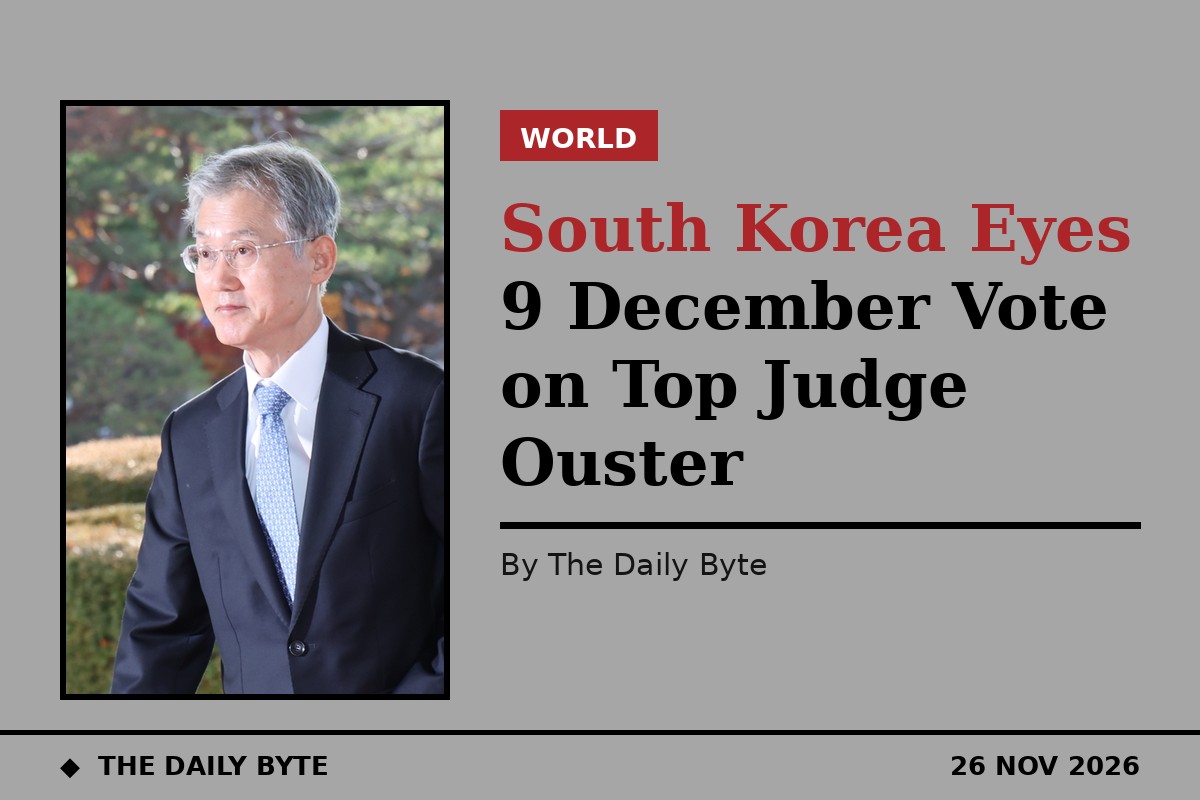
South Korea's ruling bloc is weighing a vote by 9 December on impeaching Supreme Court Chief Justice Jo Hee-de, in a confrontation between the legislature and the judiciary that has drawn concern from an international lawyers' association.
The Democratic Party of Korea adopted impeachment of the chief justice as party policy on 20 November, a day after the Supreme Court partly overturned the conviction of former Prime Minister Han Duck-soo over his role in the December 2024 martial law declaration. The party says the motion could be put to a vote in the National Assembly before the end of the year.
Party leader Kim Min-seok proposed on Wednesday that five parties in the broader ruling bloc file the motion jointly, linking the chief justice's removal to closing the book on the martial law crisis. The five are the Democratic Party, the Rebuilding Korea Party, the Progressive Party, the Social Democratic Party and the Basic Income Party.
Timetable runs against the budget deadline
The party had first discussed reporting the motion around 1 or 2 December and voting on it on 3 December, the second anniversary of the emergency martial law declaration. That plan is now shifting, because the 2 December constitutional deadline for next year's budget bill is crowding the timetable.
Democratic Party lawmaker Kim Yong-min said on 26 November that internal discussions were moving towards completing action on the impeachment motion by 9 December, when the regular session of the National Assembly ends. Under the National Assembly Act, an impeachment motion must be put to a vote no earlier than 24 hours and no later than 72 hours after it is reported to a plenary session. The specific schedule for filing and voting has not yet been set.
The party's impeachment task force says its grounds are procedural rather than based on the Han ruling itself, which it deliberately excluded to avoid questions about legality. It accuses the chief justice of infringing the president's appointment power, refusing to testify at a parliamentary audit, and breaching the special counsel law's deadline for ruling in Han's case. It is also examining allegations that the court prepared to cooperate with the December 2024 martial law declaration and misspent court funds.
The head of the task force, Yang Bu-nam, has acknowledged that individual allegations might lack sufficient gravity on their own, but argues that collectively they are more than serious enough.
Opposition and lawyers push back
The opposition People Power Party (PPP) condemned the five-party push on 26 November, calling it a “manipulated impeachment” and urging the ruling bloc to withdraw it. PPP leader Jang Dong-hyuk said the move was reckless, and floor leader Jeong Jeom-sik noted that the Changwon District Court, the Korean Bar Association and the Citizens' Coalition for Economic Justice have all issued statements opposing the impeachment.
LAWASIA, an international association of lawyers covering more than 40 jurisdictions across the Asia-Pacific region, also expressed concern in a statement released on 26 November, saying the ruling bloc's effort to impeach the chief justice should be approached with caution. A nationwide representative body of judges has separately urged colleagues to defend judicial independence as the impeachment push advances.
Critics argue the Democratic Party is using impeachment to suspend the chief justice and gain political advantage, even though the case for removal is weak. The party holds 161 of the 300 seats in the National Assembly, enough to pass a motion on its own. If it passes, the chief justice would be suspended while the Constitutional Court decides whether to remove him — which opponents say would in itself deliver the political benefit the party seeks, by keeping him from influencing judicial appointments in the meantime.
If the motion is tabled, it would be the first impeachment of a Supreme Court chief justice in South Korea's history. (The chief justice's name is also romanised as Cho Hee-dae.)
Note: this is a follow-up to our 22 November report on the ruling party's decision to seek impeachment. That report covered the decision itself; this report covers the new five-party proposal, the revised timetable and the international reaction since then.


