South Korea Probes Hack of 300 Government Email Accounts
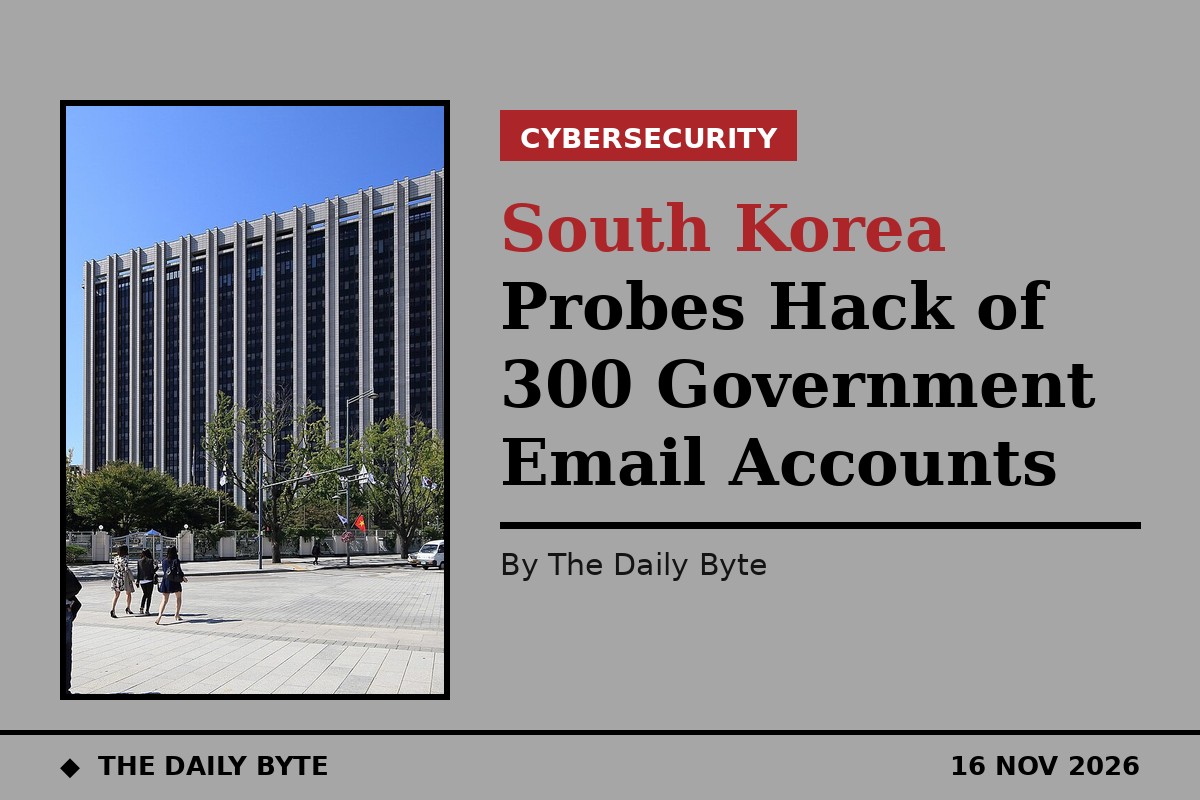
South Korea has opened a joint investigation after hackers broke into the government's official email system and gained unauthorised access to more than 300 accounts, the Ministry of the Interior and Safety announced on Monday, 16 November 2026.
The investigation is being carried out with the National Intelligence Service (NIS) and the Korea Internet and Security Agency (KISA). It follows a notification from the relevant agencies on 9 November, a week before the ministry made the incident public.
According to the ministry, the attackers exploited vulnerabilities in the networks of some local governments to reach the administrative email system operated by the National Information Resources Management Office. The attack targeted a flaw in the system's single sign-on (SSO) authentication, the mechanism that lets a user log in once and gain access to multiple connected services.
More than 300 accounts showed abnormal access
Investigators have so far identified more than 300 accounts with abnormal access. The ministry has reported the breach to the Personal Information Protection Commission, the country's privacy watchdog, and has notified the people affected. It has also blocked unnecessary connections to the email system while the investigation continues.
The ministry said the joint investigation would establish the exact cause of the hacking and the pathways the attackers used, and would check thoroughly for any additional traces of intrusion and for residual malware left inside the systems.
What the ministry has not yet said is who carried out the attack, how long the attackers were inside the system, or whether any emails or personal data were actually read or taken. The confirmed finding so far is abnormal access to the accounts, not a confirmed theft of data, and officials have not attributed the incident to any group or country.
Why a single sign-on flaw matters
Single sign-on systems are attractive targets because one weakness can open many doors. Once attackers can pass the shared login check, they may be able to move between connected services without having to break into each one separately. That is why the ministry's first response included cutting off unnecessary connections to the system, to limit any further movement while investigators work out how the attackers got in.
The incident is the latest in a run of cyber incidents in South Korea this autumn. Earlier in November, the Financial Security Institute, which oversees security for the country's financial industry, reported a breach in which personal details of around 300 people were taken from administrative forms. A separate breach at the Korea Minting and Security Printing Corporation's gift-certificate platform exposed the personal data of 3,083 users, and the crypto exchange Coinone disclosed on 15 November that a support vendor's servers had been compromised.
None of those incidents has been linked by officials to the government email hack, and they involved different systems and different organisations. But together they underline the pressure on South Korean public and financial systems, and the difficulty of securing the many local-government networks that connect into central government services.
What happens next
The joint investigation by the interior ministry, the NIS and KISA is now under way. Its findings will determine whether the intrusion went beyond the accounts already identified, whether any data left the system, and what fixes are needed in the local-government networks and the single sign-on system itself.
For the officials whose accounts were affected, the immediate advice from the ministry is that they have been notified directly. The wider lesson, for any organisation running a shared login system, is that the convenience of signing in once has to be matched by monitoring that can spot abnormal access quickly, and by the ability to cut off connections fast when something goes wrong.
Sources: Aju Press reported the ministry's announcement, the scale of the breach and the joint investigation; Aju Press reported the single sign-on vulnerability, the 9 November notification and the report to the privacy watchdog.


