South Korea and Singapore lead world robot density, IFR says
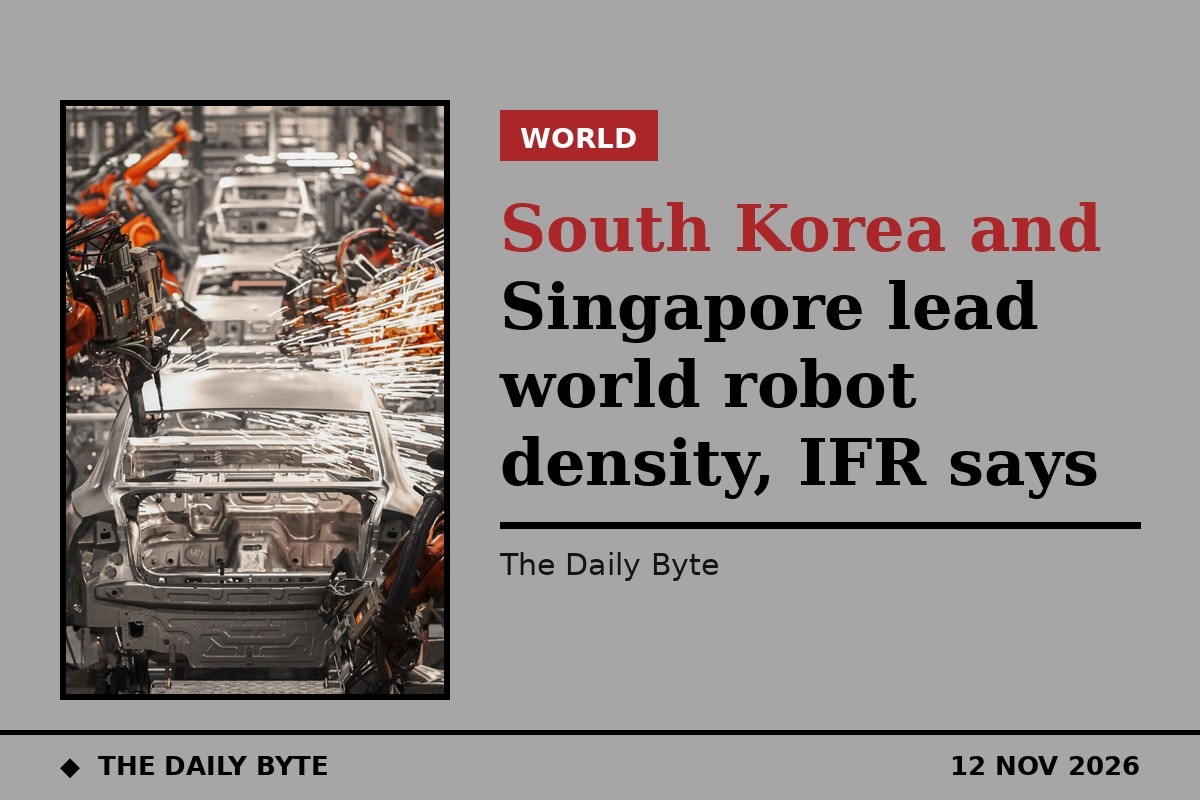
South Korea remains the world's most robot-dense manufacturing economy, with 1,066 industrial robots for every 10,000 factory workers, followed by Singapore with 873, according to new data from the International Federation of Robotics (IFR). Germany ranks third with 469, while the global average has risen to a new peak of 152.
The figures come from the IFR's World Robotics 2026 report, published on Thursday 12 November. Robot density measures the number of industrial robots in operation against manufacturing employment, giving a comparable picture of how automated factories are across economies of different sizes.
Asia pulls further ahead
Asia's robot density reached 144 units per 10,000 employees, an increase of about 47% over the five years from 2020 to 2025. Japan ranks fourth in the world with 452 robots per 10,000 manufacturing workers. China, the world's largest market for industrial robots, has a density of 193 units, ranking 19th globally, after rising 147% over the same five-year period.
IFR president Jane Heffner said tracking robot density creates a level playing field for global analysis by adjusting the number of operational industrial robots against every 10,000 employees in manufacturing. The measure counts industrial robots used in production only, and excludes service robots such as delivery and cleaning machines.
Factories keep automating
The new figures underline how quickly automation is spreading through Asian manufacturing. South Korea's lead reflects heavy automation in its electronics and car industries, while Singapore's high density comes from electronics and precision engineering despite its small manufacturing workforce. With the global average still far below the leaders, the report suggests most countries have considerable room to automate further as labour costs rise and manufacturers seek higher productivity.
Sources: Business Wire, Morningstar