South Korea Readies Market Fund as Kospi Tumbles
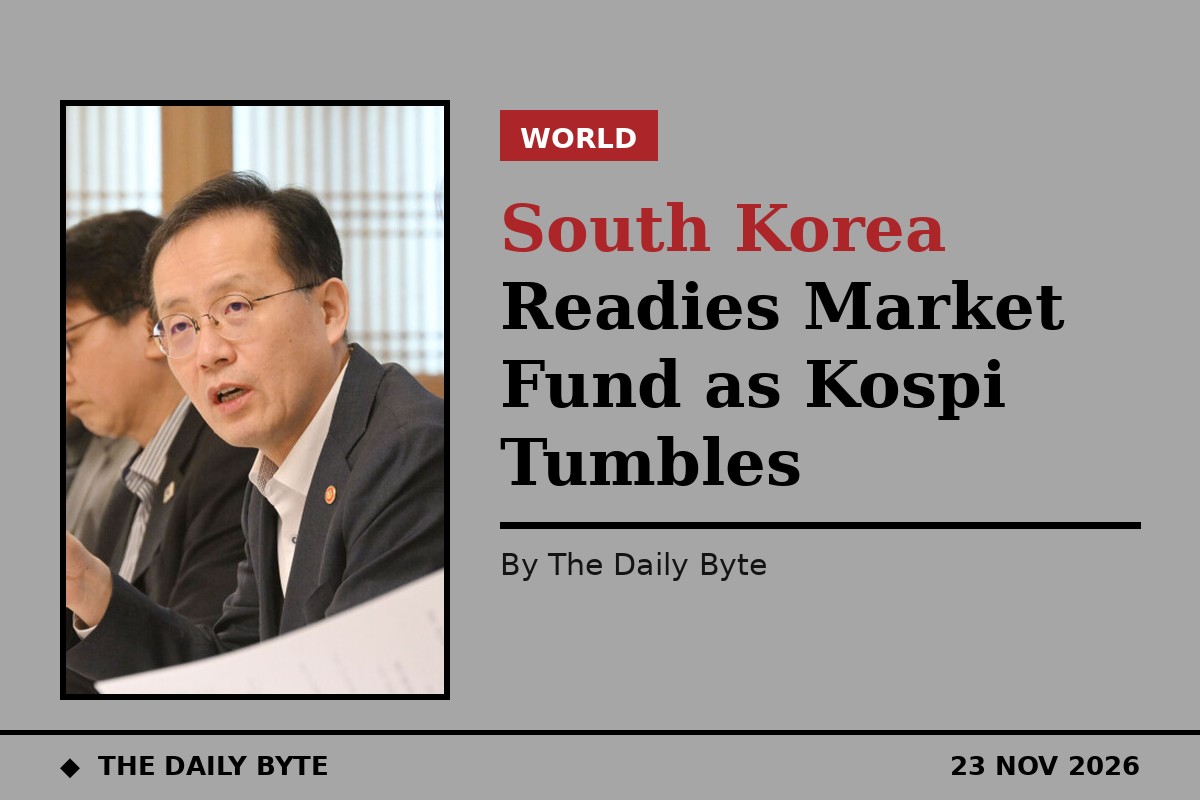
South Korea is preparing to activate its 10.76 trillion won stock market stabilisation fund, worth about $8 billion, Finance Minister Lee Hyoung-il said on Monday, 23 November, as the Kospi extended a sell-off driven by doubts over the artificial intelligence trade and chip stocks. The government has not yet decided when to deploy the fund, or how large it should be, but Mr Lee said officials were putting the procedures in place so it could be switched on quickly if markets worsen.
"Given the high impact of external uncertainties, volatility in our stock market has expanded significantly, which is why we addressed the issue," Mr Lee told a press conference at the Government Complex in Sejong. "The message we delivered yesterday is that we will decide whether to activate measures depending on market conditions. Accordingly, we are preparing so that necessary steps tailored to the situation will be implemented at an appropriate time."
The Kospi fell 3.06 per cent on Monday to close at 4,708.54, touching an intraday low of 4,586.80, and a sell-side sidecar, a brief trading curb, was triggered for a second consecutive session. The benchmark has shed nearly 20 per cent since the start of November. On Friday the Kospi and the Kosdaq plunged 5.21 per cent and 5.71 per cent respectively, and US stocks tumbled after the Korean market closed, with the Nasdaq down 5.28 per cent, the PHLX Semiconductor index down 10.73 per cent, Nvidia down 14.01 per cent and AMD down 13.25 per cent.
Emergency meeting on Sunday
The measures were drawn up at an emergency meeting chaired by Mr Lee at the Government Complex in Seoul on Sunday, attended by Bank of Korea Governor Shin Hyun-song and the heads of the Financial Services Commission and the Financial Supervisory Service. Officials blamed the turmoil on uncertainty over the profitability and financing of the AI industry, US regulations on data centres and tighter semiconductor export controls, while insisting the sector's long-term growth prospects remained intact and cautioning investors against panic selling.
The stabilisation fund, financed by contributions from financial institutions and other participants, would counter sharp declines by buying index-linked products and other securities. A similar fund worth 10.76 trillion won was set up during the Covid-19 pandemic in 2020 but was never deployed, because the market rebounded before any money was injected. Officials acknowledge the fund now looks small next to the market: the Kospi's market capitalisation has grown to 3.86 quadrillion won from 1.98 quadrillion won at the end of 2020.
Buybacks eased and short selling watched
The government also announced it would ease daily limits on listed companies' share buyback orders for three months starting on Tuesday, giving firms more room to repurchase their own shares and support their prices. The Financial Supervisory Service and the Korea Exchange will step up surveillance of illegal short selling for three months and take strict action against violations, while also examining margin lending, unsettled transactions and forced liquidations.
Short selling has surged as prices have fallen. Short-selling transactions reached 1.41 trillion won on Friday, up 222.2 billion won from the previous trading day, according to the Korea Exchange, concentrated in semiconductor and technology stocks. SK hynix recorded the highest value at 159.7 billion won, followed by Samsung Electronics at 133.8 billion won.
Taiwan, whose market is similarly dominated by semiconductor companies, has gone further. On Saturday its Financial Supervisory Commission announced five measures, including barring investors from short-selling listed shares and Taiwan depositary receipts below the previous day's closing price, and raising the minimum collateral for short selling from 130 per cent to 150 per cent.
Growth forecast stays upbeat
Despite the rout, Mr Lee struck an upbeat note on the wider economy, saying Asia's fourth-largest economy was maintaining strong momentum and could achieve growth in the upper-3 per cent range next year if present trends continued. That forecast sits awkwardly beside his own warning that volatility in the semiconductor sector could spill into the broader economy, a reminder that the fund, if it is switched on, would be treating the symptoms of a sell-off driven largely by forces outside Seoul's control.
For now, investors must wait. The government has signalled it will act, but has tied its hand to market conditions it has not defined, and the size of any intervention remains undecided. Whether the promise of a fund that has never been used is enough to steady the market will be tested in the coming sessions.


