South Korea Tops UN E-Government Survey Again
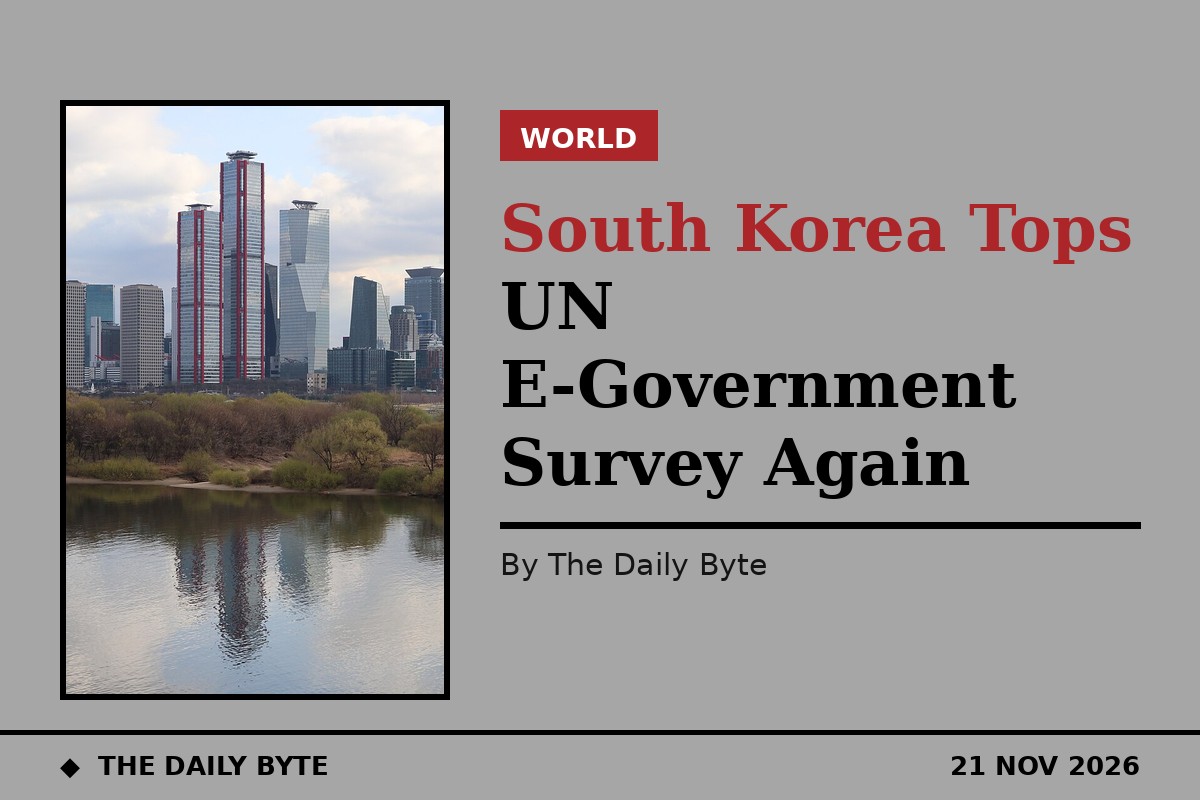
South Korea has reclaimed first place in the United Nations E-Government Survey, returning to the top of the global ranking of digital government for the first time in 12 years. The Ministry of the Interior and Safety announced on Friday, 20 November, that the country ranked first among 194 countries in the 2026 survey, with a score of 0.9794 on the E-Government Development Index.
The United Nations launched the survey, titled From Digital Government to Agentic Government, on 19 November. It is the biennial assessment produced by the UN Department of Economic and Social Affairs, and it marks 25 years since the survey began. This edition covered 193 UN member states and, for the first time, the State of Palestine.
A twelve-year climb back to the top
South Korea last led the ranking in 2014, after topping the survey in 2010 and 2012 as well. It then slipped down the table, placing third in 2016 and 2018, second in 2020, third in 2022 and fourth in 2024, before climbing three places to retake first place this year.
Denmark finished second with a score of 0.9777, followed by Singapore on 0.9722, Saudi Arabia on 0.9721 and the United Arab Emirates on 0.9711. The UN press release also names Iceland, the United Kingdom, Estonia, Finland and Australia among the top ten countries.
By component, South Korea ranked fourth in the world for online services, fifth for telecommunications infrastructure, up one place, and eleventh for human capital, up six places. The index combines those three measures to judge how far governments have taken public services online, how good the underlying connectivity is, and how able people are to use digital services.
What the survey found worldwide
The global picture improved across the board. The average E-Government Development Index rose by 4.6 per cent, from 0.6382 in 2024 to 0.6675 in 2026, and 151 of the 194 countries assessed now sit in the high or very high groups, up from 138 in 2024. Europe remains the regional leader, followed by Asia, the Americas, Oceania and Africa, while Oceania recorded the strongest relative gain at 15.5 per cent.
Progress was driven mainly by online public services, whose index rose by 12 per cent, compared with 2.1 per cent for telecommunications infrastructure and 0.6 per cent for human capital. Across the 72 services assessed, 77.5 per cent are at least partly digitalised, but only 27.4 per cent are fully digitalised. At city level, Dubai, Madrid, Manama, Riyadh, Sao Paulo and Vienna achieved the highest local online service scores.
The survey also warns that the gains are uneven. Some 1.95 billion people, or 24.31 per cent of the world population, live in countries where e-government services sit below the global average, 53.3 million more than in 2024. The UN said the survey points towards AI-enabled public administration, but stressed that officials must keep responsibility for decisions, with trusted data, cybersecurity, human oversight and auditable safeguards.
Seoul welcomes the result
President Lee Jae Myung shared the news on social media after the ministry announcement, welcoming the return to first place. The ministry said the result reflected sustained investment in online services and digital infrastructure, and in the skills needed to use them.
Li Junhua, the UN Under-Secretary-General for Economic and Social Affairs, said progress should ultimately be judged not by rankings or by the number of digital and AI applications deployed, but by whether public institutions become more capable, inclusive, accountable and resilient, and whether people can access services that respond to their needs and deserve their trust.
For South Korea, the ranking is a return to a position it held for much of the survey's early history. The next edition, due in 2028, will show whether it can hold the top spot against Denmark and Singapore, which finished within a fraction of a point behind it this time.


