South Korea Vows Talks to Defend 15% Tariff Cap
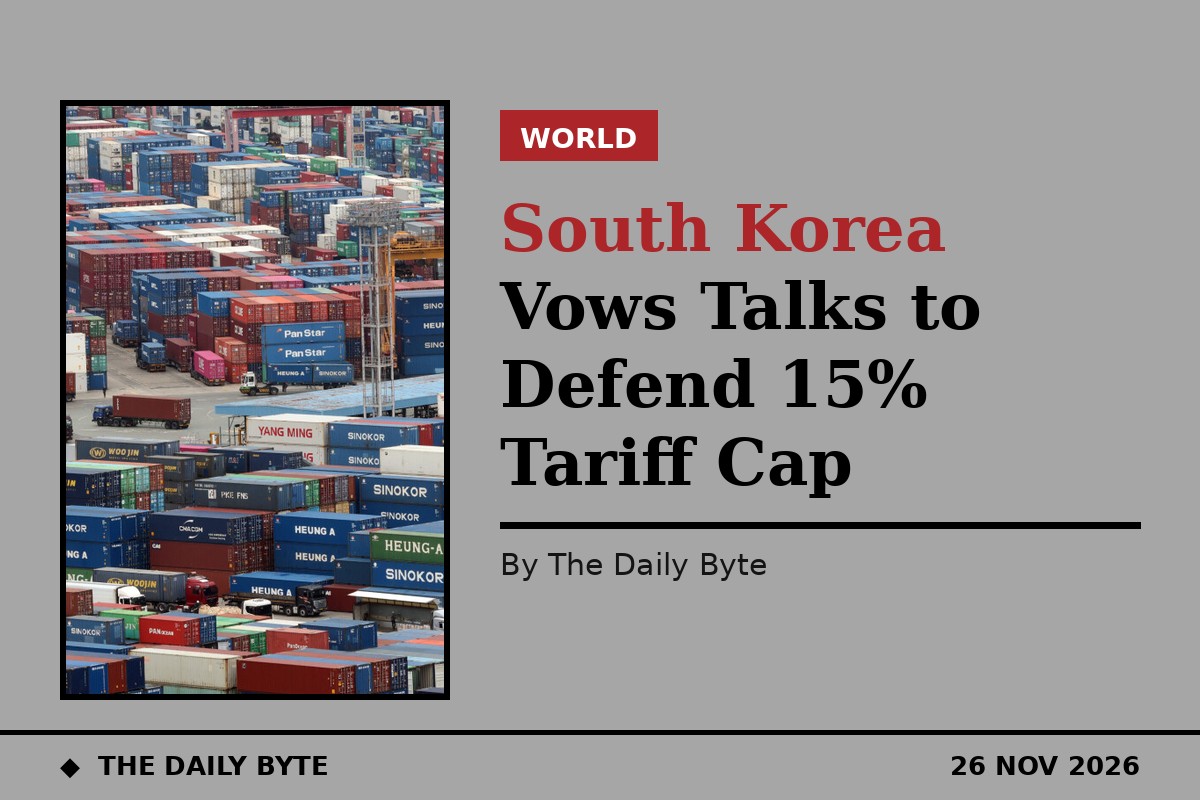
South Korea has said it will hold further talks with the United States to safeguard its national interests, after Washington proposed new tariffs on Korean goods under a probe into unfair trade practices.
The Office of the United States Trade Representative announced on Wednesday that it would impose tariffs on 14 major trading partners over what it called industrial overcapacity, following an eight-month investigation under Section 301 of the Trade Act of 1974. The proposal sets a capped tariff rate of 15 percent, including existing most-favoured-nation duties, on goods from South Korea, along with Japan, Taiwan and the European Union.
Seoul's response came on Thursday, 26 November. The Industry Ministry said South Korea's manufacturing sector was an integral part of US supply chains, and that it had stressed in consultations ahead of the announcement that the issue of excess industrial capacity did not apply to South Korea.
The proposed rate is not the final word. Washington said it may apply a tariff of up to 25 percent on Korean goods if it finds the outcome of follow-up consultations and the implementation of existing trade commitments unsatisfactory. Similar escalation clauses apply to the other economies named, with possible rates of up to 20 percent for Japan and the European Union and up to 40 percent for China.
Seoul dismisses the US case
South Korean officials pushed back firmly against the substance of the American complaint. A senior official at the Ministry of Trade, Industry and Resources told reporters on Thursday that much of the US report was simply a list of Korean policies compiled to build a Section 301 case, and that many of the American arguments were illogical or did not apply.
The official said South Korea had consistently explained that its industrial policy does not aim to create structural oversupply, and that the state does not intervene to that end. Seoul is not considering any abrupt policy shift in response, the official added.
Industry Minister Kim Jung-kwan said defending the existing 15 percent cap was a solid result in itself. Seoul expects the rate to hold, in part because it is keeping its side of last year's trade deal, under which tariffs on South Korean exports were lowered from 25 percent to 15 percent in return for a combined 350 billion dollar package of investments in the United States.
The US report took direct aim at Korea's state-led industrial development model, identifying automobiles, semiconductors and petrochemicals as the sectors where it said overcapacity was a problem. It also cited Korea's widening goods and services surplus with the United States, and the Honam semiconductor cluster project, as grounds for concern.
Why the stakes are high
The numbers explain why Seoul is treating the proposal seriously even while playing down its immediate effect. South Korea's cumulative goods trade surplus with the United States topped 100 billion dollars in the first ten months of 2026, more than twice the 49.5 billion dollars recorded for the whole of 2025, according to the Ministry of Trade and Industry.
The renewed tariff offensive also gives Washington leverage over Seoul's domestic industrial policy and its economic ties with China, as well as over the implementation of the investment commitments made under last year's deal. The proposed tariffs are subject to written comments by 5 January 2027, with public hearings beginning on 25 January, before they are finalised.
Seoul argues the pressure should ease because it is keeping its pledge to buy more American goods, including energy. An official said the United States would likely be South Korea's largest source of gas, crude oil, coal and other key energy imports this year, and pointed to a large aircraft order placed with Boeing by Korean Air in September as evidence that Seoul is making steady efforts to increase US imports, as promised in the joint fact sheet.
For now, South Korea's position is to talk rather than retaliate. The government says it will analyse the US report in detail and respond actively to the follow-up procedures, including submitting written comments in cooperation with the relevant ministries and industry. The 15 percent cap holds unless the consultations fail, and Seoul's message to Washington is that the case for raising it does not stand up.


