South Sudan Bundibugyo Virus Readiness Jumps to 72.5%
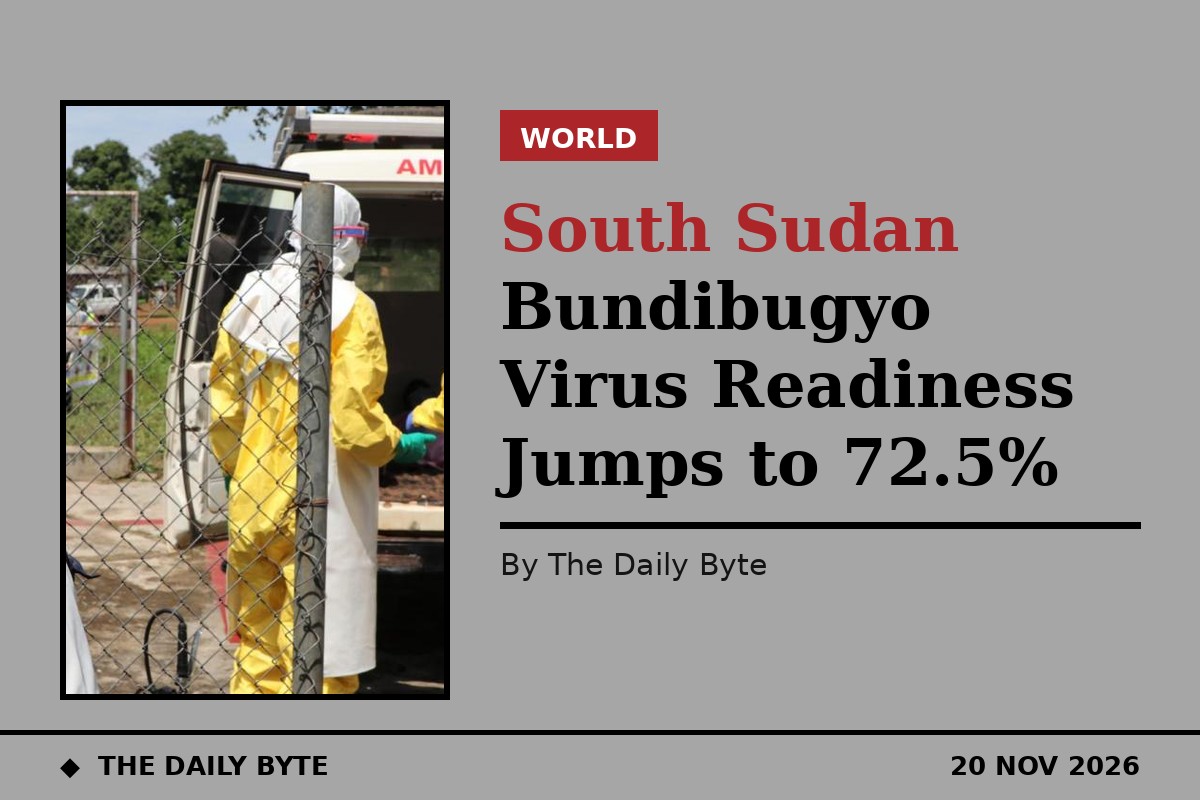
South Sudan has sharply raised its readiness for a possible Bundibugyo virus disease outbreak, lifting its national preparedness score from 29 percent in May to 72.5 percent by October 2026, the World Health Organization (WHO) has said. Bundibugyo virus disease is a form of Ebola, and the outbreak in neighbouring Democratic Republic of the Congo was declared on 15 May 2026, leaving South Sudan preparing for the possibility that a case crosses its long, porous border.
Readiness score more than doubles
South Sudan carried out four successive national readiness self-assessments during 2026, using a WHO tool that reviews the quality of the core functional areas of an emergency response. The first assessment, in May, put the country at 29 percent. By October the score had reached 72.5 percent.
The assessments did more than produce a number. They identified gaps in preparedness and shaped work to improve surveillance, screening, isolation and referral of suspected cases, so that a person showing symptoms can be spotted, separated from others and moved safely to care.
With support from WHO, the Ministry of Health activated its Public Health Emergency Operations Centre to coordinate the work, bring response teams together and track implementation of the preparedness plan. The centre also acts as an accountability hub, assigning roles to the many teams involved in readiness.
Fifteen high-risk counties identified
A sub-national risk assessment identified 15 high-risk counties where preparedness work should be concentrated. The ranking was based on proximity to affected areas in the Democratic Republic of the Congo, known population movements, the location of formal and informal border crossings, surveillance gaps and local vulnerabilities.
The analysis was supported by the WHO African Region's artificial intelligence-enabled Preparedness Data Exchange, a system that brings together preparedness and risk data to inform early, evidence-based decisions across the region.
Drills and a full-scale simulation
Preparation moved from paper plans to practice during the year. In June 2026, 50 national public health institute workers, supported by 20 national and international partner agencies, took part in a scenario-based table-top exercise to test whether the country's preparedness and readiness plan was complete.
Between July and September, health authorities ran drills at newly established isolation facilities and the National Public Health Laboratories, including an infection prevention and control drill on personal protective equipment, chlorine preparation and disinfection of potentially infectious materials.
From 19 to 24 October 2026, the country ran a full-scale simulation exercise in Juba, Yei and Yambio, testing how its emergency response systems would work during a real outbreak. The exercise brought together 93 participants from the Ministry of Health, government institutions, WHO, United Nations agencies and implementing partners.
"The simulation exercise allowed South Sudan to identify strengths and best practices, close gaps and define priorities to improve national capabilities to safely identify and isolate suspected Bundibugyo virus disease cases, protect the lives and health of our prized health workers and indeed the people of South Sudan," said Dak Duop Bichiok, the caretaker National Minister of Health.
Detection strong, containment still the test
The simulation showed that South Sudan can detect the virus in all simulated sites, including one of the 26 priority points of entry that connect it with neighbouring countries where cases have been reported. That is a significant step for a country that scored under a third on readiness only months earlier.
But WHO's own reporting makes clear that detection is not the same as containment. An earlier WHO assessment of the same exercise found that the country could detect a suspected case but was not yet in a position to contain it safely, and the estimated risk of the virus being imported into South Sudan rose from 67 percent in June to 99 percent in October 2026.
The scale of the work behind the improvement is considerable. Between May and October, 150 health workers were trained in Ebola case management across the 15 priority counties, temporary infectious disease units were set up in eight of those counties, and screening, isolation and referral capacity was strengthened at priority border points. Surveillance investments produced 76 Bundibugyo virus alerts by 30 October, all of them investigated. South Sudan has reported no confirmed cases so far.
WHO says the work must continue even though no case has yet been found. "Preparedness cannot wait until a case is detected. WHO is working with South Sudan and partners to identify gaps, strengthen response capacities and ensure that teams are ready to act quickly," said Dr Moses Ongom, officer-in-charge at WHO South Sudan. "With the outbreak ongoing in the Democratic Republic of the Congo, maintaining readiness across the region is essential to detecting cases early and preventing further spread of Ebola."


