South Sudan Ranks Last in Africa Governance Index
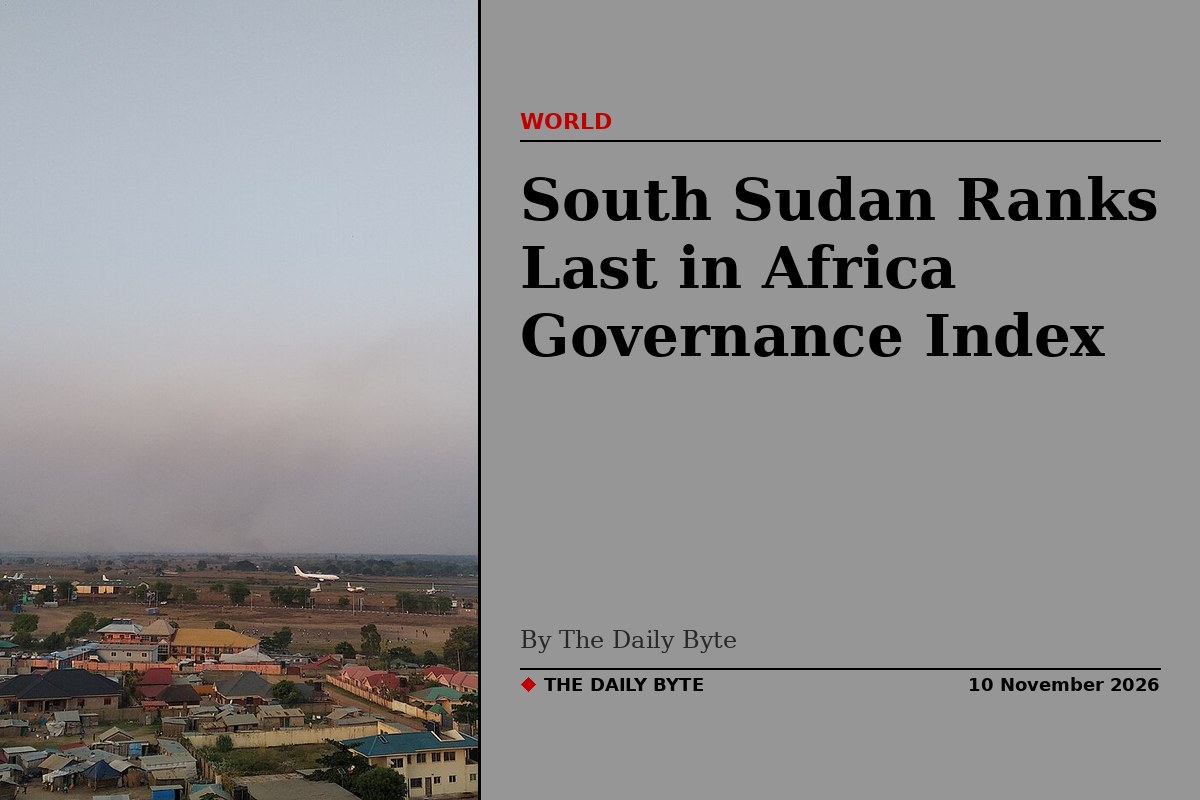
South Sudan has ranked last of 54 countries in the 2026 Ibrahim Index of African Governance, the continent's most widely watched measure of how governments perform for their citizens.
The Mo Ibrahim Foundation released the index on 31 October 2026 in Cairo. South Sudan placed 54th overall, below Somalia in 53rd, with Sudan, Eritrea and the Central African Republic also among the lowest-ranked countries.
The ranking covers governance between 2016 and 2025, a decade in which South Sudan has struggled with the aftermath of civil war, recurring political tensions and a deep humanitarian crisis.
What the index found
Seychelles topped the ranking with a score of 78.6 out of 100, followed by Mauritius on 75.0, Cabo Verde, Botswana and South Africa. South Africa held fifth place with 66.6, but the foundation flagged it as a country in increasing deterioration, meaning its decline has speeded up in recent years.
Across the continent, the average governance score reached 50.1 out of 100 in 2025, up from 49.3 in 2016. Thirty-one of the 54 countries improved over the decade, while 23 got worse, and the countries that slipped are home to just over half of all Africans.
The foundation warned that improvements in economic opportunity and human development were being undermined by deteriorating security, the rule of law and democratic participation. Nigeria, Africa's most populous country, fell 5.2 points to 44.2 and ranked 38th, the only country to decline in all four of the index's categories.
How the index works
The Ibrahim Index of African Governance has been published since 2007. The 2026 edition assesses all 54 African countries using 96 indicators drawn from 51 independent data sources.
It measures performance in four areas: security and the rule of law; participation, rights and inclusion; foundations for economic opportunity; and human development. The index looks at the delivery of political, social, economic and environmental goods and services that citizens are entitled to expect from their governments.
Alongside the overall ranking, the foundation also publishes an SDG Index. Both measures identify Seychelles and South Sudan as the highest and lowest performing countries in 2025.
Why South Sudan sits at the bottom
South Sudan became independent in 2011, but fighting broke out in Juba in December 2013 and spread across the country, displacing more than a million people in the early years of the conflict. The country has since faced repeated cycles of political crisis, localised violence and severe food insecurity.
The index does not single out one cause for a country's ranking. Its four categories mean a low overall position reflects weakness across security, participation, economic opportunity and human development at the same time, rather than a single failing.
The foundation's findings also underline a wider regional picture. East Africa's overall standing is dragged down by Somalia and South Sudan in the bottom two slots, while Kenya ranked 10th with a score of 61.0, above the continental average of 50.1 and the East African regional average of 47.5.
What happens next
The index is published as a benchmark rather than a policy prescription, and governments across the continent use it to measure their own progress against their neighbours.
For South Sudan, the ranking is a reminder of the scale of the task facing its leaders as they work to stabilise the country and deliver basic services. The foundation's data covers the period to 2025, so any changes made since then will only show up in future editions of the index.


