Southeast Asia Needs $7.1 Trillion for Infrastructure
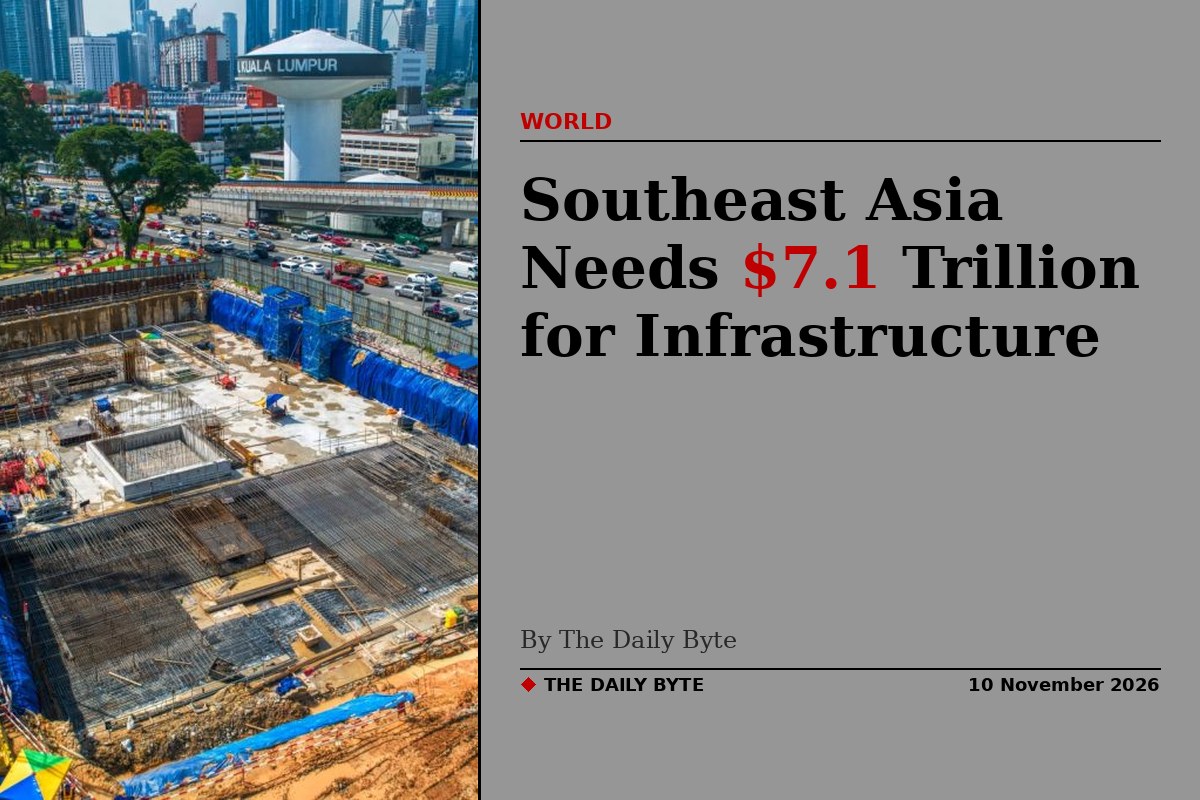
Southeast Asia needs $7.1 trillion in infrastructure investment through 2040, according to a new report from the Asian Development Bank (ADB) released on Tuesday, 10 November 2026.
The report, The $7 Trillion Challenge: Building Tomorrow’s ASEAN, puts the region’s annual infrastructure needs at $476 billion from 2026 to 2040, equal to 8.7% of the region’s gross domestic product. At current levels, government spending would cover only 45% of what is needed, leaving an estimated financing gap of $264 billion a year.
“Southeast Asia’s growth depends on what it builds next,” ADB President Masato Kanda said. “Its factories need dependable electricity, and its businesses need faster, safer ways to reach markets.”
Power and transport dominate the bill
Electricity and transport together account for 85% of the region’s infrastructure needs, requiring $3.6 trillion and $2.5 trillion respectively. Power investment must expand generation, transmission and storage, including cross-border connections under the ASEAN Power Grid, to strengthen energy security and support greater use of clean energy.
Roads remain the largest single transport need at nearly $2 trillion, while railways and airports are among the fastest-growing requirements. The report says integrated transport networks and cross-border links will help cut logistics costs and strengthen the region’s competitiveness in global markets.
Digital and health needs add billions more
Digital infrastructure requires a further $584 billion, including broadband networks and data centres, to support the ASEAN Digital Economy Framework Agreement. Health infrastructure will need another $227 billion through 2040, including investment in about 49,000 new facilities, most of them primary health care centres.
The report covers all 11 members of the Association of Southeast Asian Nations (ASEAN): Brunei Darussalam, Cambodia, Indonesia, Laos, Malaysia, Myanmar, the Philippines, Singapore, Thailand, Timor-Leste and Viet Nam.
Funding gap more than doubles earlier estimate
The ADB has more than doubled its assessment of the region’s needs from its previous estimate of $3.15 trillion for the 2016–2030 period. The bank says a shortage of well-prepared projects is a major obstacle to attracting the private investment needed, and it calls for stronger project preparation, predictable regulations and transparent procurement.
Two initiatives launched in May are intended to help close the gap: the Pan-Asia Power Grid Initiative, which will expand cross-border electricity trade across Asia and the Pacific, and the Asia-Pacific Digital Highway, which will finance fibre networks, submarine cables, internet exchange points and regional data centres through 2035.
The bank says it will help governments bring forward projects that investors can trust and people can depend on, through financing, project preparation and regional coordination.


