Spain Approves Rail Safety Measures After Train Strike
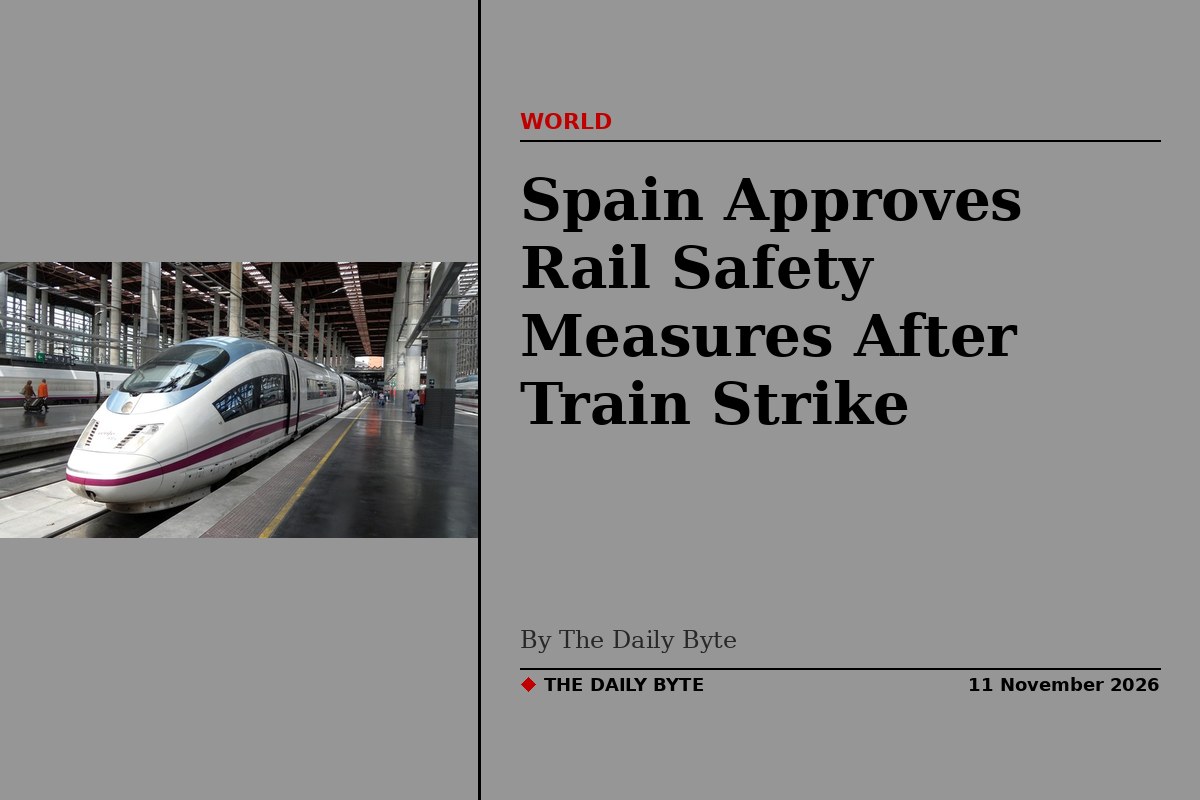
Spain's government has approved a package of rail safety measures after train drivers went on strike on Tuesday to demand more investment in maintenance, following the country's second deadly rail crash this year. The drivers' union, Semaf, called off a further strike planned for Thursday, 12 November, after the cabinet adopted the measures, and said it would instead hold the walkout on 23 November.
The decision brings a partial pause to a dispute that has disrupted rail travel across Spain, but it does not end it. A further strike remains planned for 17 November, and unions are holding a 24-hour nationwide general strike on Wednesday, 11 November, over the housing crisis, ahead of a snap general election on 29 November.
What the safety package includes
The measures give railway staff better ways to report safety concerns and more autonomy to take decisions such as stopping a train, or not restarting it, if they detect a risk. The government also clarified how the time drivers spend operating a train is calculated, and created an ombudsman post for victims of public transport accidents.
Semaf described the move as a "real change of heart" by the government. In a statement, the union said it had decided to replace the strike planned for 12 November with a new strike on 23 November, while keeping the 17 November stoppage in place.
Two deadly crashes on the same line
The dispute follows two crashes on the same high-speed line between Madrid and Seville that have killed 115 people this year. A collision in January near Adamuz, in southern Spain, killed 46 people, and a crash near Toledo last month killed 69.
Investigators said the second collision happened after a controller ordered a Renfe train to continue following a signal failure, even though a stationary Iryo train was further ahead on the same line. Talks between the government and the drivers' union on improving safety began after the January crash but were abandoned in April, according to Semaf.
Transport Minister Oscar Puente resigned last week, and Prime Minister Pedro Sanchez has appointed his deputy, Carlos Cuerpo, to run the ministry on an interim basis.
Strike disruption across the network
About 40 per cent of long- and medium-distance services were cancelled on Tuesday, according to state operator Renfe, affecting 4,042 passengers. Around 90 per cent of services on Madrid's commuter network and half of Barcelona's local services were also cancelled.
At Madrid's Atocha station, passengers described chaotic scenes as they tried to reach work. In Leganes, near Madrid, commuters had to take buses to reach the city centre, and at least five lines on the capital's local commuter network were not operating. In Catalonia, operator Rodalies said trains were running late because of non-compliance with minimum service requirements.
Semaf said its drivers were respecting the minimum service quotas set by the government, and said delays were caused by poor management of the programmed trains.
Funeral in Toledo as the country mourns
King Felipe VI and Queen Letizia joined relatives of the victims of last month's crash at a funeral in Toledo Cathedral on Tuesday. Sanchez did not attend, saying he does not attend religious services as a rule, a decision the conservative opposition criticised.
A 16th-century effigy of Christ was moved from the town of Urda, near the crash site, to Toledo for the service, according to the city's archdiocese.
What happens next
The government's measures are the first concrete response to union demands since the January crash, but Semaf has kept its strike dates for 17 and 23 November, signalling that it will judge the government on delivery rather than announcements. With a general strike under way on Wednesday and a snap election less than three weeks away, rail safety has become one of the central issues of the campaign.
For passengers, the immediate picture is mixed: Thursday's drivers' strike is off, but the 17 November stoppage still stands, and Wednesday's general strike is expected to cause further disruption across the transport network.


