Brussels gives Spain two months over crypto tax rules
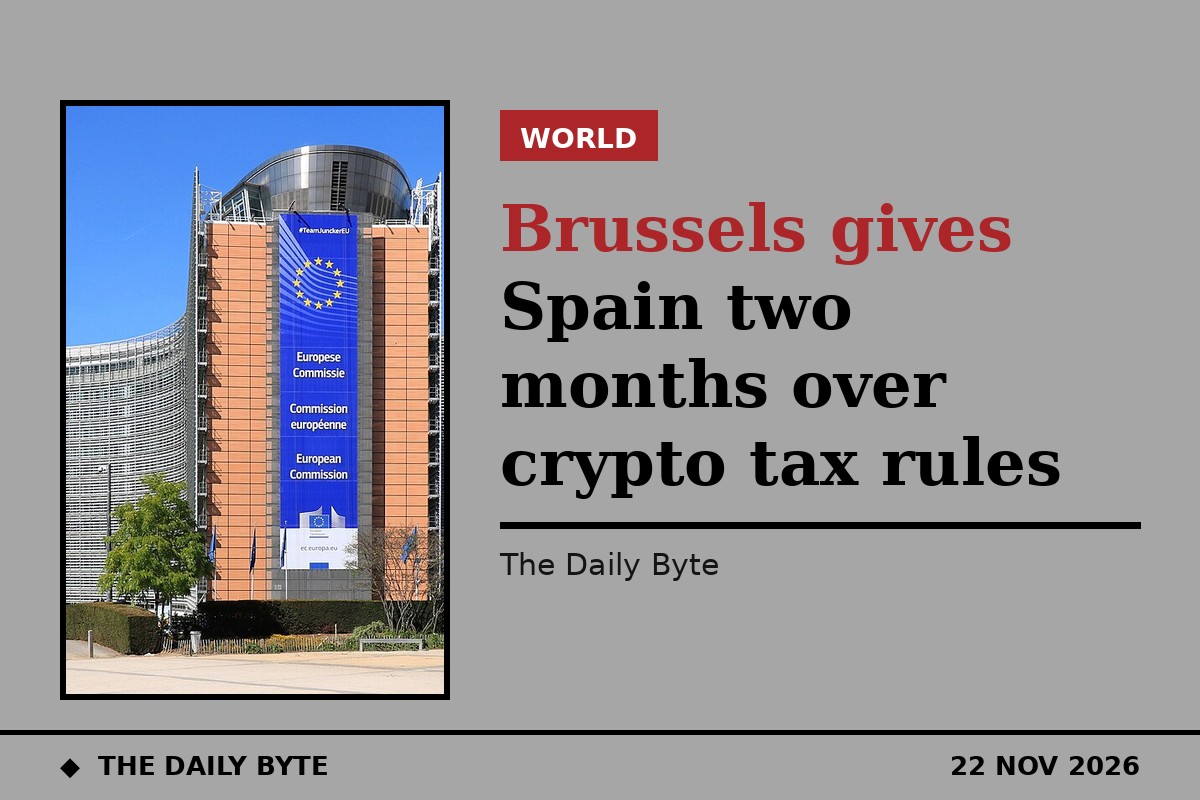
The European Commission has given Spain two months to finish writing the EU's crypto tax reporting rules into national law, after escalating infringement proceedings against Madrid on 19 November 2026. In the same package, Brussels opened a second file against Spain over its failure to implement parts of the EU's cryptoassets regulation, MiCA.
The Commission sent a reasoned opinion to Spain and Czechia for failing to fully implement DAC8, the directive that extends the exchange of tax information between EU countries to cryptoasset investments. The Spanish case is filed as INFR(2026)0060 and the Czech case as INFR(2026)0032. A reasoned opinion is the second stage of the EU's infringement procedure: if the countries do not respond and adopt the necessary measures within two months, the Commission can take the cases to the Court of Justice of the European Union and seek financial penalties.
What DAC8 requires
DAC8, formally Directive (EU) 2023/2226, is the eighth revision of the EU's Directive on Administrative Cooperation in taxation. It requires cryptoasset service providers to collect data on their clients' tax residence and report transactions and certain transfers to national tax authorities, which then exchange the information with each other.
Member states had to transpose the directive into national law before 31 December 2025, and the rules apply from 1 January 2026. The first exchange of data covering 2026 between tax authorities is due by 30 September 2027. The Commission stresses that the cross-border nature of cryptoassets requires solid administrative cooperation so that tax can be settled and collected on income and capital gains.
Why Spain is late
The Commission first warned 12 member states over DAC8 with letters of formal notice on 30 January 2026. Ten months later, only Spain and Czechia were escalated to reasoned opinions, which in practice means Brussels considers the others to have made progress and these two not.
In Spain, the delay is political. In June 2025 the government took a bill to the Cortes that would have transposed DAC8 and added the possibility of seizing cryptoassets. The text never reached a vote and lapsed when Royal Decree 806/2026, of 6 October, dissolved the Congress and the Senate and called general elections for 29 November. The new Cortes is constituted on 23 December, and the two-month deadline expires in mid-January 2027, when the new government will barely have been formed. A caretaker executive cannot present bills, so the response Brussels receives in January will at most be a commitment with a timetable.
Second file over MiCA
In the same infringement package, the Commission opened a second file against Spain, INFR(2026)2153, at the earlier letter of formal notice stage. It concerns two failures: not transposing the reform of the fifth Capital Requirements Directive that introduced the cryptoasset regulation, whose deadline expired on 30 December 2024, and not notifying the implementing measures for several articles of MiCA, which had to be communicated before 30 June 2025.
Spain already operates a domestic crypto reporting form, Form 721, for qualifying overseas holdings, but the Commission's action concerns the EU-wide framework, not the Spanish form. If Spain and Czechia fail to respond adequately to the reasoned opinions, the Commission can refer both cases to the Court of Justice and seek fines.
Frequently asked questions
What is DAC8? DAC8 is the EU directive that extends automatic exchange of tax information between member states to cryptoasset investments. It was adopted in October 2023 and applies from 1 January 2026.
How long do Spain and Czechia have to respond? Two months from 19 November 2026, so until mid-January 2027.
What happens if they do not comply? The European Commission can refer the cases to the Court of Justice of the European Union and ask for financial sanctions.
What is the MiCA file about? It is a separate infringement procedure, INFR(2026)2153, over Spain's failure to transpose parts of the Markets in Crypto-Assets regulation and notify implementing measures on time.
Sources: Europe Says reported the reasoned opinion and the MiCA file in detail; Odaily confirmed the 19 November opinions, the case numbers and the two-month deadline.


