Spain Freezes Foreign Degree Recognition Amid MIR Surge
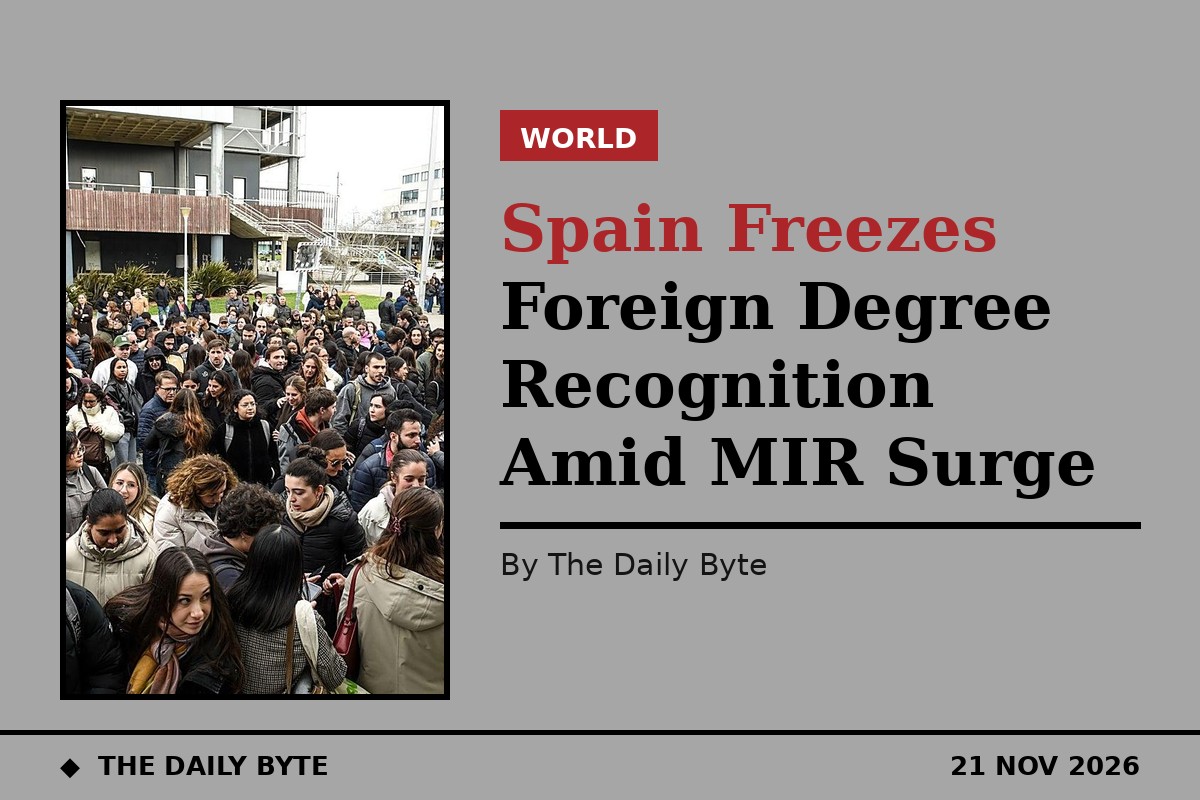
Spain has stopped accepting new applications to recognise foreign university degrees, after foreign doctors outnumbered Spanish applicants for the country's medical residency exam for the first time.
The Ministry of Science, Innovation and Universities, headed by Diana Morant, blocked new recognition applications a day after the latest exam figures were published, according to the newspaper ABC. Euronews reported the freeze on 19 November.
For the first time since the MIR exam was created, foreign applicants outnumbered Spaniards: 24,142 doctors applied for the 2027 exam, including 12,569 from other countries against 11,573 Spanish nationals, according to the Asociación MIR España. Provisional lists published by the health ministry on 13 November admitted 21,668 doctors to compete for 9,676 specialist training places.
The ministry said the shutdown of the online portal used for applications was caused by a series of attempted cyberattacks on public websites around the world last month. The portal has since partly reopened, but it is still not accepting new recognition applications.
Recognitions have risen eightfold since 2017
Recognition of foreign qualifications has climbed steeply for years. In 2025 the ministry processed 85,564 applications for recognition and equivalence of foreign university degrees, more than double the 39,975 processed in 2024 and eight times the 10,224 recorded in 2017. Of last year's cases, 49,906 were full recognitions, the only category under which a foreign doctor can sit the MIR exam.
Medical degrees dominate the flow. Spain recognised 30,303 medical degrees from outside the EU in 2025, more than four times the roughly 7,000 doctors graduating from Spanish universities each year.
Only 968 places for doctors without residence permits
The health ministry reserves a maximum of 10 percent of MIR places for candidates who do not hold a Spanish residence permit, meaning they compete among themselves for just 968 of the 9,676 medicine places on offer. According to health ministry figures, 7,363 applicants are chasing those 968 places.
Competition for those places has intensified sharply. Javier Padilla, the secretary of state for health, said the ratio had climbed from just over two applicants per place in the previous call to more than seven.
Many foreign doctors are unaffected by the cap because they apply through the ordinary route: EU citizens and anyone holding a permanent or temporary residence permit compete in the general pool. Only those in Spain on study permits, or who fall outside those categories, are caught by the 10 percent quota.
Medical bodies warn of hiring on worse terms
The surge has alarmed medical organisations. The president of the Organización Médica Colegial told RTVE that private companies could be tempted to hire doctors who hold recognised degrees but no specialist training on lower salaries and with more precarious conditions, and that the situation also affects private health care.
The OMC has asked the government to require a clinical competence test for applicants with recognised non-EU degrees, comparable to assessments during specialist training in Spain. The health ministry says it is preparing a contingency plan for the increase in non-EU applicants, while noting that some matters, including candidates' administrative status, fall outside its remit.
The next round of the exam is expected to take place on 23 January 2027. For thousands of foreign-trained doctors already in Spain, the frozen recognition portal leaves their route into specialist training uncertain until it reopens.


