Spain General Strike Over Housing Crisis in 14 Years
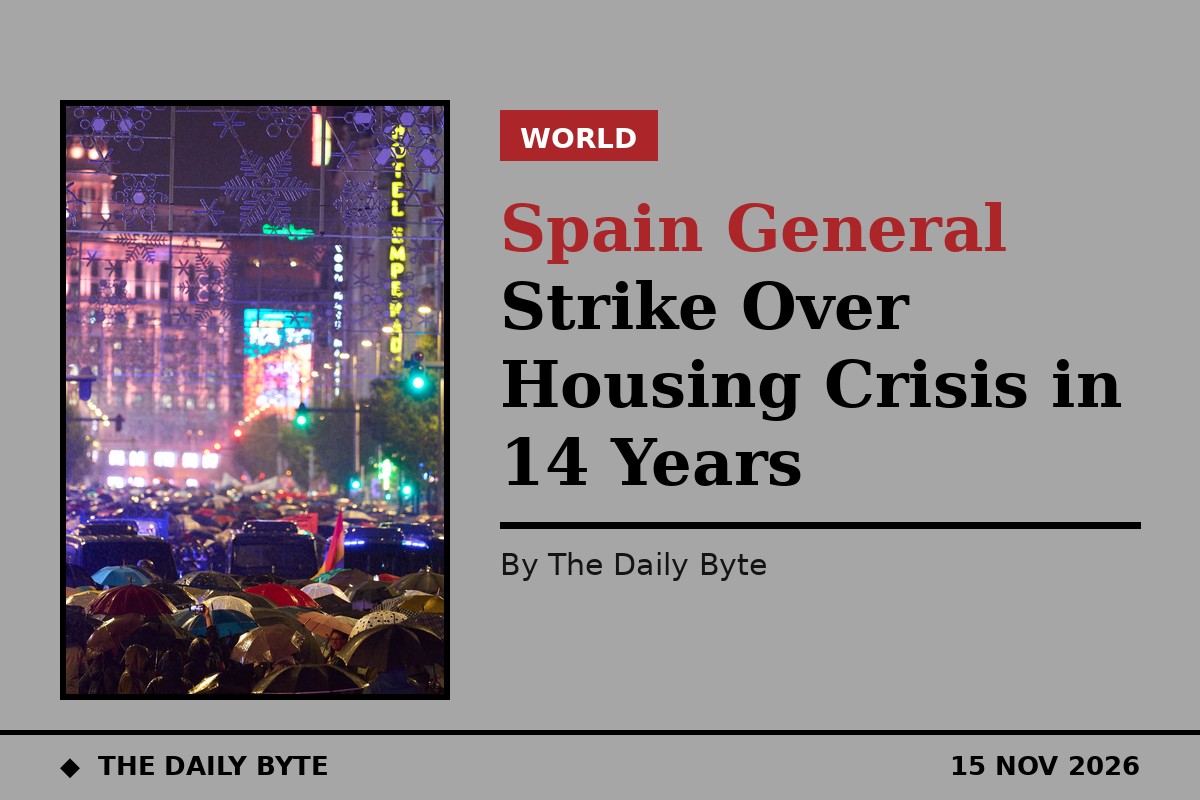
Millions of Spanish workers staged the country's first general strike in 14 years on Wednesday, 11 November, in a mass protest against the housing affordability crisis, less than three weeks before a snap general election.
The walkout, backed by Spain's two largest unions, the UGT and the CCOO, along with tenants' associations, brought picket lines, roadblocks and disrupted public transport to cities across the country. Unions said four million workers took part, while the tenants' union said it expected participation to reach five million by the end of the day.
It was the first general strike in Spain since 2012, when workers downed tools against austerity measures during the eurozone debt crisis. This time the target was different: not a single reform or employer, but what organisers described as deteriorating living conditions and the authorities' failure to guarantee access to housing.
What triggered the strike
The spark was the eviction on 23 September of Maricarmen Abascal, aged 87, from the Madrid flat where she had lived for 70 years. Her case became a symbol of the housing crisis, and the Tenants' Union called for a general strike, a call quickly taken up by the major labour unions.
Spain has a deficit of about 750,000 homes, according to the Bank of Spain, a shortfall projected to grow to more than a million by 2028. Rents and house prices have risen sharply, and evictions have become a central political issue, even as Spain's economy has performed strongly by European standards.
Protesters endured stormy weather to set up picket lines in Madrid, Barcelona and Valencia, where roadblocks disrupted traffic and public transport was affected in several cities. At least 42 people were arrested in connection with incidents during the day, according to reports from the strike.
An election looms
The strike was organised 18 days before the snap general election scheduled for 29 November, and it quickly took on a highly political dimension. The Socialist government of Prime Minister Pedro Sánchez backed the movement, with no ministers scheduling any official events on the day of the strike.
Mr Sánchez hopes to harness voter anger over housing to shift the political narrative away from corruption cases involving his inner circle and a deadly train crash last month. The election was called after the government's housing cost measures were voted down in parliament.
The contrast between Spain's economic figures and daily life was at the heart of the protest. According to International Monetary Fund forecasts, Spain is expected to post growth of 2.5% in 2026, among the highest in advanced economies. Since Mr Sánchez took office in 2018, the unemployment rate has fallen from 14.55% to 10.18%, according to Spain's National Institute of Statistics.
Yet organisers argued that those figures have not translated into affordable homes. Participation exceeded 90% in the port and car industries, halting operations at ports across Spain and at the Seat plant in Barcelona, according to reports from the day.
What happens next
With the election on 29 November, housing is now firmly at the centre of the campaign. The unions and tenants' groups that organised the strike have shown they can bring large numbers onto the streets, and the government that backed them will be judged on whether it can turn that support into homes people can afford.
For now, the strike has delivered its message: in one of Europe's fastest-growing economies, millions of workers say they cannot afford a place to live.


