Spain Holds State Funeral for 69 Train Crash Victims
By The Daily Byte
·11 Nov 2026
·4 min read
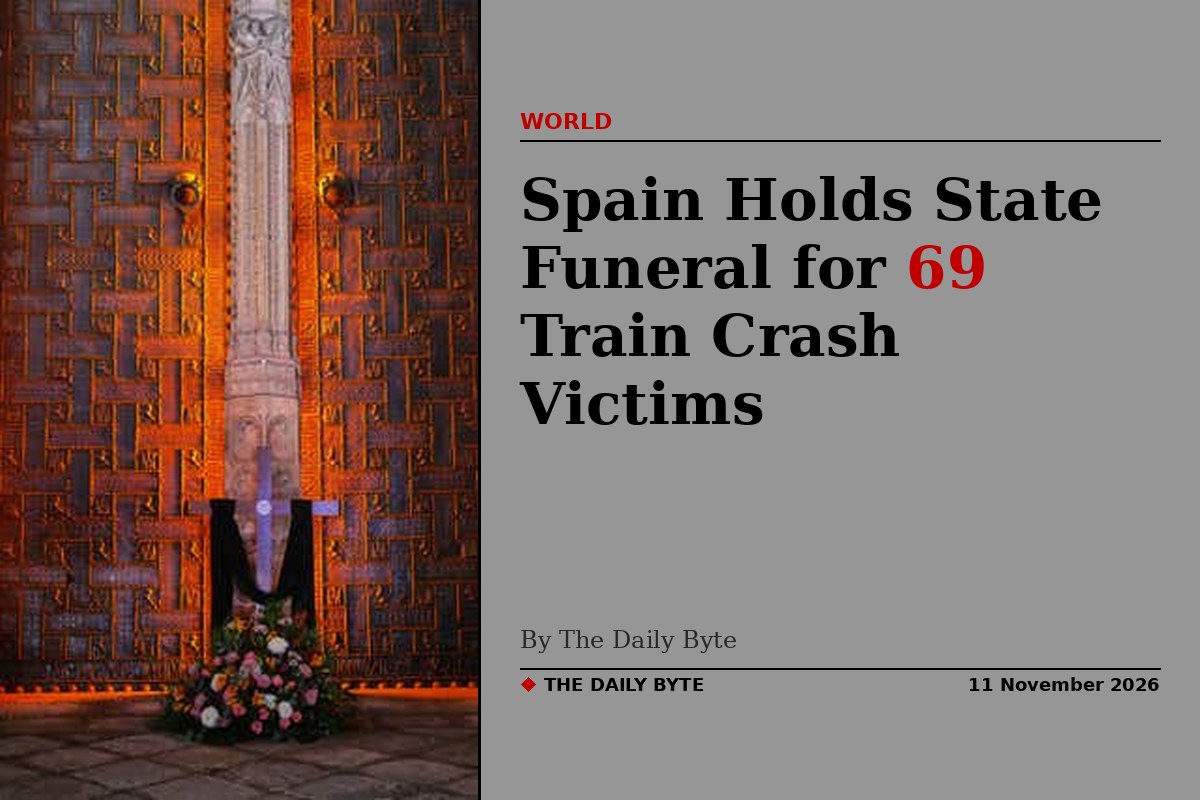
Spain has held a state funeral for the 69 people killed in a high-speed train collision near Urda last month, with King Felipe VI and Queen Letizia joining relatives of the victims at Toledo Cathedral on Tuesday, 10 November. The ceremony, held almost two weeks after the crash, brought families, injured passengers and public representatives together in the 13th-century cathedral in central Spain.
Residents of Urda placed 69 candles near the altar, one for each person who died, and a 16th-century sculpture of Christ, the Cristo de la Vera Cruz, was brought from the town for the service. The Archbishop of Toledo, Francisco Cerro Chaves, led the Mass, offering support to the families and injured people, thanking those who had responded to the disaster and calling for its causes to be clarified.
## A cathedral filled with families
Around 150 relatives of victims and injured passengers attended the service, alongside representatives of national and regional institutions. After the service, the king and queen spoke with relatives and people injured in the collision. The royal household said they had also visited injured patients at Toledo's university hospital on 29 October and met families of people then reported missing.
Among those at the cathedral were Carlos Cuerpo, who has taken responsibility for the transport portfolio, and Alberto Núñez Feijóo, leader of the opposition People's Party. Regional president Emiliano García-Page was also present, as were other ministers and regional and local representatives.
Prime Minister Pedro Sánchez did not attend. He said he did not attend religious services as a rule. The funeral was a Catholic service organised by the Archdiocese of Toledo, and its religious character and the prime minister's absence drew political debate. Spain will hold a general election on 29 November, in which Sánchez is seeking re-election.
## The crash and its aftermath
The collision happened on 28 October, when a high-speed train struck another train that was stationary on the Madrid-Seville line near Urda, around 87 miles south of Madrid. Sixty-nine people were killed in the disaster, according to the [Associated Press](https://www.chelmsfordcitynews.co.uk/news/national/26717955.spain-holds-state-funeral-69-killed-high-speed-rail-crash/).
It was the second deadly collision this year involving Spain's high-speed rail network. In January, a separate collision near Adamuz in Andalusia killed 46 people. Residents of both Urda and Adamuz were among those present at the Toledo service, and the two accidents have raised questions about safety on a railway that connects Madrid with southern Spain.
Under growing pressure, transport minister Óscar Puente stepped down after the crash. His resignation was followed by that of Luis Pedro Marco, who was head of Spain's railway infrastructure operator. Sánchez has pledged an investigation and improvements to restore trust in the rail system, which last year carried 45 million travellers, including millions of tourists.
## Safety questions remain
The investigation into the Urda collision was still in progress at the time of the funeral, and the cause remained unresolved. Possible explanations have been discussed publicly, but no formal determination had been announced, according to the [London Daily News](https://www.londondaily.news/spain-honours-69-urda-rail-crash-victims-at-toledo-cathedral-funeral/).
The European Union's independent prosecutor said last week that it had opened an investigation into possible fraud in the use of European funds allocated for safety upgrades and renovations on the same high-speed railway line on which both fatal crashes this year took place.
The funeral took place on the same day as a separate strike by train drivers seeking greater safety and maintenance investment. Spain's cabinet approved measures including better channels for railway staff to raise safety concerns and greater scope to stop or not restart a train when they detect a risk. The government also created the position of an ombudsman for victims of public transport accidents, intended to coordinate support for affected people and their families, including psychological, social and legal assistance.
Rail travel in Spain was disrupted on Tuesday by the train drivers' strike, and a general strike on Wednesday was expected to cause further disruption to public transport and to close or slow down businesses, factories and shops across Spain. For the families in Toledo Cathedral, however, the day was about remembrance: 69 candles, a sculpture carried from Urda, and a final farewell to the people they had lost.


