All 69 Spain Train Crash Victims Identified as Aid Approved
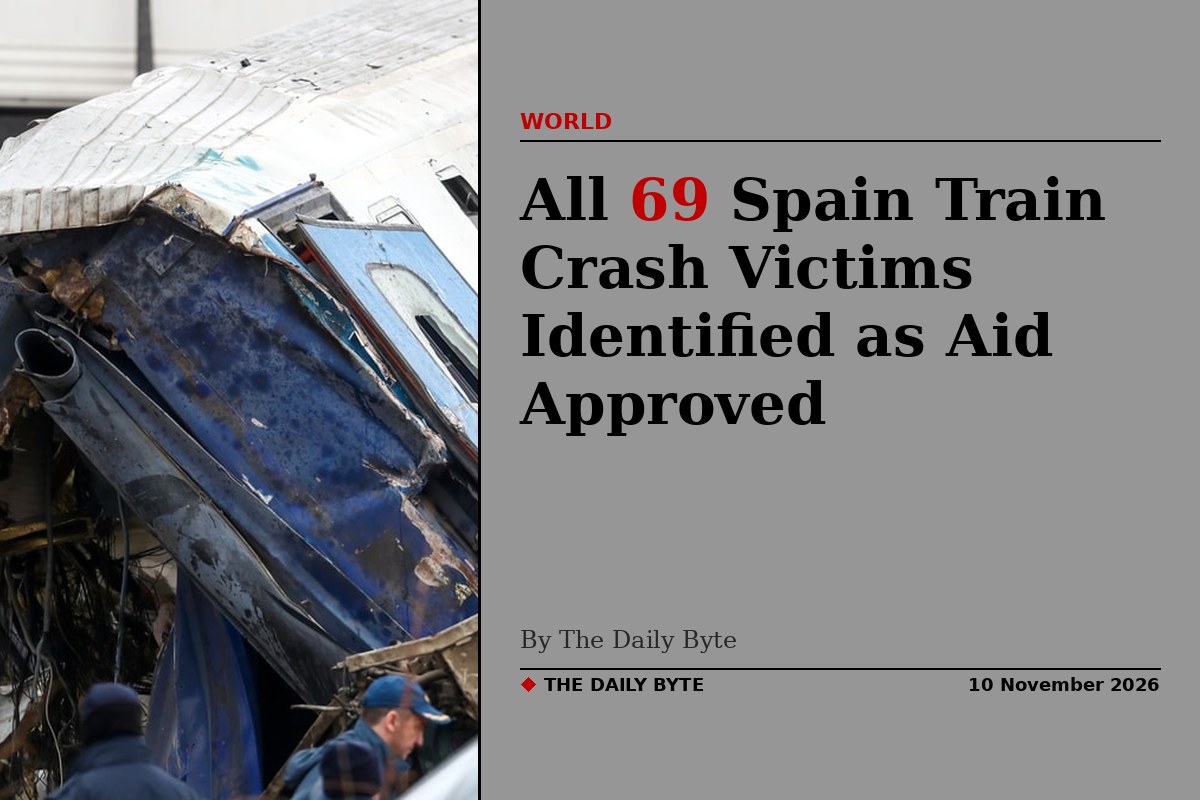
Spanish authorities have formally identified all 69 people killed in the high-speed train collision near Urda, in the province of Toledo, closing the forensic phase of one of the worst rail disasters in Spain in recent years.
The Institute of Legal Medicine and Forensic Sciences of Toledo and Ciudad Real completed the identifications on Monday 2 November, and the victims' families and the relevant consulates were notified. The crash happened on Wednesday 28 October, when a Renfe high-speed train travelling from Madrid to Seville struck the rear of a stationary Iryo train on the same line.
Who the victims were
Of the 69 people killed, 54 were Spanish nationals and 15 were foreign citizens. The foreign victims included four citizens of the United States, two Australians and two Japanese citizens, and one citizen each from Argentina, Canada, the Czech Republic, France, Mexico, Portugal and Tunisia. All 69 were adults, comprising 40 men and 29 women.
Fifty-six victims were identified through fingerprint analysis by the Civil Guard's criminalistics service, and the remaining 13 through DNA testing by the National Institute of Toxicology. The final three identifications, announced late on 2 November, were two Australians and a Japanese citizen, closing the last missing-person reports from the crash.
More than 100 people were injured in the collision, and 29 remained in hospital in the days after the crash, according to the authorities' update at the time.
€30m aid package approved
The Spanish government approved a €30 million emergency assistance package on 3 November to support victims and their families. For each person killed, the package provides a direct payment of €72,121.46, alongside an insurance compensation advance of the same amount, with further support for injured survivors.
Prime Minister Pedro Sánchez said the government would advance compensation payments and improve temporary incapacity cover for those hurt in the crash, as part of the package agreed by the cabinet.
Transport minister resigns
Transport Minister Óscar Puente announced his resignation on the evening of 3 November, after appearing before parliament to answer questions about the crash and to set out new safety measures. He said he had decided to step down within minutes of learning of the disaster, but stayed in office until the emergency response was under way and the first compensation and safety measures were in place.
'A transport minister in a country like Spain cannot remain in office after two accidents of this seriousness in less than a year,' Puente told lawmakers, referring to a second fatal high-speed crash in January near Adamuz, in Córdoba province, which killed 46 people. He also confirmed that he was withdrawing from the candidate lists for the early general election on 29 November.
Investigation continues
The investigation into the Urda collision remains open. Transport officials have said a computer failure knocked out the signalling system on the morning of the crash, halting six moving trains on the line, after which controllers in Madrid took over. Investigators are examining the signalling failure and the decisions made at the control centre in the minutes before the collision.
The crash was Spain's second fatal high-speed rail disaster this year, and it has put the safety of the Madrid-Seville line under renewed scrutiny weeks before the general election.


