Spain Train Drivers Strike Over Rail Safety Fears
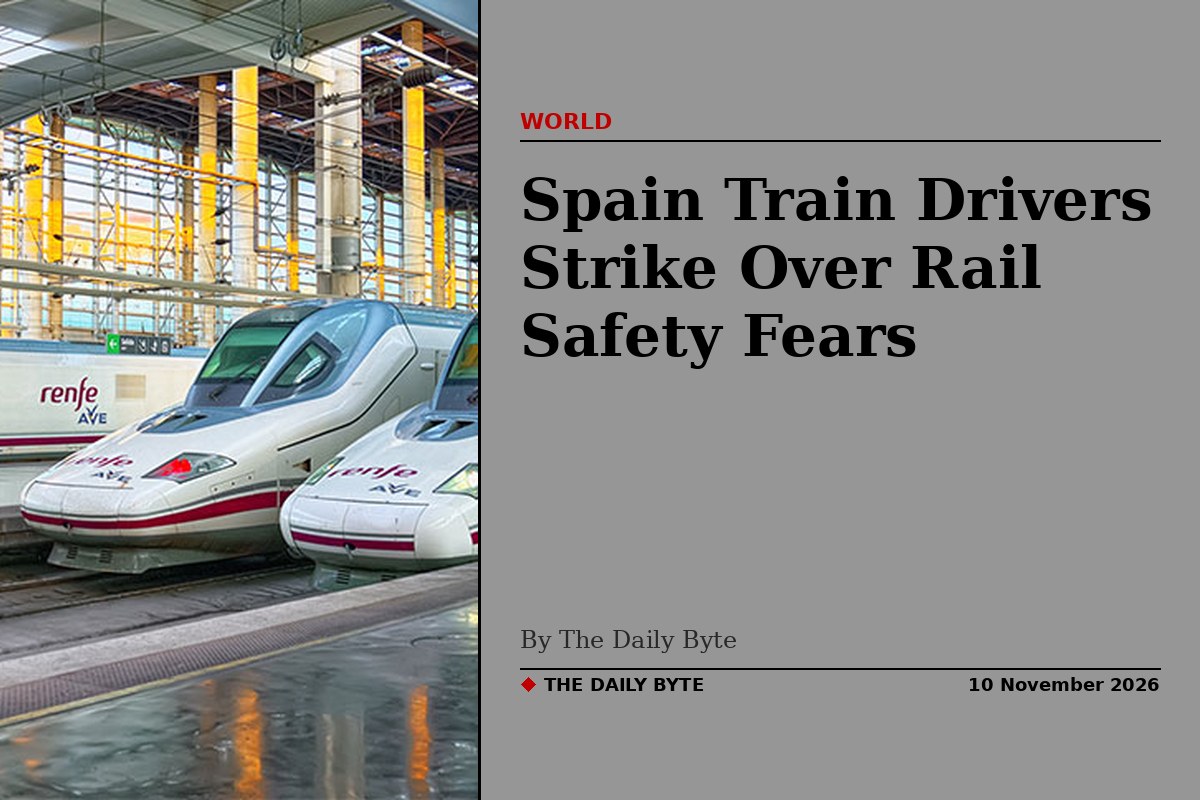
Spanish train drivers went on strike on Tuesday, 10 November 2026, in a 24-hour stoppage over rail safety, causing widespread disruption across the country after two fatal crashes on the same high-speed line this year.
The drivers' union, Semaf, called the strike to demand more investment in maintenance and safety, saying the government had failed to deliver on commitments made after the first of the two crashes in January.
State operator Renfe said about 40% of long- and medium-distance services were cancelled on Tuesday, affecting 4,042 passengers. About 90% of services on Madrid's commuter network were cancelled, along with 50% of local services in Barcelona.
Two crashes on the same line
Prime Minister Pedro Sanchez last week appointed his deputy, Carlos Cuerpo, to run the Transport Ministry on a provisional basis after Oscar Puente resigned over the two crashes on the Madrid-Seville high-speed line, which together killed 115 people.
The first crash, in southern Spain in January, killed 46 people. The second collision, last month near Urda in Toledo province, killed 69 people after a controller ordered a Renfe train to continue following a signal failure, even though a stationary Iryo-operated train was further ahead on the same line, according to Mr Puente.
King Felipe VI and Queen Letizia were due to join relatives of the victims of last month's crash at a funeral in Toledo cathedral later on Tuesday.
Drivers say safety talks stalled
Talks with the government on improving safety on Spain's high-speed network, the most extensive in Europe, began after the January crash but were abandoned in April, according to the train drivers' union.
Semaf said its drivers were respecting the minimum service quotas set by the government, and blamed delays on poor management of the trains that were running. In Catalonia, operator Rodalies said trains were running late because minimum service requirements were not being met.
Madrid's Cercanias commuter network suspended services on six lines, with only occasional trains running on two others. The strike also forced cancellations on the Madrid-Barcelona high-speed line and on services linking Madrid and Valladolid.
Renfe offered passengers free ticket changes or cancellations, but warned that few seats were available for rebooking.
Government approves safety measures
The Spanish government approved a series of safety measures on Tuesday, including a clarification of how the time drivers spend operating a train is calculated. A decree approved the same day recognised train drivers' right to stop a train, or refuse to start one, if they face serious and imminent danger, broadcaster RTVE reported.
Drivers are seeking clear rules for operating in severe weather and a ban on trains resuming normal speeds after a failure of the automatic train protection system, which was linked to last month's crash.
Further partial stoppages by train drivers are planned for Thursday, 12 November. A separate nationwide general strike called by Spain's largest unions is due on Wednesday, 11 November, over wages, working conditions and housing, ahead of a general election on 29 November.
Sources: Reuters and Bytes Europe.


