St Kitts to End Citizenship by Investment Scheme
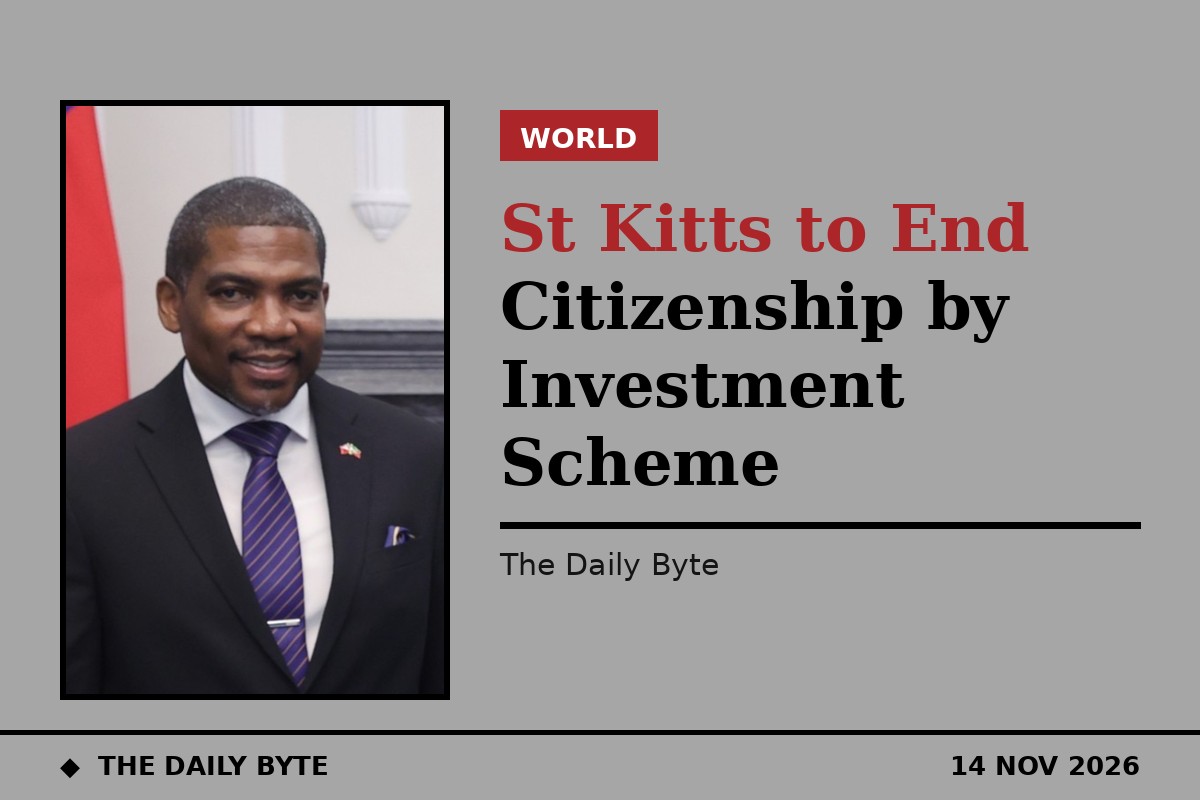
St Kitts and Nevis will wind down its citizenship by investment programme, Prime Minister Terrance Drew announced in a national address on Friday night, ending a scheme that has run for 42 years and once supplied most of the government's revenue.
Drew told the twin-island federation that the programme would close on a timeline still being negotiated with the European Union, and that he had formally given the government's position to Brussels. He gave no closing date in the address, which was broadcast on radio and television on 13 November.
"St Kitts and Nevis will wind down its citizenship by investment programme responsibly on a timeline now being negotiated with the European Union," Drew said. "It was never sustainable to rely on CBI forever."
Why the scheme is ending now
The pressure comes from Europe. Drew pointed to a revised European Union visa suspension law, in force since December 2025, which lists investor-citizenship schemes as a possible ground for suspending visa-free travel to the Schengen area. He said the European Commission wrote to his government in June inviting it to wind the programme down over a transition period so that visa-free access could be preserved.
The European Union has given the countries of the sub-regional Organisation of Eastern Caribbean States with citizenship by investment programmes until 1 June 2028 to end them or risk losing visa-free access to the Schengen area. Antigua and Barbuda, Dominica, Grenada, St Kitts and Nevis and St Lucia all operate such programmes, through which citizenship is granted to foreign investors in return for a substantial investment in the country's socio-economic development.
Antigua and Barbuda, Dominica and St Lucia have already made similar statements about phasing out their programmes. St Lucia's Prime Minister Phillip J Pierre told a news conference earlier in the week that Castries had submitted a response to the EU, while Antigua and Barbuda's Prime Minister Gaston Browne has said his country will adopt options to terminate its programme with a longer transition period.
Nothing changes for existing citizens
Drew's first message was to people who already hold a St Kitts and Nevis passport. "Nothing changes tonight for any person who lawfully holds our citizenship," he said, adding that nothing changes for citizens at home and abroad when it comes to travel. "This decision is what protects it," he said.
He stressed that the change would not happen overnight and that he would announce the final date for receiving citizenship by investment applications as soon as it is agreed with the European Union. Until then, the programme will continue, he said, on the strictest standards in its history, with no rush, no discounts and no fire sale. Staff of the Citizenship Unit will be redeployed to lead a new drive for conventional foreign direct investment.
Less reliance on passport money
Drew argued that the federation has been preparing for this moment since 2022. In that year, he said, citizenship by investment money made up as much as 70 per cent of the government's revenue. In 2026, it is less than 20 per cent. Last year, he said, citizenship by investment income fell to six per cent of the size of the economy, and the economy is still growing.
He cited a review by the International Monetary Fund in May, saying the fund found debt sustainability maintained and the banking system broadly stable, with stronger capital and fewer bad loans. The fund also said geothermal and solar energy projects were advancing steadily and that a successful energy transition could strengthen medium-term growth.
The replacement plan is built around energy. Drew said work continues on drilling six geothermal wells in Nevis and building a power plant, with a power link carrying that energy to St Kitts. A 50 megawatt solar plant would help make the federation a net energy supplier, he said, with neighbours including Antigua and Barbuda already interested in buying power.
Drew said he held talks on Thursday with a delegation from the European Union about how the bloc's Global Gateway strategy can support the transition, including the Nevis geothermal project and a power link between neighbouring Caribbean islands. Discussions have also taken place with Taiwan, the United States, Ireland, Saudi Arabia and Italy, as well as the Caribbean Development Bank, the Inter-American Development Bank and the Green Climate Fund.
He also pointed to tourism, saying that from November 2027, P and O Cruises will home port two of its ships, Iona and Avia, in St Kitts for the winter cruise season. "We relied on sugar, and the world changed. We relied on CBI, and the world changed again," Drew said. "This time, we saw the change coming, and we prepared."


