States sue HUD over mixed-status housing aid rule
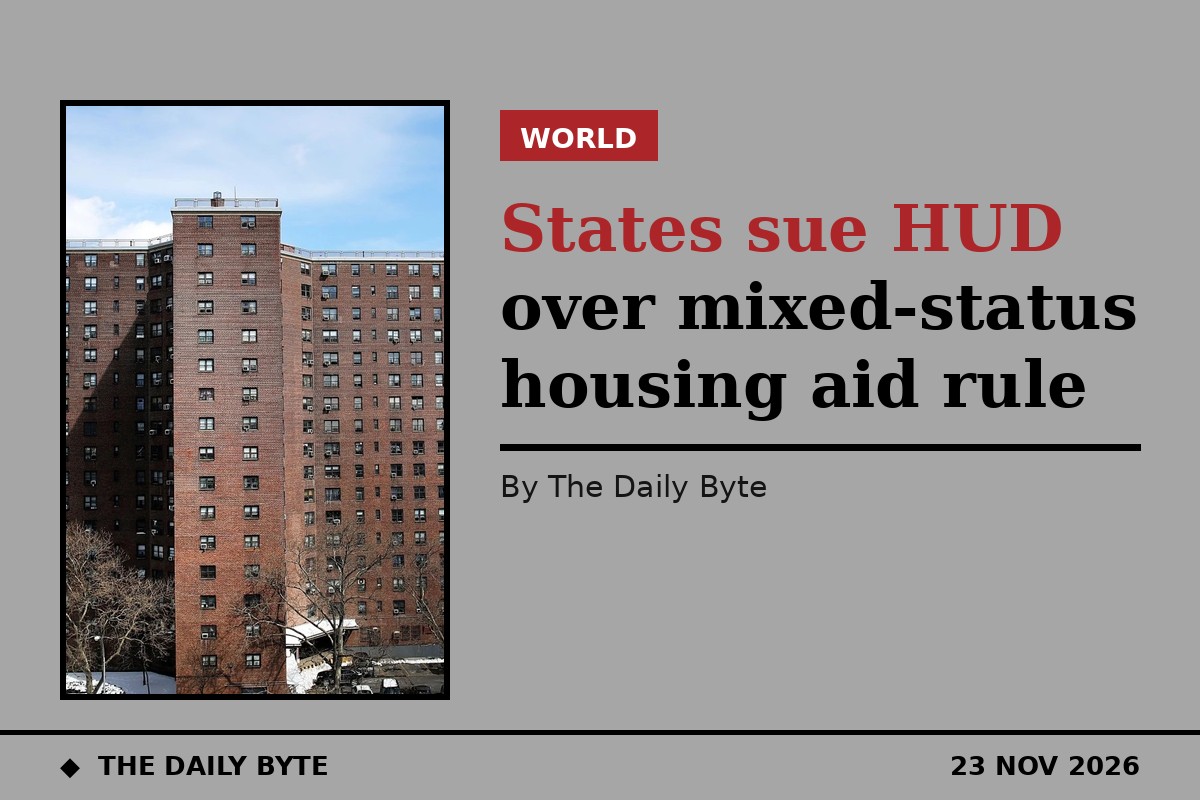
More than 20 states sued the United States Department of Housing and Urban Development on Monday, 23 November, asking a federal court to block a new rule that would strip federal housing assistance from families in which any member lacks eligible immigration status.
The lawsuit, filed in the U.S. District Court for the District of Massachusetts, challenges a final rule that ends nearly 30 years of “proration”, the system under which a family’s housing subsidy is reduced so that it covers only the eligible members of the household. Under the new rule, a household can keep its assistance only if every member is a U.S. citizen or an eligible immigrant.
What the new rule changes
Congress codified the proration protection in 1997, stating that families receiving prorated assistance “shall not” lose their benefits just because an ineligible family member lives with them. The new rule removes that protection entirely, so U.S. citizens and eligible immigrants who live with an ineligible relative would be forced to choose between keeping their housing and keeping their family together.
HUD itself estimates that about 20,000 mixed-status families, totalling 78,100 people, would lose their housing assistance under the rule. That includes around 55,000 people who are fully eligible for federal housing help, many of them children and seniors. Washington state’s attorney general noted that HUD’s own analysis estimates 65 percent of the eligible members of mixed-status families are under the age of 18.
The rule also imposes new burdens on U.S. citizens already in federal housing programmes. Every citizen would have to provide a Social Security number and consent to having their citizenship checked through the federal SAVE database. If the database cannot automatically confirm their citizenship, they would have to produce official documents such as an original or certified birth certificate, a naturalisation certificate or a passport. The Minnesota attorney general’s office said an estimated 3.8 million adult U.S. citizens lack a document proving their citizenship, and another 17.5 million face barriers to obtaining one.
The rule was finalised on 12 November and is scheduled to take effect on 14 December. HUD Secretary Scott Turner first announced the proposed rule in January.
The states’ case
The coalition is led by the attorneys general of New York, California and Massachusetts, and includes 22 states and the District of Columbia, along with the governor of Pennsylvania. The states argue that the rule illegally reverses nearly 30 years of federal policy and clear congressional intent, exceeds HUD’s statutory authority, and violates the Administrative Procedure Act because the department issued an arbitrary rule without the reasoned decision-making the law requires.
They are asking the court to declare the rule unlawful, strike it down, and block HUD from implementing or enforcing it against the plaintiff states, their local governments and their public housing authorities.
The states also warn that the rule will increase homelessness and push major costs onto state and local governments. By HUD’s own estimates, sheltering people displaced by the rule could cost governments between $20,000 and $50,000 per person each year. HUD also acknowledges that losing rental assistance could leave many subsidised homes vacant, cut rental income for housing providers and drive private landlords out of the Section 8 voucher programme, making it harder for eligible families to find a home.
“Minnesotans are sick and tired of Trump’s politics of cruelty, and that’s exactly what this new rule from HUD is,” said Minnesota Attorney General Keith Ellison. “This rule will illegally take housing support from low-income Minnesotans for no good reason.”
Cities file a second lawsuit
A separate coalition led by San Francisco filed its own lawsuit on Monday to block the same rule. It brings together the cities of Boston, Chicago, Los Angeles, New York, San Diego, Seattle and Providence, along with Los Angeles County, King County, Santa Clara County and several housing authorities. That suit says the rule would displace at least 15,500 mixed-status families across the country, and that about three-quarters of the people affected, roughly 55,000, are U.S. citizens or are otherwise eligible for rental assistance.
“HUD is forcing people to choose between keeping their housing or keeping their family together,” said San Francisco City Attorney David Chiu.
In a written response, the HUD press office said the rule “ends the exploitation of taxpayer dollars”. California’s attorney general said more than 7,000 households in California would be affected, while Washington state said about 600 mixed-status families there face losing their homes or being split up.
The states are seeking a court order freezing the rule before it takes effect on 14 December. Minnesota Attorney General | CalMatters


