Sudan cathedral floor found at Old Dongola site
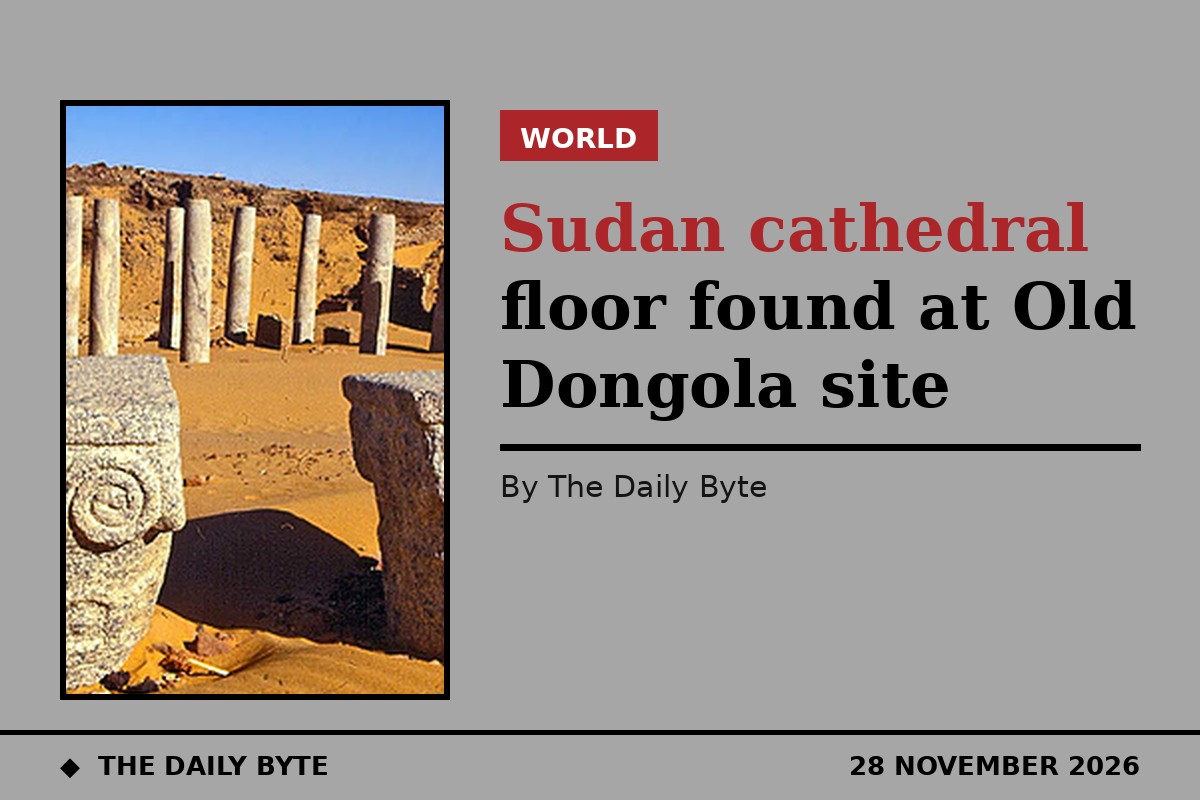
Archaeologists in northern Sudan have reached the original floor of a monumental medieval cathedral, uncovering the scale of one of the most important Christian buildings in medieval Africa. A joint Polish-Sudanese expedition working at Old Dongola, once the capital of the Christian Kingdom of Makuria, announced in November that excavators inside the ruins of the Great Church of Jesus had finally reached the cathedral's original medieval floor.
The team, from the Polish Centre of Mediterranean Archaeology at the University of Warsaw and Sudan's National Corporation for Antiquities and Museums, is directed by Professor Artur Obluski. The breakthrough came at the base of a monumental staircase, where walls still stand about 11 metres high. The team cleared the stairwell and exposed massive buttresses bracing the building's eastern apse, along with the remains of a second, smaller church built on an upper floor of an adjoining structure.
A building of remarkable size
The church was first identified in 2021, but much of it remains buried under collapsed vaulting and windblown sand. So far the original floor has been reached only at the base of the staircase, not across the whole interior, and in places more than 11 metres of fill still occupies the main nave. Even so, the measurements already taken point to a building of remarkable size. The team estimates the church was about 47 metres wide and 57 metres long, with its height cautiously estimated at around 21 metres, roughly six modern storeys. Obluski described it as a building larger than the White House in Washington, and said the team planned to excavate it further.
Arabic chroniclers remembered the Great Church of Jesus as the wealthiest and grandest cathedral in Christian Nubia, and the researchers believe it was probably the largest church in medieval Nubia and may have served as the cathedral of Dongola. The upper-floor church yielded fragments of painted plaster bearing Greek inscriptions, including a passage identified as part of the Prayer of Hannah, the mother of the prophet Samuel, written in careful Greek letters only about half a centimetre high. Six large shelving units are now filled with fragments of painted plaster recovered from the site.
The capital of Makuria
Old Dongola, on the east bank of the Nile about 160 kilometres south-east of modern Dongola, was the capital of Makuria from the sixth century until the kingdom's fall in the fourteenth century. A Polish archaeological team has worked at the town since the 1960s, and the current expedition resumed at full strength in 2025 after a two-year break, despite Sudan's continuing civil war.
The discovery matters because it gives researchers direct access to the floor level of a building that shaped religious life across Nubia, and because the church may have influenced the design of other churches in the region. Much work remains: the team must clear the nave before the full plan of the cathedral can be known, and the painted plaster must be pieced together before the decoration of its walls can be understood. For now, the staircase and the floor beneath it offer the first firm measure of a cathedral that stood at the heart of a Christian kingdom for eight centuries.


