Sudan rejects Ethiopia offer to host peace talks
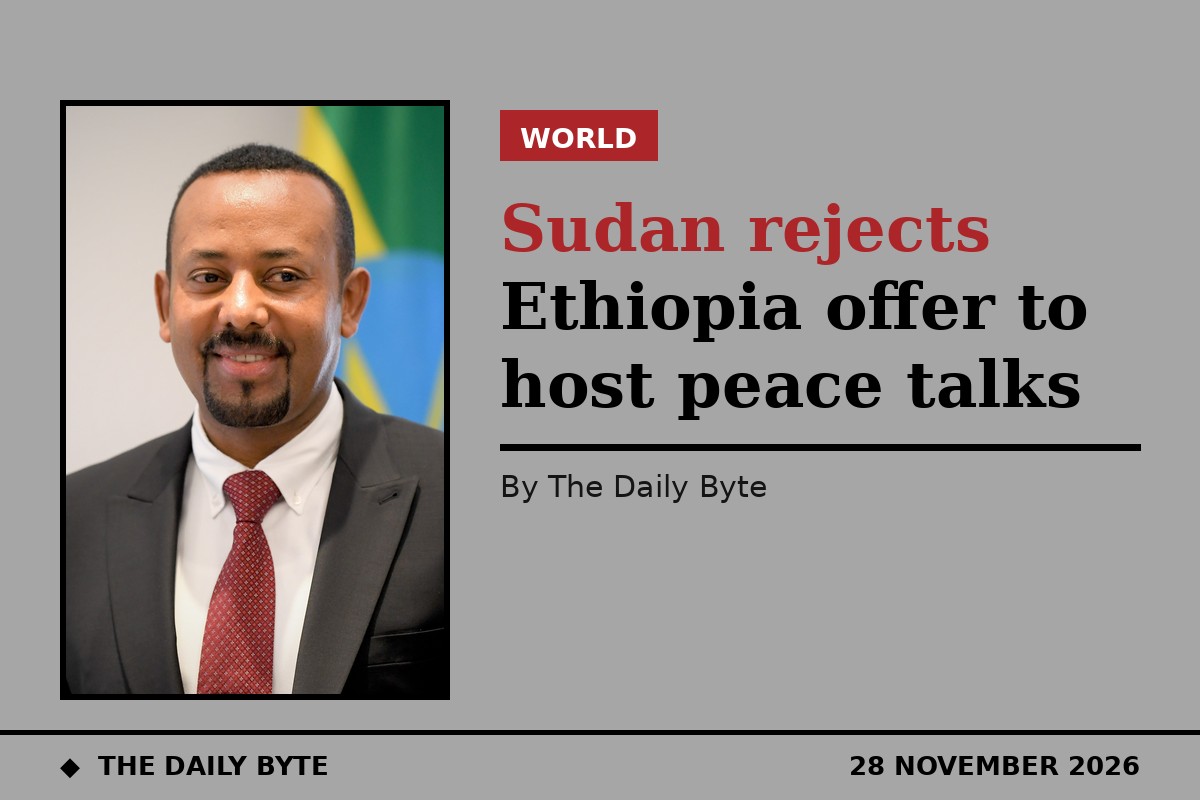
Sudan's army-backed government has rejected Ethiopian Prime Minister Abiy Ahmed's offer to host an inclusive dialogue aimed at ending the country's civil war, arguing that Addis Ababa lacks the neutrality required to facilitate talks between the warring sides.
In a statement carried by the official Sudan News Agency (SUNA), the government in Port Sudan said any country seeking to host or facilitate negotiations must be neutral and must respect Sudan's sovereignty. It said Ethiopia did not meet that test, and it urged the African Union to exclude Ethiopia from any arrangements to host or facilitate the proposed dialogue.
Abiy announced the initiative on 24 November, inviting all Sudanese military, political and civilian parties to take part in open talks hosted and facilitated by Ethiopia. In an Arabic-language statement dated 23 November and released the following day, he said the dialogue should end the war, launch a political process and produce agreement on arrangements for Sudan's next phase, including a broadly accepted national unity government tasked with restoring state institutions and overseeing reconstruction. The statement set out no starting date and no ceasefire mechanism, and it did not say whether a truce would have to come before negotiations.
Khartoum demands investigation into drone claims
Khartoum's rejection rested on allegations that Ethiopia has supported the paramilitary Rapid Support Forces (RSF) and allowed drones to be launched from Ethiopian territory to strike targets inside Sudan. The government demanded an independent investigation into those allegations and reserved the right to pursue diplomatic and legal channels over them. The allegations against Ethiopia have not been independently established, and Ethiopia has rejected the claim that it supports the RSF.
Abiy has maintained that his government's initiative is intended to provide an impartial platform for all Sudanese stakeholders. He recalled Ethiopia's earlier role in bridging differences between the Transitional Military Council and the Forces of Freedom and Change in 2019, after Sudan's December Revolution, and he said Sudan's stability was integral to the security of both Ethiopia and the wider Horn of Africa.
African Union calls for Sudanese-led process
The African Union has stepped into the dispute without taking Ethiopia's side. In a statement issued on Wednesday 25 November, African Union Commission chairperson Mahmoud Ali Youssouf acknowledged Ethiopia's proposal and the position taken by the Sudanese authorities. He said any process seeking to resolve the conflict must be inclusive, Sudanese-led and Sudanese-owned, in order to secure lasting peace while protecting the country's sovereignty, unity and territorial integrity. The AU statement did not designate Ethiopia as an approved mediator and announced no agreed framework for negotiations.
The rejection has exposed the split among Sudanese factions over who should broker an end to the war. The initiative was welcomed by the Transitional Peace Government affiliated with the Sudan Founding Alliance, known as Tasis, which includes the RSF, and by the Civil Democratic Alliance of Revolutionary Forces, known as Sumoud, a civilian coalition associated with former prime minister Abdalla Hamdok. The contrast between Khartoum's rejection and the rival camp's welcome shows how quickly an offer to end the fighting can become another point of contention over who controls the peace process.
The timing of the initiative added to the tension. It arrived just as Sudanese Prime Minister Kamil Idris met Egyptian President Abdel Fattah al-Sisi in Cairo, where a joint statement reaffirmed Egypt's support for Sudanese state institutions and its opposition to the establishment or recognition of parallel entities, a position understood to be aimed at the RSF-aligned transitional government.
No venue, no agenda and no ceasefire in sight
Sudan's war began on 15 April 2023, following a power struggle between the Sudanese Armed Forces, led by General Abdel Fattah al-Burhan, and the RSF, commanded by Mohamed Hamdan Dagalo, widely known as Hemedti. The fighting has spread across much of the country, destroying infrastructure, disrupting food supplies and collapsing essential services. According to UNICEF's 2026 humanitarian mid-year report, about 33.7 million people in Sudan need humanitarian assistance, including 17.3 million children, and millions have been displaced inside the country or forced to seek refuge in neighbouring states.
For now, there is no agreed venue, agenda or facilitator for talks, and no ceasefire in sight. The African Union says it remains committed to supporting a peaceful resolution, including through the efforts of Burundi's President Evariste Ndayishimiye, who currently chairs the African Union. But with Khartoum insisting that the Sudanese people themselves must determine the venue, agenda and facilitator of any negotiations, and with the rival camp welcoming the Ethiopian offer, the path to the negotiating table remains blocked by the same divisions that have sustained the war.


