Sudan Rejects Ethiopia's Offer to Host Peace Talks, Questioning Its Neutrality
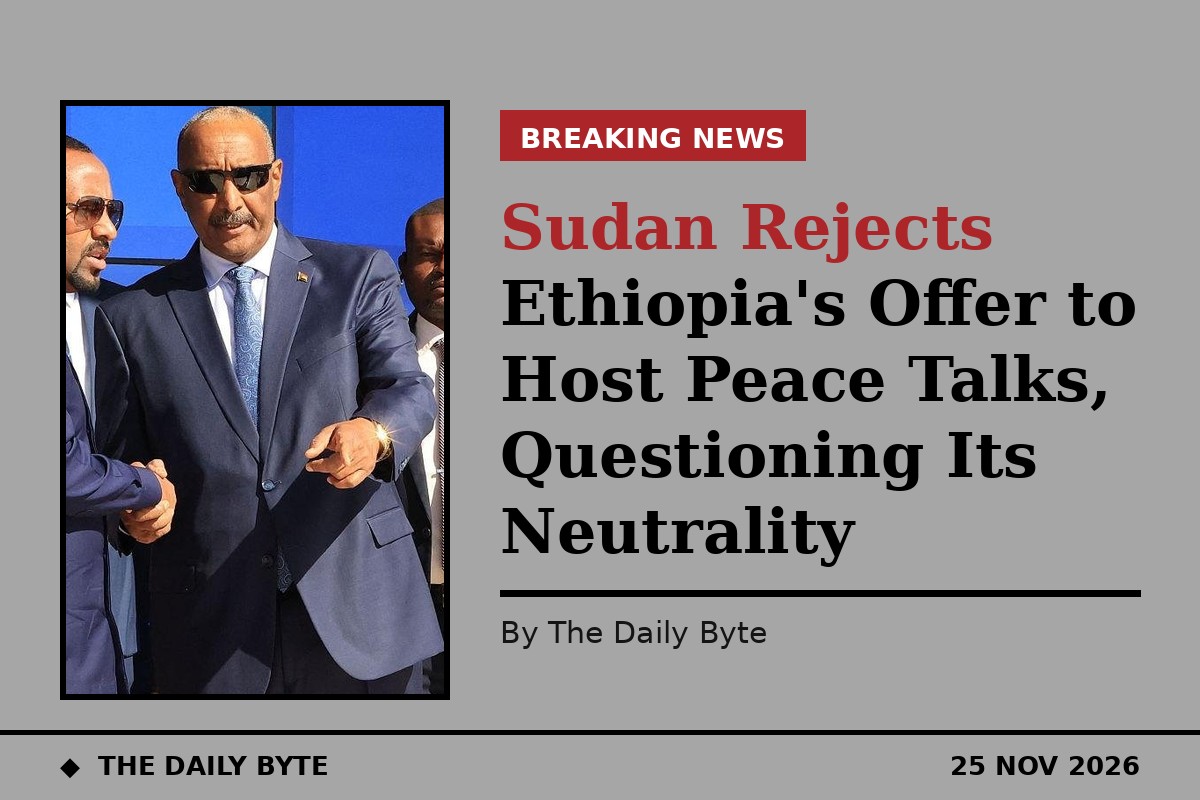
Sudan's army-aligned government has rejected Ethiopia's offer to host peace talks aimed at ending the country's civil war, saying Addis Ababa cannot act as a neutral mediator while it stands accused of supporting the paramilitary Rapid Support Forces (RSF).
The rejection, announced on Wednesday, came a day after Ethiopian Prime Minister Abiy Ahmed said his country was prepared to host and sponsor an inclusive Sudanese dialogue bringing together military, political and civilian groups. Khartoum's response was carried by the state-run Sudan News Agency (SUNA).
In its statement, the Sudanese government said the neutrality of any host country and respect for Sudan's sovereignty were essential conditions for involvement in the peace process. It repeated accusations that Ethiopian territory had been used to support RSF operations, including drone attacks inside Sudan, and that Ethiopia had provided the group with logistical help and training facilities.
Rival factions split over the offer
Not all Sudanese factions share Khartoum's position. The RSF-aligned Transitional Peace Government, established under the Sudan Founding Alliance known as Ta'asis, welcomed the Ethiopian initiative on 24 November. Its information minister and spokesperson, Khalid Ahmed Danna, described the invitation as a constructive opportunity to advance efforts to end the war and address its underlying causes.
The civilian coalition known as the Civil Democratic Alliance of Revolutionary Forces, or Somoud, also welcomed Abiy's announcement, describing it as consistent with the historical relationship between the two neighbouring countries and calling for coordinated regional and international efforts to support a Sudanese-led peace process.
Abiy had presented the proposal as support for Sudan rather than an advance of Ethiopia's interests, saying Addis Ababa would engage all parties without favour and that Sudanese actors must determine their country's future.
Khartoum wants Ethiopia excluded
Khartoum went further than simply declining the offer. The government called for an independent investigation into the alleged use of Ethiopian territory for military operations against Sudan, and urged the African Union and other regional and international partners to exclude Ethiopia from any arrangements to host or facilitate Sudanese peace negotiations.
Instead, the government insisted that the venue, agenda and mediation arrangements for any national dialogue must be established through consensus among Sudanese stakeholders.
The dispute comes against a backdrop of rapidly deteriorating relations between the two neighbours. Earlier this month, Ethiopia ordered the closure of Sudan's consulate in Assosa and the departure of six Sudanese diplomats, and Sudan responded by closing Ethiopia's consulate in Gedaref. Sudan has also lodged complaints with the United Nations Security Council and the African Union's Peace and Security Council, accusing Ethiopia of facilitating drone attacks against Sudanese territory. Ethiopia denies supporting the RSF and has in turn accused Sudan of assisting armed groups opposed to its government.
Separate mediation track continues
Tensions rose further after reported drone strikes on Khartoum on 22 November damaged residential properties and a United Nations facility, drawing condemnation from Saudi Arabia, Qatar, Egypt, Kuwait, Jordan, the United States and the United Nations.
Meanwhile, a separate diplomatic track continues. On 25 November, representatives of the Sudan Founding Alliance travelled to Addis Ababa for consultations with a five-party international mediation mechanism comprising the African Union, the United Nations, the European Union, the Arab League and the Intergovernmental Authority on Development (IGAD). That track is distinct from Abiy's proposal, but both show the growing competition over efforts to end a war that began in April 2023 and has displaced millions of people.
Without the army-aligned government's participation, an Ethiopian-hosted dialogue would struggle to secure the legitimacy a lasting settlement needs.