Big Bend border wall cleared by Supreme Court
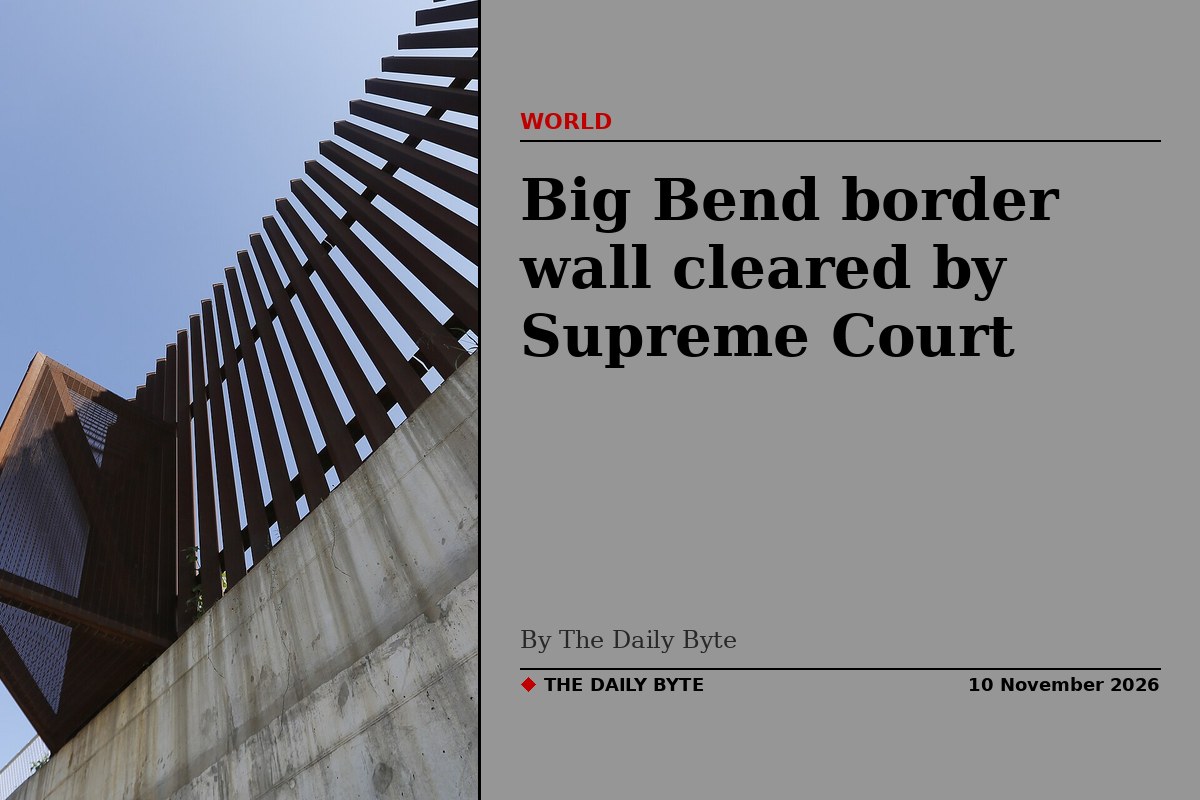
The US Supreme Court has cleared the Trump administration to resume building border barriers and roads in the Big Bend region of West Texas, including inside Big Bend National Park, lifting a federal judge's order that had halted the work last month.
The court acted on Monday 9 November in an unsigned order in the case Mullin v. Friends of the Ruidosa Church, granting the government's emergency request to stay a preliminary injunction issued in October by US District Judge Kathleen Cardone in El Paso. Justice Ketanji Brown Jackson was the only member of the court who said she would have refused the request.
The justices declined the administration's separate request to reverse Judge Cardone's ruling outright. The stay remains in place while the government pursues a full appeal, so construction can go ahead while the legal challenge continues. Reuters reported the ruling, and CNN reported the same decision.
What the case is about
The lawsuit was brought by the Center for Biological Diversity, a Big Bend-area river guide and a group seeking to preserve a historic adobe church in Ruidosa, Texas, which says its fragile structure is threatened by the construction. The challengers attacked a series of waivers issued by the Department of Homeland Security to speed up building in the region, setting aside a range of environmental, historic-preservation and conservation laws.
The waivers were issued between February and July by Homeland Security Secretary Markwayne Mullin and his predecessor Kristi Noem, under a 1996 federal law aimed at speeding barrier construction in areas of high illegal crossings at the southern border. The administration found the region to be an area of high illegal entry and said border officials had seized large quantities of drugs there.
Judge Cardone blocked the project in October, finding that the waivers lacked clear congressional authorisation and breached the so-called major questions doctrine. She noted that Big Bend has, by far, the lowest rate of migrant apprehensions along the whole border. The Supreme Court disagreed for now, saying the law at issue likely bars courts from reviewing the claims, and that the government's interest outweighs any aesthetic, recreational and environmental harm alleged by the challengers.
What will be built
The administration says most of the construction in the Big Bend sector, spanning more than 300 miles, will take place on privately owned land. Big Bend National Park itself would get a 17-mile non-contiguous vehicle barrier system, rather than the 30-foot pedestrian barrier planned for other areas, along with new patrol roads and detection equipment.
Work in the park was paused in August after the project drew bipartisan criticism over its possible impact on the park's landscape and wildlife. Crews had already begun clearing land for roads and border security infrastructure, prompting protests and lawsuits. Congress has provided about $46 billion to accelerate border barrier construction, and Customs and Border Protection has said crews are erecting barriers at a pace of about 12 miles a week.
What happens next
The underlying lawsuit is not over. The challengers say they will keep fighting the government's authority to waive environmental and preservation laws, and the case will now work its way through the appeals courts. If the Supreme Court declines to take up the case, the stay ends automatically.
For now, the ruling is a significant win for one of President Donald Trump's longest-standing priorities. He has long presented building or reinforcing barriers along the US-Mexico border as a central part of his immigration policy, and the Big Bend sector contains some of the longest unwalled stretches of the frontier.


