Supreme Court Clears Big Bend Border Wall Construction
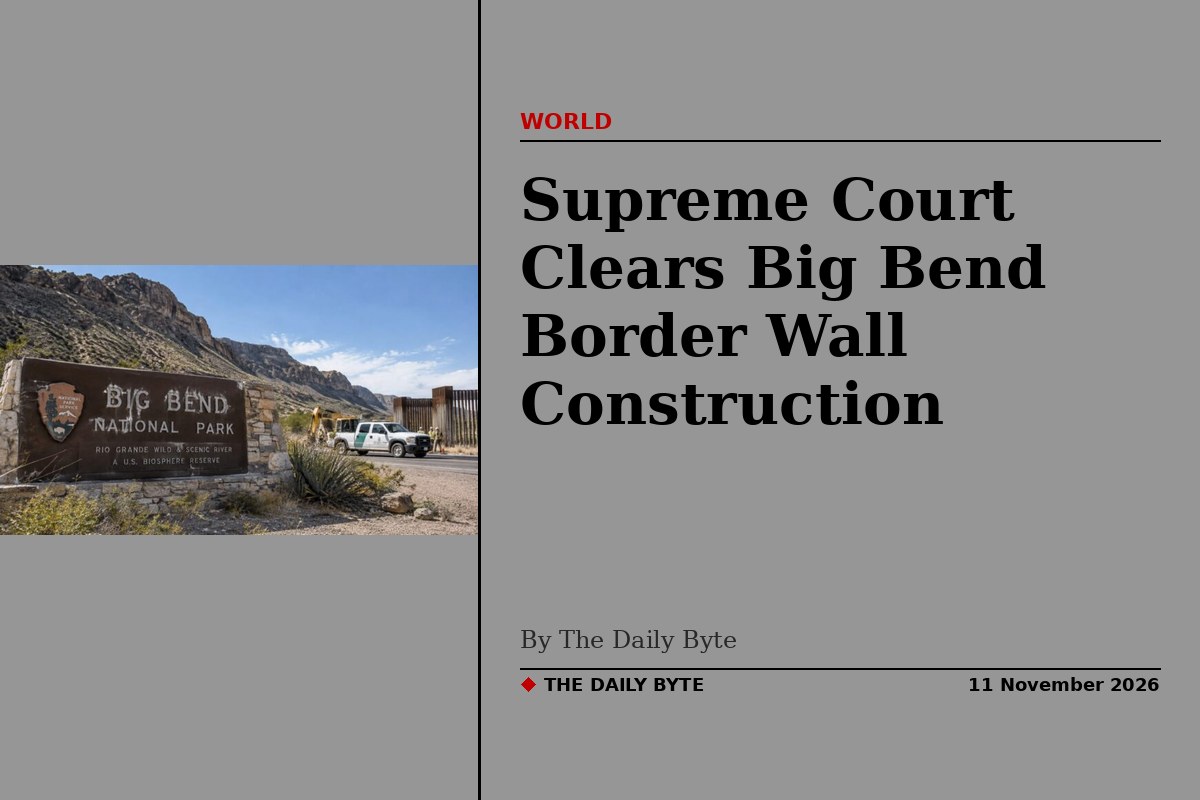
The US Supreme Court has cleared the way for the Trump administration to resume building a border wall through the Big Bend region of Texas, ruling 8-1 on Monday to lift a lower court order that had halted construction.
In an unsigned five-page order, the justices stayed a preliminary injunction issued by US District Judge Kathleen Cardone in El Paso. Justice Ketanji Brown Jackson was the only dissenter, recording her opposition without giving reasons.
The decision allows work to restart on barriers, patrol roads and surveillance equipment along a remote stretch of the US-Mexico border that includes deserts, canyons, part of the Rio Grande and Big Bend National Park. Construction on the latest phase of the project began in August.
What the court decided
The case, Mullin v. Friends of the Ruidosa Church, turns on a 1996 immigration law, the Illegal Immigration Reform and Immigrant Responsibility Act. Section 102 of that law gives the homeland security secretary broad power to build barriers and roads in areas of high illegal entry, and to waive environmental and other laws to do so.
The court said the district judge likely lacked the power to block the project, holding that Congress had shown a "clear preference for expeditious border construction". The justices wrote that the government's interest in border security "outweighs any aesthetic, recreational, and environmental harm" claimed by those challenging the wall.
The administration had asked the court to intervene after Judge Cardone, who was appointed by President George W. Bush, declined to pause her own ruling. The Justice Department made its emergency application on 21 October. US Solicitor General John Sauer told the court that gaps in the barrier in the Big Bend sector could be exploited by drug cartels entering the United States from Mexico.
A vast and sensitive landscape
The Big Bend Sector stretches for about 517 miles along the border, making it one of the largest Border Patrol sectors by area. The Wall Street Journal reported that the administration wants to build barriers and roads along a 300-mile stretch of it, in a largely undeveloped region that includes Big Bend National Park.
Environmental groups have opposed the project, arguing that it will damage some of the most sensitive ecosystems in the park and along the Rio Grande. The Center for Biological Diversity, one of the plaintiffs in the case, criticised the decision after it was issued.
Opposition has not come only from environmentalists. Texas Senator John Cornyn, a Republican, published an opinion article on Monday arguing against the wall in Big Bend, a sign of the local resistance the project has faced even within the president's own party.
What happens next
The Supreme Court's order is not a final ruling on whether the wall is lawful. It temporarily lifts the injunction while the underlying case continues, with the US Court of Appeals for the Fifth Circuit due to hear arguments in early 2027 on whether the Department of Homeland Security exceeded its authority under the 1996 law.
For now, though, contractors can return to work. The decision is the latest in a series of emergency rulings in which the court has allowed the administration to press ahead with contested policies while the legal challenges play out.


