Supreme Court declines Custodia Bank appeal in Fed master account fight
By aminah
·18 Nov 2026
·4 min read
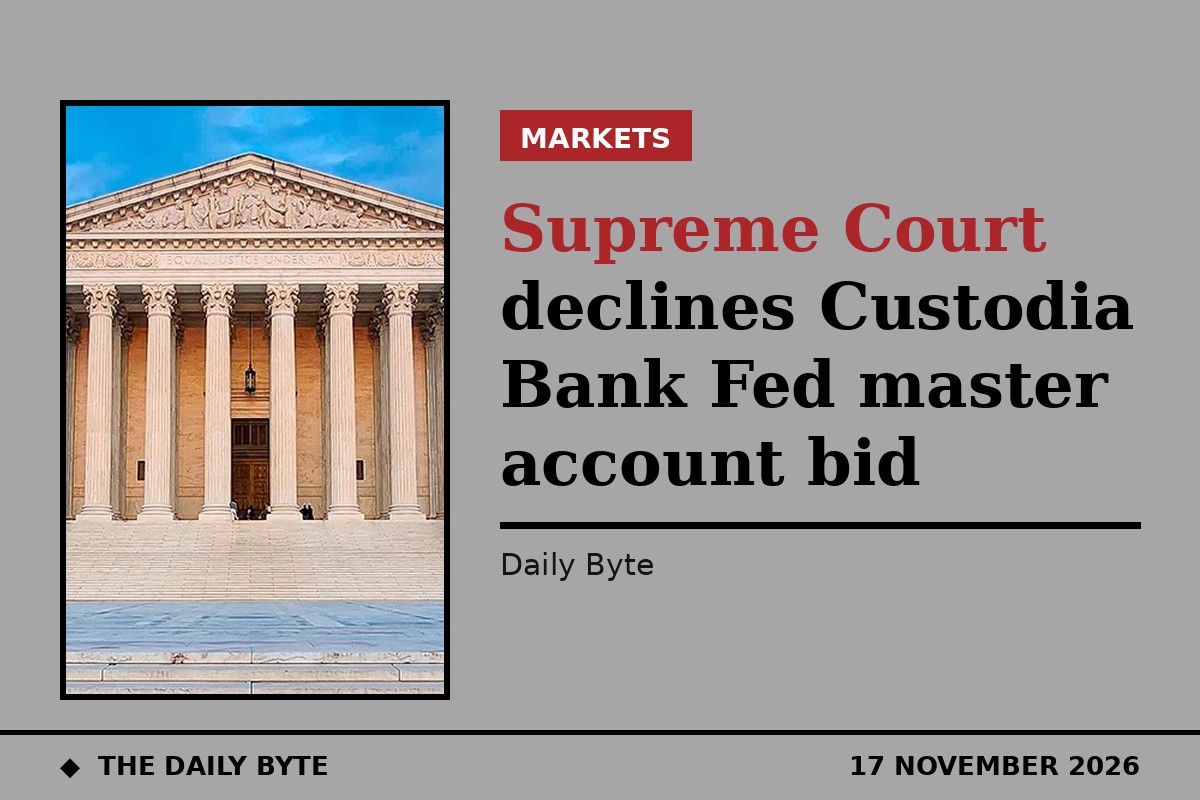
The United States Supreme Court has declined to hear Custodia Bank's appeal over the Federal Reserve's refusal to grant it a master account, bringing the crypto-focused bank's six-year legal battle to an end. The court listed the case among the petitions it denied in its order list on Monday 16 November 2026.
The one-line entry for case No. 26-62, Custodia Bank v Federal Reserve Board, carried no written statement and no noted dissent. A denial of certiorari is not a ruling on the merits, but it leaves standing the lower court's decision — and that decision is now the final word in Custodia's case.
## What a master account is — and why it mattered
A master account is the account a bank holds directly with the Federal Reserve. It allows a bank to process payments through the central bank's system itself, rather than routing transactions through third-party correspondent banks. For Custodia, a Wyoming-chartered bank founded by Caitlin Long that focuses on digital assets and US dollar payments, direct access was central to its business model.
Custodia applied for a master account in October 2020. After waiting around two years for a decision, it sued the Federal Reserve in 2022. The Federal Reserve Bank of Kansas City rejected the application in January 2023, citing concerns about risks linked to the bank's crypto-focused business model.
Custodia argued that eligible depository institutions are entitled to a master account under federal law. The courts disagreed. A US district judge ruled against the bank in March 2024, and the US Court of Appeals for the 10th Circuit affirmed that decision in October 2025, finding that Federal Reserve banks have discretion to turn down applications even from legally eligible institutions.
## The dissent that warned of sweeping Fed power
The appeals court ruling was not unanimous in spirit. In March 2026, US Circuit Judge Timothy Tymkovich dissented from the full court's denial of a rehearing, arguing that the ruling grants Federal Reserve banks significant power over state-chartered institutions. His warning was that legal eligibility now gets a bank an application, but the Reserve Bank decides whether it gets an account — and on what terms.
The Supreme Court's refusal to intervene confirms that reading as the law in Custodia's case, and it binds federal courts in the six states of the 10th Circuit, Wyoming included. The petition had drawn supporting briefs from the Blockchain Association, the Digital Chamber and Senator Cynthia Lummis with former Senator Patrick Toomey, before it was considered at the justices' conference on 13 November.
## Same charter, different answer
The outcome looks uneven beside a parallel case. Kraken Financial holds the same Wyoming special purpose depository institution charter as Custodia and applied to the same Reserve Bank. On 4 March 2026, the Kansas City Fed approved a limited-purpose account for Kraken, classed as Tier 3 with an initial term of one year.
The terms show how narrow that route is. Kraken can use only the Fedwire Funds Service, gets no intraday or discount-window credit, faces a closing balance limit and earns no interest. The terms follow a template the Fed Board has been drafting since December 2025, and the Federal Reserve has also been discussing a "skinny master account" concept introduced by Governor Christopher Waller.
For crypto-facing banks, the message is that direct access to the Fed's payment rails is a privilege the Reserve Banks may grant or withhold, not a right that follows from a state charter. Custodia's court fight is effectively over, and the bank — largely dormant while it tried to clear regulatory hurdles — must now rely on commercial correspondent banking relationships for settlement, like other institutions without a master account.
## Frequently asked questions
**Did the Supreme Court rule against Custodia Bank?**
Not on the merits. It declined to hear the appeal, which leaves the 10th Circuit's ruling — that Reserve Banks may refuse master accounts — standing as the final word.
**What is a Federal Reserve master account?**
It is an account a bank holds directly with the Fed, giving it direct access to the central bank's payment services instead of routing payments through another bank.
**Is there another route in for crypto banks?**
Kraken Financial received a limited Tier 3 account from the Kansas City Fed in March 2026, with strict limits and no credit or interest. The Fed is also discussing a narrower "skinny" account concept.
[Source: Unchained](https://unchainedcrypto.com/custodia-bank-loses-fed-master-account-fight-as-supreme-court-wont-take-case/) | Supreme Court order list: [supremecourt.gov](https://www.supremecourt.gov/orders/courtorders/111626zor_cb7d.pdf)