Supreme Court Rejects Tamil Nadu Cauvery Water Plea
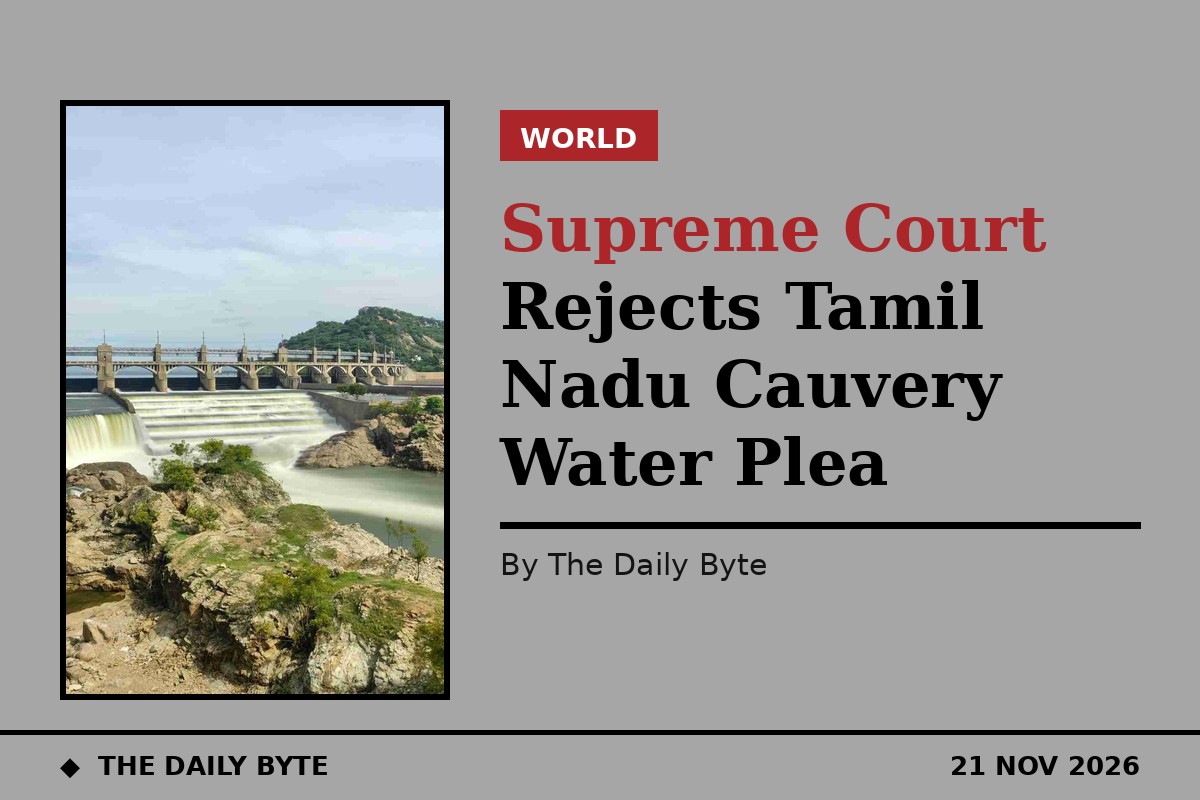
NEW DELHI — India's Supreme Court on Friday dismissed Tamil Nadu's pleas seeking directions to Karnataka to release 11 thousand million cubic feet (TMC) of Cauvery river water, rejecting the state's claim that a backlog of water was owed to it at the inter-state border.
A bench of Justices Vikram Nath and Aparesh Kumar Singh passed the order on 20 November. Tamil Nadu had asked the court to direct Karnataka to clear a backlog of 11 TMC of water as it stood on 7 October, immediately, and to release it at the rate of 1.3 TMC per day over 10 days at Billigundulu, the key water-measuring station on the banks of the river along the Karnataka-Tamil Nadu border.
Before pronouncing the order, Justice Nath noted that Tamil Nadu had filed a third application on the same day, seeking to bring additional documents on record, and said orally that it would also be dismissed. The court had reserved its decision on the two main applications on 12 October.
The shortfall Tamil Nadu claimed
Tamil Nadu contended that there was a shortfall of 11.719 TMC in the flows due to it at Billigundulu, the inter-state border measuring point, up to 6 October. It also argued that Karnataka was withholding water despite having sufficient reserves in its reservoirs.
The state's wider grievance centres on the water-sharing arrangement under the Cauvery Water Disputes Tribunal award, under which Tamil Nadu claims an annual entitlement of 64 TMC. At an earlier hearing, Tamil Nadu submitted that it had received only 14 TMC and argued that, even accounting for the deficit in basin flows, it was entitled to a proportionate 55.29 per cent share, leaving a shortfall of approximately 20 TMC.
Tamil Nadu had moved the court seeking implementation of the Cauvery Water Management Authority's directions requiring Karnataka to release water to the state, amid allegations that it was not receiving its stipulated share. The authority had directed releases of 3,500 cusecs for 15 days from late July, and later recommended 12,000 cusecs daily for 15 days from 12 August. Karnataka disputed the allegations, citing distress conditions in the Cauvery basin, while maintaining that it was complying with the water authority's directions.
A dispute that keeps returning
The Cauvery dispute between the two southern states has run for decades, and the Supreme Court has repeatedly been asked to intervene in years when the monsoon fails. Tamil Nadu's application said the south-west monsoon had been deficient in the Cauvery basin in the current water year, and that the flows realised at Billigundulu were only about 10 per cent of what was stipulated for the period.
The timing matters for farmers. Tamil Nadu argued that nearly three-quarters of its annual quantum of 167.25 TMC is required to be realised at Billigundulu between June and September, when the Kuruvai paddy crop is raised and operations for the Samba crop are undertaken. In August, the state alleged that it did not receive its allocated share despite facing a rain-deficient year, and that the shortfall left it unable to supply water for irrigation.
The tribunal's award sets monthly stipulated flows to be ensured by Karnataka at Billigundulu during June to January each year: 123.14 TMC from June to September and 44.11 TMC from October to January, a total of 167.25 TMC.
What the ruling means
With the applications dismissed, Tamil Nadu has no judicial direction compelling Karnataka to release the claimed 11 TMC. The state must now pursue any further relief through the Cauvery Water Management Authority and the Cauvery Water Regulation Committee, the statutory bodies that set release schedules, rather than through the court.
For Karnataka, the order removes the immediate prospect of a court-ordered release at the height of the irrigation season. For Tamil Nadu, it is a significant setback in a dispute where every dry year brings the same argument back before the judges — and where the next monsoon, not the next hearing, is likely to decide how much water actually flows.


