Supreme Court Refuses Urgent CEC Recall Plea
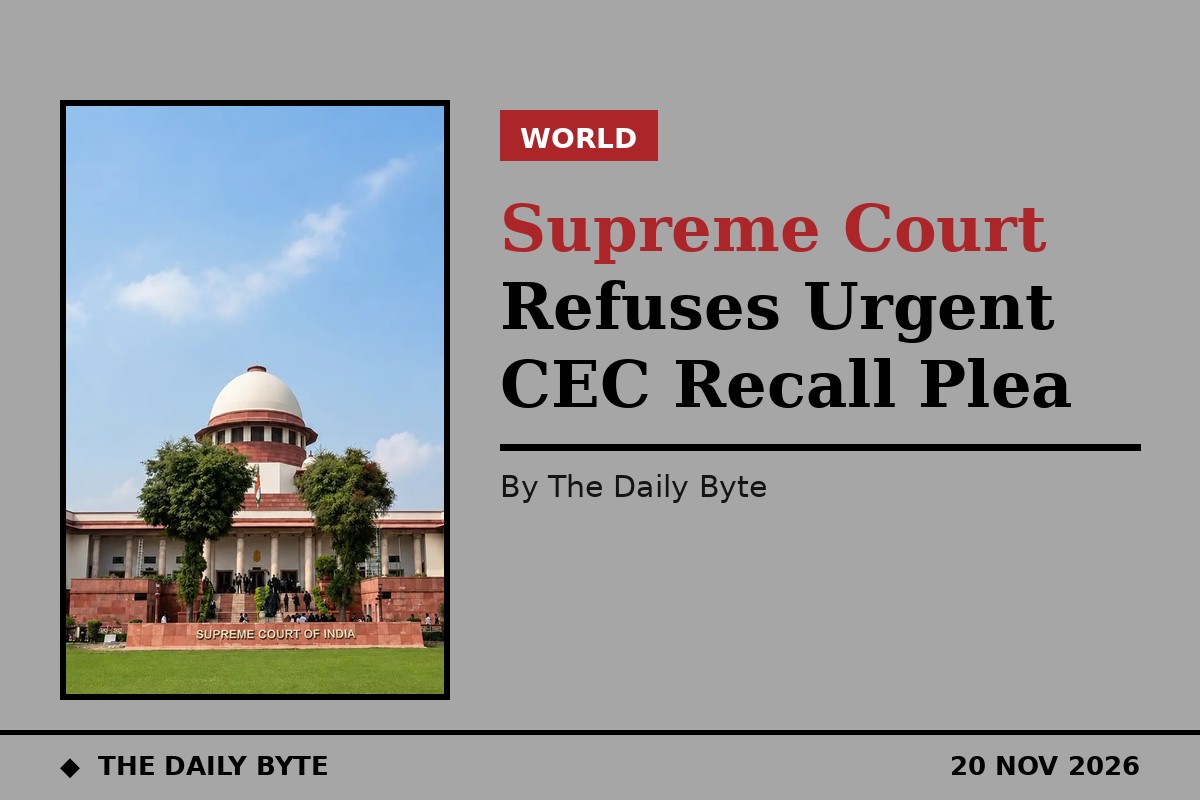
India's Supreme Court on Friday refused to urgently list an application seeking recall of its September split verdict in the case challenging the law that governs the appointment of the Chief Election Commissioner and other Election Commissioners.
A bench headed by Chief Justice of India Surya Kant, with Justices Joymalya Bagchi and V Mohana, said the recall application could be taken up by the five-judge Constitution Bench already constituted to hear the challenge to the 2023 law. Advocate Prashant Bhushan, who mentioned the application, had asked for it to be listed before the original two-judge bench that passed the order.
Bhushan argued that the recall plea should go before Justices Dipankar Datta and Satish Chandra Sharma, the two judges who delivered the September 23 verdict, because the recall challenges that very order. He also pointed out that Justice Sharma is due to retire at the end of next week, and sought a listing before then.
The Chief Justice declined the request. "You can raise before the bench when the matter comes. Presiding judge is there in any case," he said, adding that the five-judge bench could consider the recall application even after the retirement of one of the judges who delivered the split verdict. Justice Bagchi observed that the Constitution Bench could also examine the validity of the reference itself.
The conflict claim
The recall application is filed on the ground that Justice Sharma had a conflict of interest, because his son, Siddharth Sharma, is a standing counsel for the Election Commission of India before the Madhya Pradesh High Court. Bhushan maintained that the reference to a larger bench arose only because of Justice Sharma's dissent.
"If J Sharma had not dissented in this case, then it would not have been referred to the Constitution Bench," Bhushan said. The Chief Justice replied that Justice Datta had also ultimately agreed to refer the matter, adding: "My role was only to constitute the bench."
A curative petition has also been filed before the court seeking relief against the September 23 order. It alleges a "reasonable apprehension of bias and propriety" in Justice Sharma's participation in the case, on the same ground relating to his son's role as counsel for the Election Commission.
What the September verdict said
The two judges delivered separate opinions on September 23 after hearing the petitions on merits over five days in May and July 2026. Justice Datta held that there was no constitutional bar preventing the two-judge bench from deciding the challenge, and that the questions could be examined by applying settled constitutional principles without a reference to a larger bench.
Justice Sharma disagreed. He held that whether Parliament was justified in excluding a neutral selector from the appointment committee was an important question arising for the first time, involving a substantial question of law on the interpretation of the Constitution, and that it could not finally be decided by a two-judge bench under Article 145(3) and the Supreme Court Rules.
Both judges ultimately passed a common order directing that the papers be placed before the Chief Justice for consideration of the desirability of constituting a Constitution Bench to decide the validity of the 2023 Act. A five-judge bench has since been constituted.
The 2023 law at the heart of the case
The petitions challenge Sections 7 and 8 of the Chief Election Commissioner and Other Election Commissioners (Appointment, Conditions of Service and Term of Office) Act, 2023. Section 7 provides for the appointment of the Chief Election Commissioner and other Election Commissioners by the President on the recommendation of a selection committee comprising the Prime Minister, the Leader of the Opposition in the Lok Sabha and a Union Cabinet minister nominated by the Prime Minister.
The law removed the Chief Justice of India from the selection process. It replaced the mechanism prescribed by the Supreme Court in its 2023 judgment in the Anoop Baranwal case, under which the Chief Justice sat on the selection committee. Whether that change satisfies the constitutional requirement of free and fair elections is among the questions the Constitution Bench will now have to decide, along with the recall application and the objection to the reference order.
Sources: Live Law: Supreme Court Declines To List Plea Seeking Recall Of CEC Verdict Before Same Bench | LawBeat: EC Appointment Case: Supreme Court Refuses Urgent Listing Of Prashant Bhushan's Recall Plea


