SC Sends Journalists' Abuse Claims to Inquiry Panel
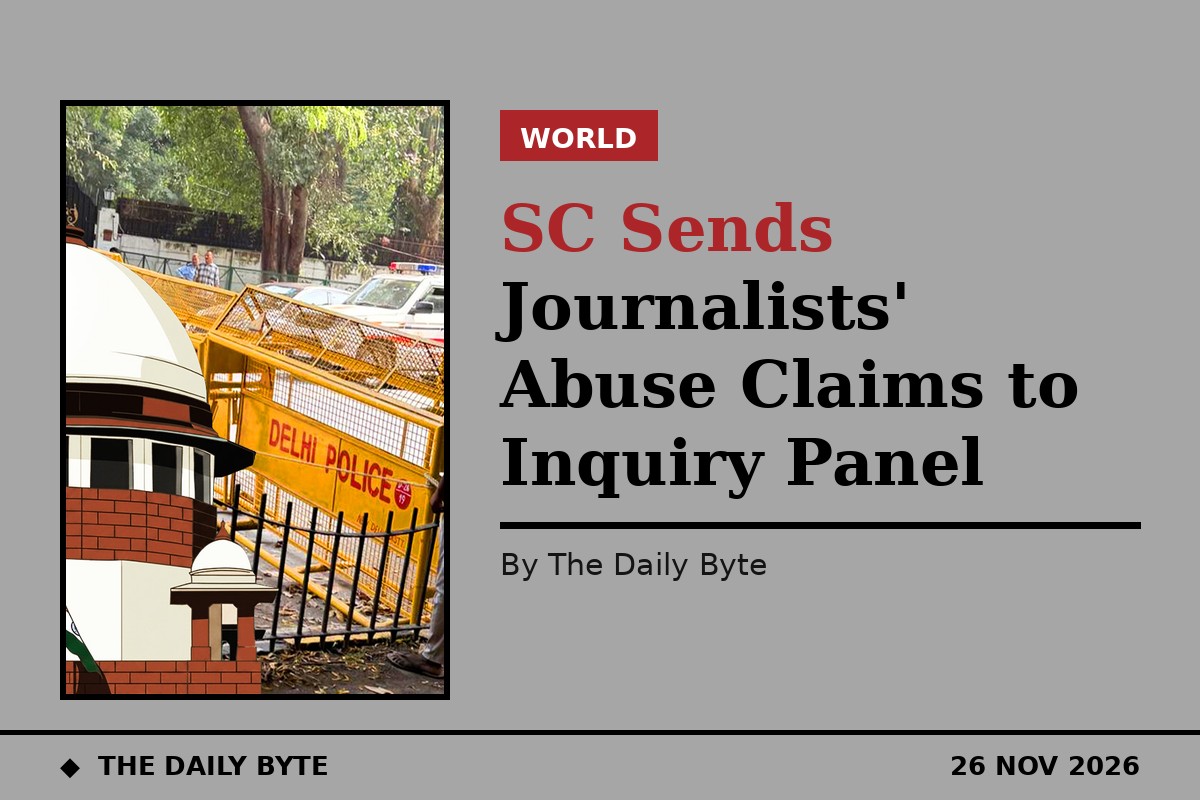
India's Supreme Court has sent complaints from seven Kerala journalists to a court-appointed inquiry committee, after they alleged they were manhandled and wrongfully detained by Delhi Police while covering protests demanding the resignation of Chief Election Commissioner Gyanesh Kumar.
A bench headed by Chief Justice of India Surya Kant, with Justices Joymalya Bagchi and V Mohana, heard the case on Thursday, 26 November, and directed the Empowered Inquiry Committee to examine the allegations and record its factual findings. The bench disposed of the petition without expressing any opinion on the merits of the complaints.
The petition was filed by the Kerala Union of Working Journalists, along with other journalist bodies including the Network of Women in Media, India, the Free Speech Collective and the Delhi Union of Journalists. It alleged that reporters covering the October protests in the national capital were subjected to unlawful detention, physical assault, manhandling and intimidation by police and security personnel.
The seven journalists named in the petition work for Kerala news organisations. They are Suhail Muhammed, chief reporter and news anchor of 24 News; V.S. Rahul, a cameraperson with 24 News; Sajin, a reporter with Asianet News; Roshni Rajan of Reporter TV; Vishnuprasad, a press photographer with Mathrubhumi; Miji P. Jose, a senior reporter with Manorama News; and reporter Farsana.
Among the incidents alleged in the petition were an attempt to snatch a photographer's camera and the physical assault of a woman journalist while she was reporting live. The petitioners also said the police action breached the Supreme Court's own order of 11 October, which said lawyers, journalists and other professionals should not be hindered in discharging their professional duties.
What the committee must establish
Justice Bagchi said the committee would first have to establish the facts: whether the journalists were present at the protest, whether force was used against them and, if so, whether that force was excessive in relation to what was needed to maintain public order. The journalists have been asked to place the relevant material before the committee.
Senior Advocate P.V. Dinesh, appearing for the journalists' union, told the court that the Delhi Police had filed a composite counter-affidavit that did not deal specifically with the allegations concerning the seven journalists, and asked for a separate affidavit addressing each complaint individually.
Solicitor General Tushar Mehta, appearing for the government, maintained that all the allegations had been addressed in the counter-affidavit already filed. The Delhi Police, in its affidavit, denied that it had at any point sought to obstruct or interfere with the bona fide discharge of journalistic duties, whether during the protests in question or otherwise.
The wider question the court will examine
Beyond the seven individual complaints, the bench said it would examine the broader constitutional questions around the protection available to journalists covering demonstrations and other public events. Justice Bagchi observed that one question was whether journalists enjoy a special or different category of protection while covering protests, or whether their rights in such situations are governed by the same considerations that apply to other members of the public.
During the hearing, Justice Bagchi orally remarked that self-proclaimed journalists may not have the same protection as accredited journalists. The remark was made during arguments and is not a ruling. The bench framed a set of questions it proposes to examine, including who qualifies as a journalist, whether professional accreditation or institutional affiliation should determine the protection available, and whether forcibly removing a journalist from a protest site amounts to custody and what its constitutional consequences would be.
The police also argued that social media influencers, content creators and reel makers would not get the same protection as accredited journalists, and that content creators are not covered by the court's earlier directive exempting media personnel from movement restrictions at the protest sites.
The inquiry committee the complaints have been sent to is headed by former Supreme Court judge Justice Subhash Reddy. It was constituted by the Supreme Court in August to inquire into police action during the July student protests. The bench also indicated that similar cases involving individual journalists could be identified by the nodal counsel and placed before the same committee.
The petitioners had sought an independent inquiry, action against officials found responsible, compensation for the affected journalists and guidelines to protect journalists covering public events. For now, the court has kept the focus on the facts: the committee will examine what happened to the seven journalists, while the court itself takes up the larger question of what protection the law gives the press at a protest.


