Supreme Court Strikes Down UP Pension Laws
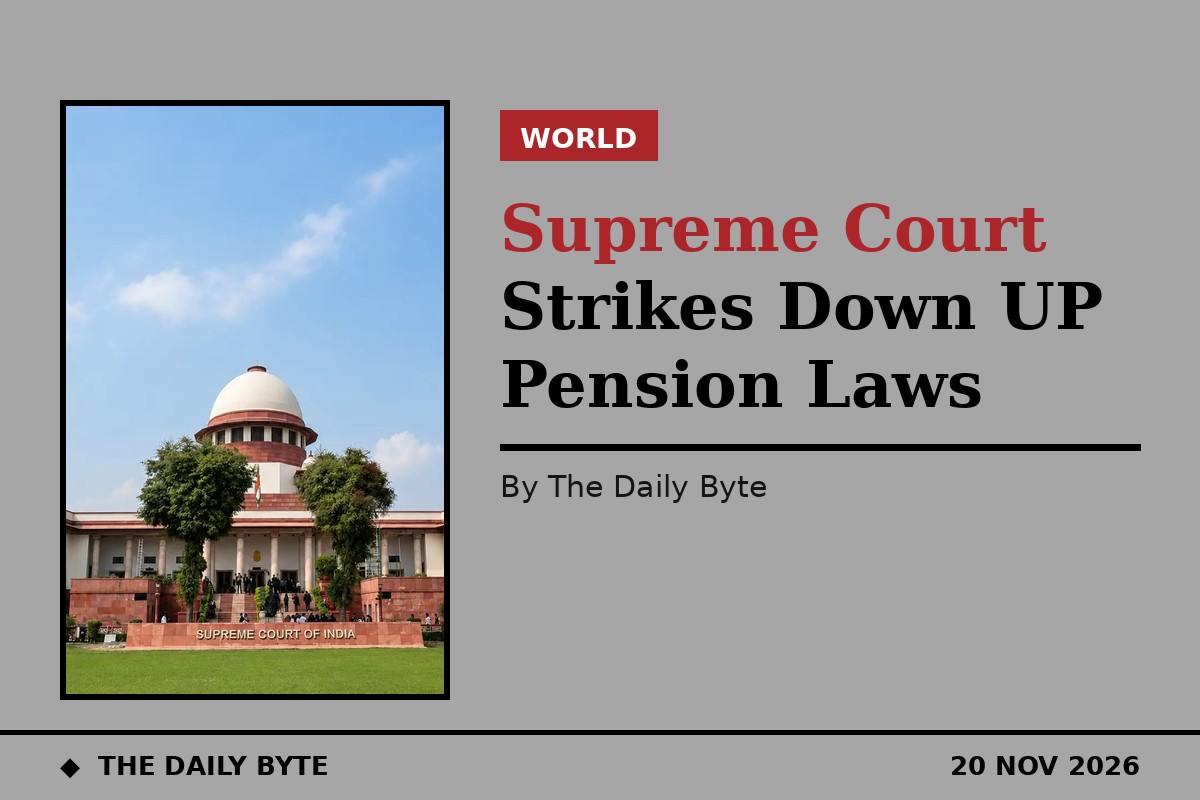
India's Supreme Court on Friday struck down two Uttar Pradesh laws that excluded years of service worked before regularisation from pension calculations, ruling that once an employee is brought into regular government service, the earlier years of work cannot be wiped from the record.
A bench of Justices Dipankar Datta and Satish Chandra Sharma declared the Uttar Pradesh Qualifying Service for Pension and Validation Act, 2021, and the Uttar Pradesh Entitlement to Pension and Validation Act, 2025, unconstitutional. The laws had sought to keep service rendered in work-charged establishments, and as temporary, daily-wage and muster-roll employees, out of the qualifying service counted towards pension, even after the employees concerned had been regularised.
The ruling is a significant win for retired government employees in Uttar Pradesh who spent years in insecure, lower-status posts before being absorbed into the regular establishment, and who found that those years counted for nothing when their pensions were calculated.
What the court struck down
The two Acts were the state legislature's response to an earlier Supreme Court decision. In Prem Singh v. State of Uttar Pradesh in 2019, the court held that service in a work-charged establishment must be counted as qualifying service for pension, and read down Rule 3(8) of the Uttar Pradesh Retirement Benefits Rules, 1961, which had stood in the way.
Uttar Pradesh then passed validating legislation intended to restore the old position. The 2021 and 2025 Acts introduced fresh definitions of qualifying service and validated past denials of pension, with the effect of excluding pre-regularisation service once again.
The bench held that this did not cure the problem. A legislature seeking to undo a court ruling must actually remove the legal defect the court identified, the judges said, and these enactments had failed to do so. The court observed that once an employee is regularised under a duly formulated scheme, the nature of the initial appointment cannot be revived to deny pensionary benefits, noting that regularisation obliterates the “birthmark” of the initial appointment and integrates the employee into the regular establishment.
The 2019 ruling behind the case
The case, brought by the Uttar Pradesh Ground Water Department Non-Gazetted Employee Association and others, reached the court as a batch of writ petitions, civil appeals and contempt proceedings. The employees involved had served in work-charged, temporary, daily-wage, muster-roll or seasonal capacities before being regularised, and many had retired to find their pensions calculated as if those years had never happened.
The court clarified the scope of its 2019 decision, explaining that Prem Singh had not held that every work-charged employee was automatically entitled to a pension regardless of the conditions of appointment. What it had held was that excluding work-charged service from qualifying service was impermissible under the statutory framework then in force.
Tested against that standard, the validating Acts were constitutionally infirm, the bench said, because they sought to extinguish the effect of a final adjudication without removing its legal foundation. The court accordingly set aside the judgments of the Allahabad High Court that were under challenge in the connected appeals.
What happens next
The court directed that the pension claims of eligible employees be considered in line with the principles laid down in Prem Singh. Retired employees covered by the judgment may approach the competent authorities with full particulars of their past service, and the authorities must examine the claims and decide entitlement to pension and other retirement benefits within six months of receiving the applications.
Monetary benefits will ordinarily be restricted to the three years preceding the institution of the writ petition in Prem Singh, the court said. Any amounts found due must be released within the timelines laid down, and delayed payments beyond those timelines will attract simple interest at 9 per cent a year.
The state was also given a final six-month period to comply with the directions in Prem Singh in the pending contempt matters, with the court cautioning that continued non-compliance may amount to aggravated contempt. The judgment is reported under neutral citation 2026 INSC 1252.
Sources: Live Law – Supreme Court Strikes Down UP Laws Excluding Work-Charged Employees' Pre-Regularisation Service From Pension | India Legal – Supreme Court strikes down UP laws denying pension benefits for pre-regularisation service of work-charged employees


