Suzuki to Build Japan's First Homegrown LFP Car Batteries
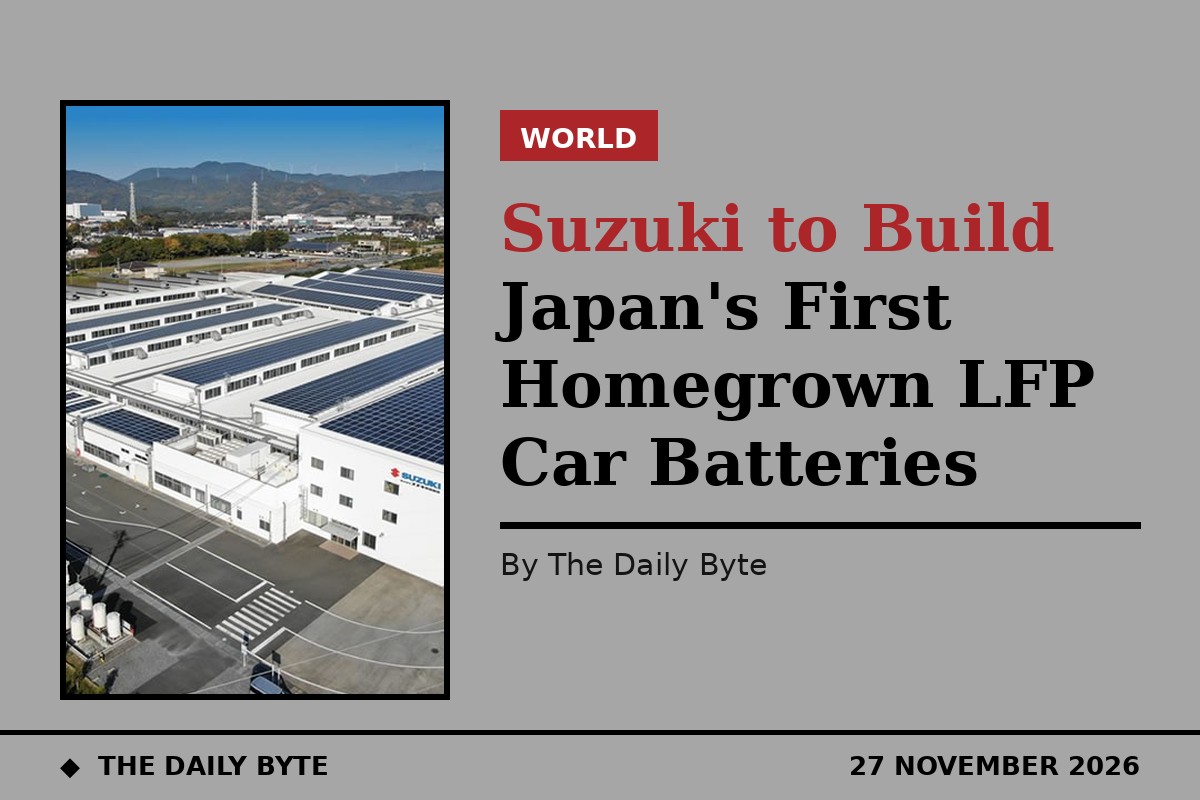
Suzuki Motor and battery maker ELIIY Power will build Japan's first domestic mass-production line for lithium iron phosphate batteries for cars, after the government certified their joint project on 26 November and agreed to fund more than two-fifths of its cost.
Japan's Ministry of Economy, Trade and Industry approved the project under a supply security plan for storage batteries, certified under the Economic Security Promotion Act. The two companies will invest about 44.7 billion yen, roughly 280 million dollars, to build a battery plant in Kosai, Shizuoka Prefecture, and the government will provide a grant of up to 18.7 billion yen.
Production is scheduled to begin in October 2029, with annual capacity of 0.48 gigawatt-hours. That is enough batteries for about 18,000 of Suzuki's e-Sky mini electric vehicles, based on that model's 26 kilowatt-hour battery. Phased commercial deliveries for homes, businesses and vehicles are planned from fiscal 2030, which begins in April 2030.
Iron and phosphorus instead of nickel and cobalt
Lithium iron phosphate, known as LFP, uses iron and phosphorus in the battery's cathode instead of nickel and cobalt. The chemistry is generally cheaper to make and is regarded as strong on safety, although it has usually offered less driving range than the ternary batteries commonly fitted to Japanese electric vehicles. ELIIY Power, a Tokyo-based battery specialist founded in 2006, will supply the cell manufacturing know-how, while Suzuki will handle production. The two companies will develop the battery modules and mass-production technology together.
The batteries are designed to do two jobs. They will serve as stationary storage in homes, offices and factories, and as traction batteries in vehicles. Used vehicle modules that fall below automotive tolerances will be reconditioned for residential and commercial storage systems. Since February 2026, Suzuki has been testing an electric version of its Carry kei truck, fitted with an ELIIY Power LFP battery, with farmers in Shizuoka, Aichi and Kumamoto prefectures.
Cutting reliance on Chinese suppliers
The project is aimed squarely at supply security. Suzuki currently relies on Chinese suppliers, including BYD, for the LFP packs installed in its electric models such as the e-Sky minicar and the e-Vitara crossover. By making the cells at home, next to its existing vehicle plant in Kosai, Suzuki hopes to insulate its assembly lines against Chinese mineral export curbs and other disruptions abroad, while the government wants to reduce the risk that supplies of a strategically important component could be cut off.
The planned output is small by electric vehicle industry standards, and the plant will add only a modest amount of domestic capacity in a market dominated by Chinese and South Korean producers. But if the vehicle version enters production as planned, it will be Japan's first mass production of LFP batteries for cars, and it gives the country's small-car makers a domestic, non-Chinese source of the chemistry that is fast becoming the default for affordable electric vehicles.


