Sweden Centre Party Backs Kristersson for PM
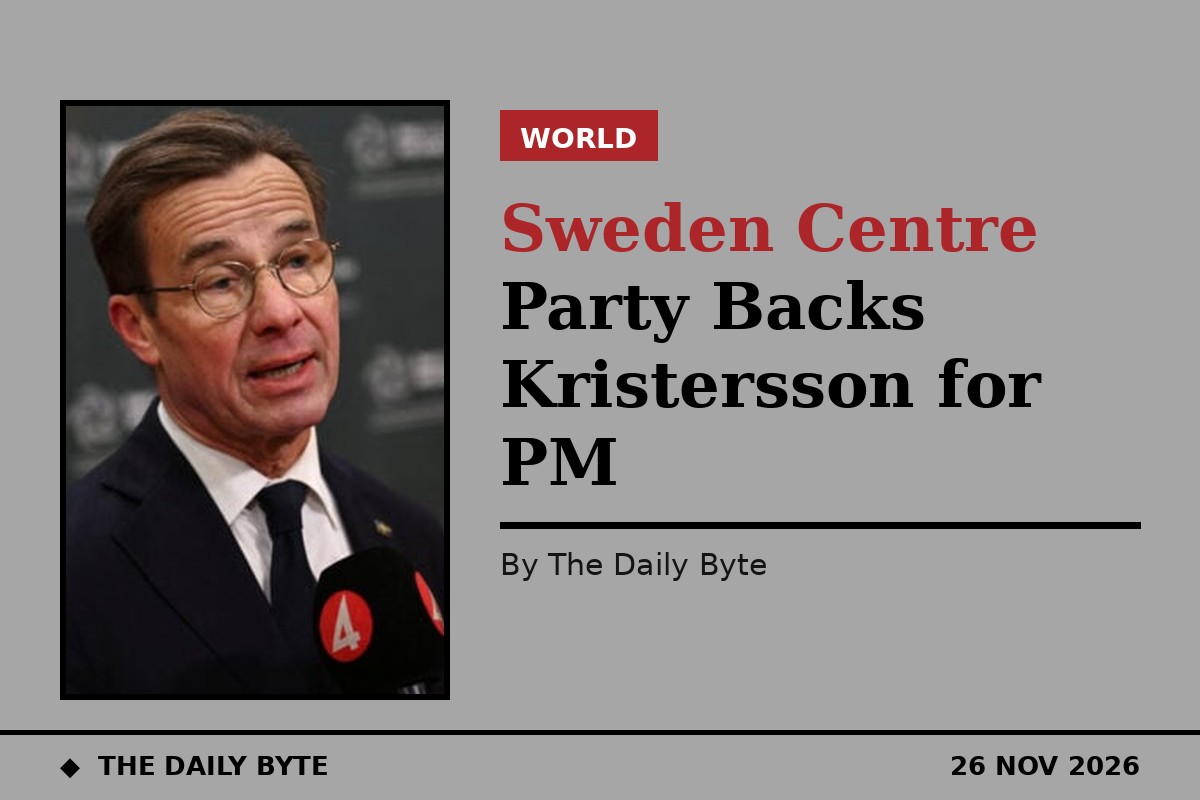
Sweden's Centre Party leadership has recommended backing caretaker Prime Minister Ulf Kristersson and joining his four-party minority government, a move that could break a deadlock over who should govern the country that has lasted more than two months since September's election.
Centre Party leader Elisabeth Thand Ringqvist said on Thursday that the party's board and parliamentary group had agreed to recommend a yes vote in Monday's prime ministerial ballot in the Riksdag, and to take part in the government that parliament's speaker has put before lawmakers. "We are recommending that the governing council support the Centre Party voting in favour at Monday's prime ministerial vote and taking part in the four-party government that the speaker has put before parliament," she said after the meeting.
The recommendation still has to be approved by the party's governing council, and Thand Ringqvist was clear that the outcome was not settled. She said the board's decision was not unanimous and that it was not certain the council would give its backing. The recommendation was reported by Swedish public broadcaster SVT, which said the proposed government would mark "a new direction for Sweden", rather than a continuation of the previous four years.
The move is a sharp change of direction for the Centre Party, which campaigned in the 13 September election for a centre-left government led by Social Democrat Magdalena Andersson. The centre-left opposition bloc won 176 of the 349 seats in parliament, against 173 for the centre-right bloc, but Andersson failed twice to form a government and was rejected by lawmakers in a first vote in mid-October. Thand Ringqvist herself was then rejected as prime minister on 3 November, by 324 votes to 25, with only her own party's members voting for her.
Speaker Andreas Norlen then gave Kristersson, leader of the Moderates, the task of trying to form a government. The four parties in the proposed government would be the Moderates, the Christian Democrats, the Liberals and the Centre Party. Even together they would fall short of a majority, so the government would depend on the Sweden Democrats, who hold 62 seats, tolerating it in parliament. That is the point that has caused the deepest argument inside the Centre Party, which promised voters it would not support a government dependent on the Sweden Democrats, even if that party held no cabinet seats.
The internal opposition surfaced before Thursday's meeting, when 35 Centre Party politicians wrote that joining a right-wing government with the Sweden Democrats holding the balance of power would betray voters who had been promised a new direction. Kristersson welcomed the leadership's recommendation, saying in a written comment: "A coalition government with our four parties with a focus on growth and welfare would be good for Sweden."
Parliament is due to vote on whether Kristersson should form the next government on Monday 30 November, with the ballot scheduled for 1pm. It would be the third of a maximum of four prime ministerial votes allowed under Sweden's constitution. If a fourth attempt also fails, a new election must be called within three months, something Sweden has not done since 1958. Until a new government takes office, Kristersson remains in charge as caretaker prime minister, and a transition budget is already in place for 2027.
The deadlock has now lasted about 75 days since election night, and the coming days will decide whether the Centre Party's change of course is enough to give Sweden a working government, or whether the country edges closer to an extra election.


