Swedish Gripen cleared to down missile over Poland
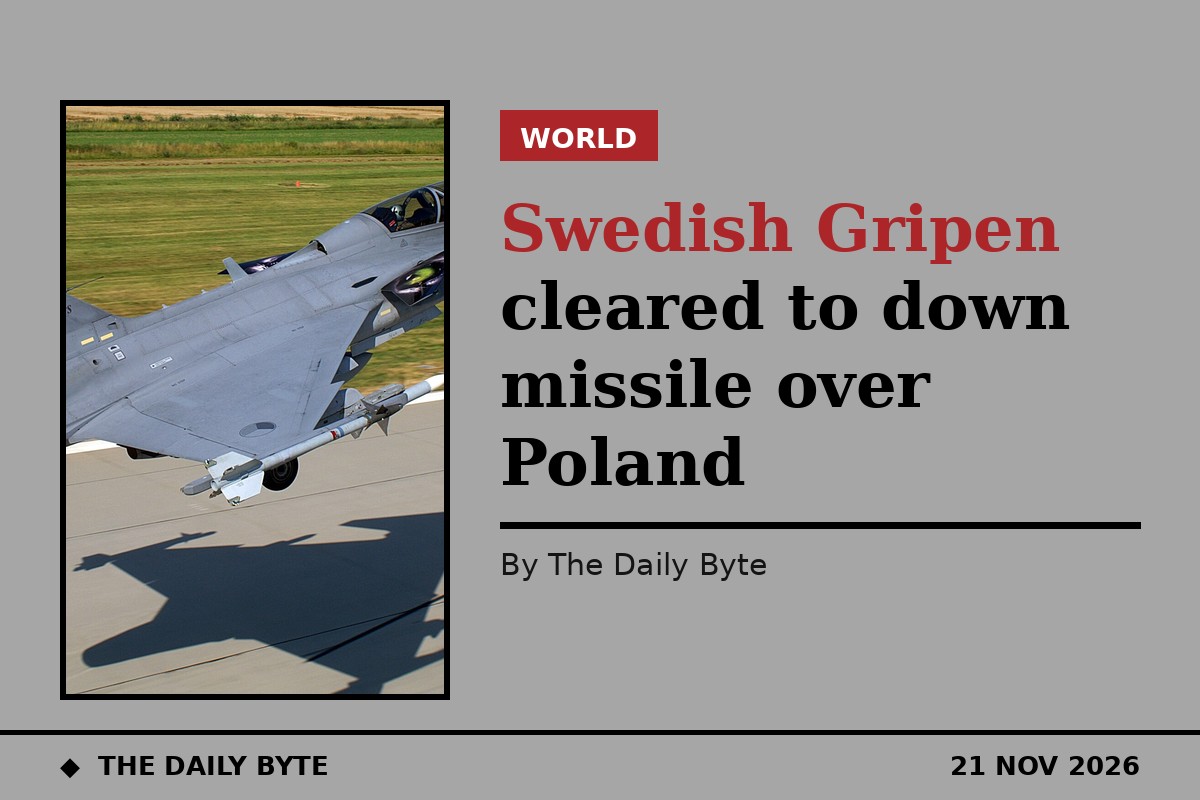
A Swedish fighter pilot was authorised by NATO to shoot down a suspected Russian cruise missile over Poland on Friday, but held fire because bad weather made it impossible to identify the target with certainty. The account, given by Poland’s operational commander, explains why none of the three objects that crossed into Polish airspace that morning was brought down.
Lieutenant General Ireneusz Nowak, the operational commander of the Polish Armed Forces, told the newspaper Rzeczpospolita that the pilot had tried to intercept an object preliminarily identified as a Russian Kh-101 cruise missile. Two Swedish JAS 39 Gripen fighters were operating under NATO’s Combined Air Operations Centre at Uedem in Germany, which had issued a condition-based order allowing pilots to use their weapons once specified conditions were met. The pilot could not confirm the target either by sight or through the aircraft’s electro-optical systems, so no missile was fired.
Authorisation is not the same as identification
The episode shows the gap between permission to engage and the conditions that must be satisfied before firing. Poland revised its air defence procedures earlier this year to allow certain engagements without visual identification, provided other requirements for identifying the threat are fulfilled. In this case the pilot could not establish that identification through visual or electro-optical means, and the Swedish Armed Forces have not themselves disclosed the conditional authorisation described by the Polish commander. The Swedish force did confirm that its aircraft tracked several targets over Polish territory during a mission lasting several hours, which involved aerial refuelling in darkness and preparation of aircraft at a forward base in Poland. Its deputy air force chief, Niclas Magnusson, said the pilots had operated in difficult weather and low visibility.
The wider response involved two Polish F-16 fighters alongside the Swedish Gripens, supported by a Polish Saab 340 airborne early-warning aircraft and a Dutch tanker aircraft, with ground-based air defences also activated. Polish authorities tracked eleven objects approaching the country that were assessed as potential threats to national airspace. The Polish air navigation agency temporarily suspended operations at Rzeszów-Jasionka and Lublin airports so military aircraft could respond, and the control tower at Rzeszów-Jasionka, an important gateway for military aid to Ukraine, was evacuated. Infrastructure Minister Dariusz Klimczak said nine people, including six operational staff, were moved to a temporary shelter.
What came down in south-eastern Poland
Defence Minister Władysław Kosiniak-Kamysz identified a Russian Kh-101 cruise missile at Nowy Lipowiec, near the Ukrainian border. A second object that came down near Rudnik nad Sanem was provisionally assessed as another missile, and debris found at Mołodycz was believed to belong to a jet-powered drone, although the classifications of the latter two objects remained preliminary while investigators examined the wreckage. Polish authorities estimated that the missile identified at Nowy Lipowiec had spent about three minutes inside Polish airspace. No one was hurt and no critical infrastructure was damaged.
The incursion happened during one of Russia’s largest bombardments of Ukraine since the full-scale invasion began, and while Poland was hosting Exercise Koalicja, the first large-scale exercise of the Coalition of the Willing’s Multinational Force Ukraine, at Nowa Dęba. Polish Prime Minister Donald Tusk called the airspace violations a likely deliberate provocation, and a day later NATO Secretary General Mark Rutte visited Warsaw and promised the alliance would defend every inch of Polish territory. Poland has said it will ask NATO for more air defence resources, including airborne early-warning aircraft and F-35 fighters, to reinforce the alliance’s Eastern Sentry operation. Russia has made no public comment on the objects that landed in Poland.
Sources: Air Data News and Defence Matters and Institute for the Study of War.


