Swiss vote Sunday on fireworks, arms and pensions
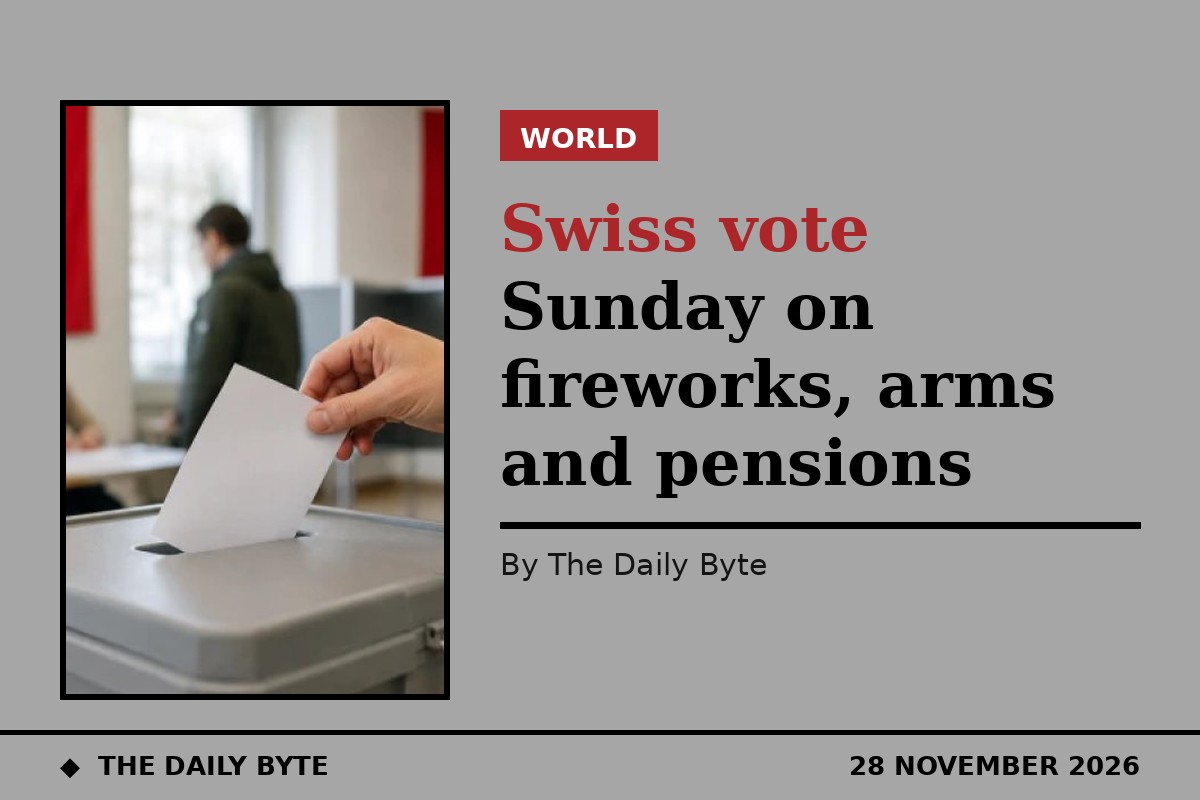
Swiss voters go to the polls on Sunday 29 November to decide four national proposals covering fireworks, arms exports, pension funding and the taxation of married couples. Turnout is projected at about 52 percent, above Switzerland's long-term average of 47.3 percent, suggesting unusually strong engagement with the issues.
The four questions
The first proposal would introduce restrictions on fireworks, limiting their use in a country where firework displays are a longstanding part of national celebrations. The second would amend the regulations governing the export of military equipment, changing the rules under which Swiss-made weapons can be sold abroad.
The third proposal concerns how to finance an additional annual pension payment, effectively a 13th monthly payment for retirees. The fourth would change the tax system applied to married couples, ending a longstanding arrangement under which married couples can face a higher combined tax burden than unmarried couples.
Together the four measures cover everyday life, government finances and the country's security policy, at a time when Switzerland is balancing its longstanding neutrality against growing international debate over arms exports.
What the polls say
A public opinion survey released on 18 November by research institute gfs.bern, commissioned by the Swiss Broadcasting Corporation (SRG SSR), found considerable support for tighter fireworks regulations. Opposition to the proposal on the taxation of married couples has been increasing, according to the same survey.
Public opinion remains divided over the other two measures. Both the financing of the additional pension payment and the amendments to arms export regulations face closely contested outcomes, with neither side holding a clear lead in the polling.
The survey projected voter participation at approximately 52 percent, exceeding Switzerland's long-term average turnout of 47.3 percent. That suggests the combination of cost-of-living, tax and security questions has drawn more voters than a typical referendum day.
The arms export debate
The proposal to amend the War Materiel Act has drawn the sharpest international attention. Under the new rules, Bern would no longer be obliged to require a non-re-export declaration from buyers of Swiss weapons, although it could continue to do so for reasons of neutrality or security policy.
Under neutrality law, sales and transfers to Ukraine would remain prohibited. Critics, including Social Democratic National Council member Jacqueline Badran, argue the change would produce the most lax War Materiel Act in Europe and damage the country's reputation. Supporters, including the Neue Zürcher Zeitung, argue that rigid export conditions would decimate Switzerland's defence industry and that the country needs to be able to supply its partners without excessive restrictions.
The Financial Times has argued that Switzerland is attached to an image of independence and self-sufficiency that no longer reflects its dependence on western markets and industries, warning that the country could find itself in a future crisis with little bargaining power.
What the government recommends
Switzerland's Federal Council and parliament have recommended supporting the proposals on pension financing and amendments to the War Materiel Act. Both institutions have expressed opposition to the initiatives seeking restrictions on fireworks and changes to the taxation of married couples.
The outcome on Sunday will determine the direction of several important policy debates, including how the country finances retirement benefits, regulates military equipment exports and approaches longstanding social and tax arrangements. Results are expected on Sunday evening.


