Sydney Fire Ant Outbreak Worse Than Feared, Taskforce Set
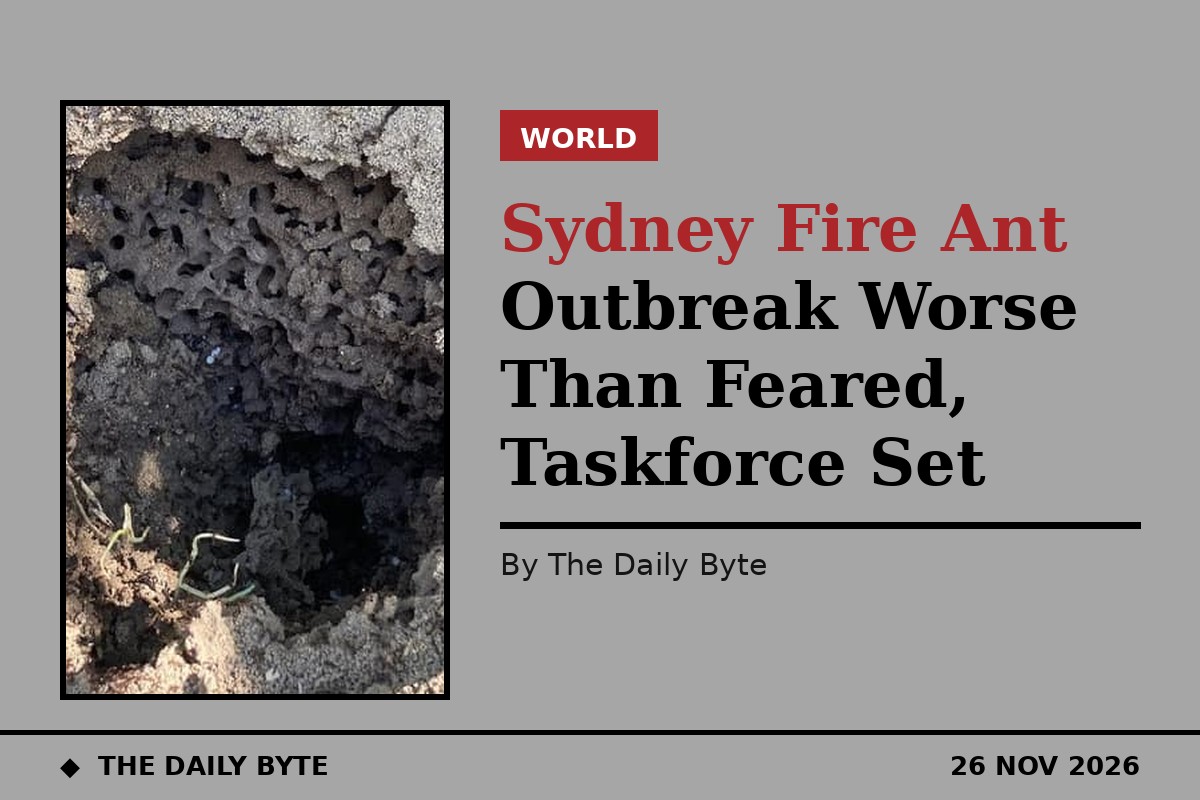
A fire ant infestation in Sydney's west is much worse than first thought, with authorities setting up a specialist taskforce after discovering a wider outbreak and a type of colony never before found in New South Wales.
The NSW Biosecurity team confirmed and destroyed a nest of red imported fire ants at an industrial site in Auburn, western Sydney, over the weekend. Experts said the nest could have been around for as long as a year.
Although the first nest was successfully treated, continuing surveillance has since found a more extensive presence of fire ants, and a colony containing multiple queens. That means the infestation has probably spread and will be harder to treat, prompting the government to step up its response.
A colony type never seen in NSW before
The National Fire Ant Eradication Program confirmed that all samples from the Auburn detection are consistent with the polygyne social form of red imported fire ants. Unlike colonies with a single queen, these colonies contain multiple queens and can support a higher concentration of ants and nests within a relatively small area, making them complex to treat.
This type of colony has not previously been detected in NSW and is rare even in south-east Queensland, where fire ants are more widespread.
"Polygyny colonies can spread rapidly and establish new nests nearby, making it particularly important that authorities identify the full extent of this infestation," said Reece Pianta, advocacy director of the Invasive Species Council.
A separate incursion from Enfield
Current expert advice indicates the Auburn infestation is not linked to the detection at the Enfield Intermodal Logistics Centre two months ago, with imported goods suspected to be the source of both incursions. The first fire ant nest in Sydney was found at Enfield on 23 September, more than six kilometres from the Auburn site. Investigations into the origins of both detections are continuing.
NSW Agriculture Minister Tara Moriarty said the ants were likely brought in inadvertently via an overseas import, and that the Auburn outbreak was different from what had occurred in the past.
"This fire ant type is different to what has occurred in the past and is seemingly the result of infested imported goods," she said. "Our government is boosting our on-ground resources and establishing a Taskforce to focus on tracing the supply chains that have led to this occurring and checking high risk locations."
The five-point response
The NSW Government is scaling up its response with five priority actions over the coming weeks. A specialist taskforce will trace movements of high-risk carrier materials coming into NSW from intermodal centres. A Biosecurity Control Order will be issued by Friday to formally regulate the movement of soil, turf, building materials, plants and mulch through Auburn. The area and its surrounds will be comprehensively treated within a 500-metre radius of the detection site. More biosecurity staff will be brought in from the Commonwealth, Queensland and other states and territories, along with additional detection dogs. And community engagement will be stepped up, including a drop-in centre near the Auburn site.
The public is asked to stay vigilant, report suspicious ants or mounds, and not enter biosecurity sites. Fire ants are prohibited matter in NSW. Anyone who finds a suspicious mound should leave it alone, take a clear photo or video from a safe distance, and call the Biosecurity Helpline on 1800 680 244.
A row over biosecurity funding
The outbreak has also become a political argument over biosecurity funding. Moriarty called on her federal counterpart, Julie Collins, to do more, saying the ants were dangerous to humans, animals and the environment. "They can chew through electrical wire," she told reporters. "And when they attack, they don't do it singularly. They do it as a group and join together."
Collins said the federal government had delivered more than $2 billion in additional biosecurity resourcing since 2022, including more than $296 million in the current red imported fire ant eradication program, and that biosecurity officers inspected nearly 350,000 commercial sea and air cargoes in the last financial year.
NSW has put the most money of any state into the national fire ant eradication program, contributing $95 million. Across the Enfield zone, 729 reported cases have been inspected, detector dogs have assessed 120 sites, and 1,600 people have been engaged face to face.
What is at stake
The Invasive Species Council has warned that a widespread infestation of red fire ants could cost the economy up to $2 billion, and said the threat extended well beyond Sydney. "We need to make sure fire ants have not already hitchhiked their way to other parts of NSW or interstate," Pianta said.


