Syria Arrests General Over Ghouta Chemical Attack
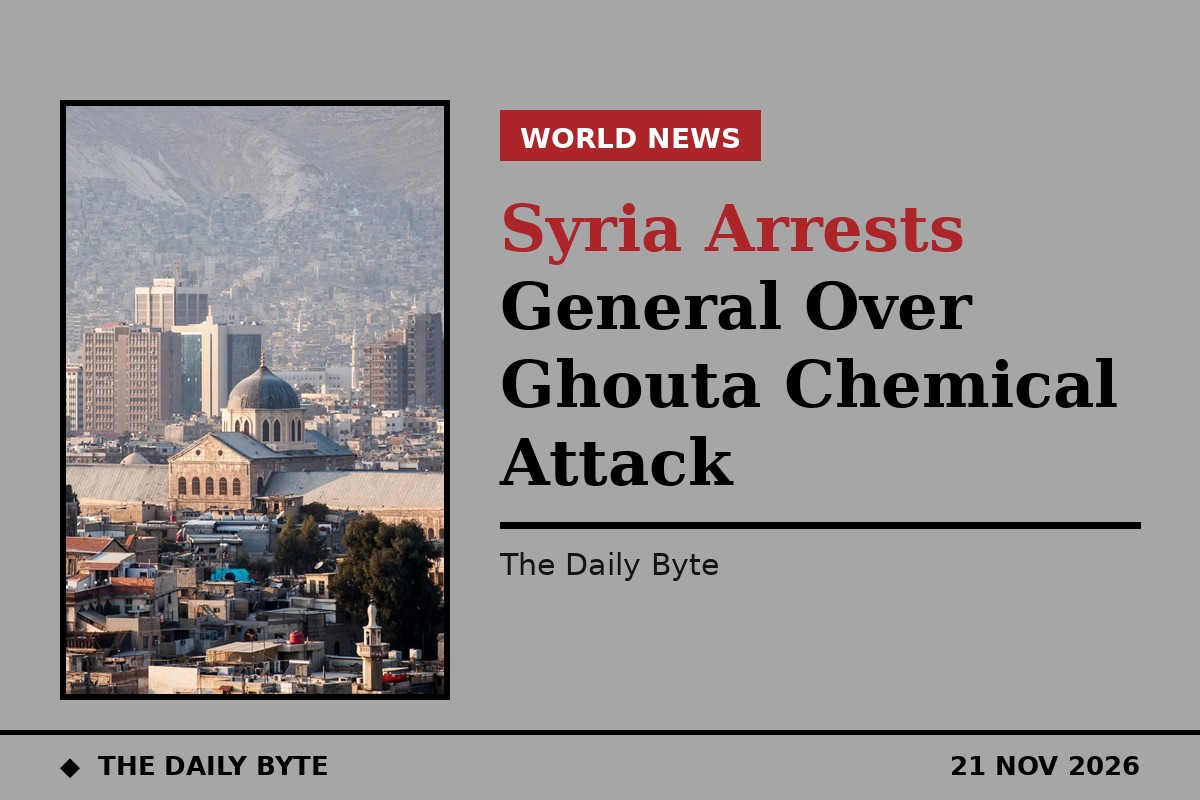
Syrian authorities have arrested a former brigadier general accused of a direct role in the 2013 chemical attack on Eastern Ghouta, one of the deadliest atrocities of the country's civil war, the interior ministry announced on Friday.
Khardal Ahmad Dayyub, a former brigadier general in the ousted regime of Bashar al-Assad and a former head of Air Force Intelligence in Daraa, was taken into custody by security forces, according to the ministry statement. He has been referred to the judiciary for further investigation and legal proceedings.
The ministry said Dayyub was directly involved in systematic violations against civilians, including a role in chemical attacks during his service in the Damascus regional branch while stationed in the Harasta area near the capital. It said he supervised repressive attacks and contributed to logistical coordination for the shelling of Eastern Ghouta with internationally banned chemical weapons.
He is also accused of overseeing what the ministry called an assassination committee in Daraa, recruiting operatives for field executions, and of facilitating the movement of foreign operatives inside Syrian territory under official security cover. He is further suspected of extrajudicial killings and of coordination with Iran and its Lebanese proxy Hezbollah, which supported the ousted government during the war.
Dayyub has not been convicted of any offence, and the ministry has not disclosed where he was detained or what specific charges he will face. The allegations against him have not been tested in court.
The 2013 Ghouta attack
The attack at the centre of the case took place on 21 August 2013, when chemical weapons were used against rebel-held areas in Eastern and Western Ghouta near Damascus. More than 1,400 people were killed and more than 10,000 injured, most of them women and children, according to the figures cited in the ministry's announcement and in reporting of the attack.
Survivors and medics documented the attack through videos and interviews, and a United Nations report later confirmed the use of sarin gas. The incident drew global condemnation and led Syria to agree to relinquish its chemical arsenal to avoid American military strikes. Syria subsequently joined the Organisation for the Prohibition of Chemical Weapons and disclosed its toxic stockpile under pressure from Russia and the United States.
Assad remained in power for more than a decade after the attack, until he was ousted by Islamist-led rebels in December 2024 and fled to Russia. A transitional administration led by President Ahmad al-Sharaa was formed in January 2025. The civil war, which began in 2011 with a crackdown on dissent, killed more than half a million people and displaced millions.
A second arrest in two days
Dayyub's arrest came a day after Syrian authorities detained another former senior officer, Brigadier General Rawad Zaidan, accused of planning the 2014 al-Otaiba ambush in Eastern Ghouta, in which more than 150 people were killed. Interior Minister Anas Khattab announced that arrest on Thursday.
The two arrests in two days are the latest steps in the new administration's campaign to pursue former regime figures accused of serious violations. The authorities have repeatedly announced arrests of individuals accused of abuses against civilians during the 2011-2024 conflict, and have said they are documenting victims, preparing a legal framework for accountability and moving from promises towards early implementation.
Syria held its first public trial of senior Assad-era officials in April, including former intelligence chief Atef Najib, whose treatment of detained teenagers in Daraa helped spark the 2011 uprising. A Damascus court convicted Najib and other former officials, including Bashar and Maher al-Assad, who were tried in absentia, in August.
Whether Dayyub's case reaches a courtroom, and what evidence the authorities produce to support the chemical attack allegation, will be the next test of a transitional justice process that has so far produced arrests and announcements faster than verdicts. For the families of the Ghouta victims, who have waited more than thirteen years, the arrest is a step they have long demanded, but only a trial can establish what Dayyub did.


