Syria Courts West With EU Forum and Warship Visit
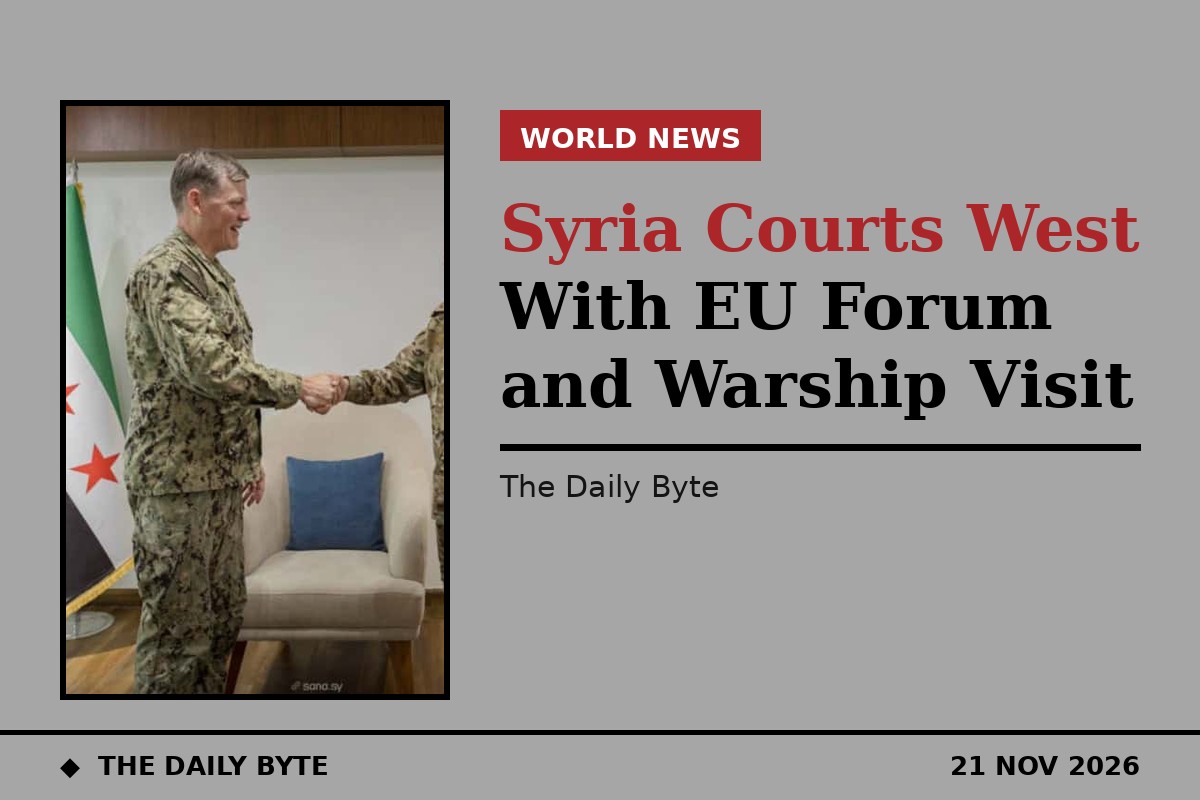
Syria has capped a week of Western engagement by hosting a European Union economic forum in Damascus, welcoming a French warship and holding talks with the commander of the United States-led coalition against Islamic State.
The Syria Partnership Coordination Forum, held in the capital on Tuesday 17 November, brought together EU member states, G7 countries, Arab states, the United Nations and financial institutions including the World Bank and the European Investment Bank to align international aid with Syria's reconstruction needs.
A $192 million package from Brussels
European Commissioner for the Mediterranean Dubravka Suica told the forum that the EU expected to sign a $192 million economic support package for Syria, aimed at reconstruction and economic recovery. She also formally launched a Syria Technical Assistance Hub to coordinate aid and investment.
"Syria must lead its own recovery. We are here to support you, working hand in hand with development banks, financial institutions and businesses," Suica said. Syrian Foreign Minister Asaad Hassan al-Shaibani called for stronger international coordination, innovative financing and greater private-sector investment to speed up recovery.
Suica also met Shaibani on 17 November to discuss cooperation with the World Bank on development programmes. The forum followed an EU discussion paper that proposed a broad upgrade in ties with Syria, including a revival of a long-frozen trade accord, and the bloc has said it plans a major investment conference in Damascus in 2027.
Warships and commanders in Damascus
Five days before the forum, Syria hosted the French frigate Surcouf, the first visit by a French military ship. The commander of Syria's Naval Forces and Coastal Defense, Brigadier General Mohammad al Saud, met a French delegation headed by Admiral Mackara Ouk to discuss naval cooperation.
On the same day, 12 November, Syrian Defence Minister Murhaf Abu Qasra met Rear Admiral Liam Hulin, commander of the anti-Islamic State coalition, in Damascus. Hulin had previously visited Syria in September. Syrian media gave no details of the talks beyond coordination on shared issues, but on the same day the authorities said they had dismantled an Islamic State cell in Aleppo and arrested four of its members.
Strains beneath the outreach
The diplomatic activity has not removed the pressures on the new government. Syria's ambassador to the United Nations, Ibrahim Olabi, told the Security Council on 16 November that Israel must end its incursions along the Golan border and return to international law, accusing Israeli forces of bombarding villages and detaining Syrians. Syrian media reported a new Israeli incursion near the border on the evening of 16-17 November.
At home, students at Rojava University in Qamishlo protested on 16 November against government plans to merge their institution with the state-run Al Furat University, saying Kurdish-language teaching would be reduced. Islamic State cells remain active, and the future of Kurdish-led forces in the east is still unresolved.
For a government that took power less than two years ago after the fall of Bashar al-Assad, the week's engagements amount to a visible step towards normalisation with Western capitals. Whether the promised money and military cooperation follow will be the test of a week in which Damascus was, for once, hosting rather than asking.


