Syria and Jordan mend ties after deadly airstrikes
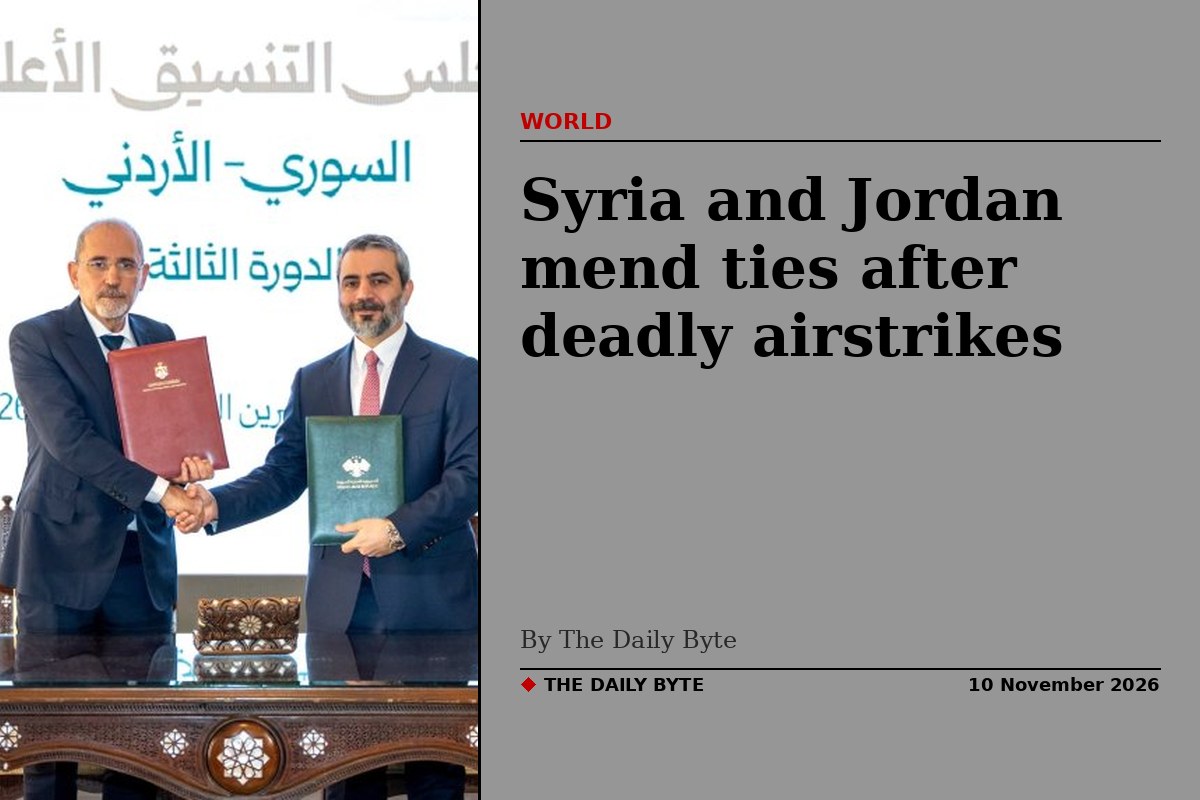
Syria and Jordan have moved to mend ties after deadly airstrikes, with their foreign ministers meeting in Damascus and signing 11 cooperation agreements alongside a joint investigation into the incident.
Syrian Foreign Minister Asaad al-Shibani and Jordanian Foreign Minister Ayman Safadi met on Monday for the first time since Jordanian airstrikes killed civilians in southern Syria last month. The two countries announced a joint security and technical committee to investigate the circumstances of the strikes.
Jordan said its strikes on 26 October targeted Islamic State militants linked to a deadly attack on a church in Jordan's Karak province. Syrian authorities said the strikes killed seven civilians, including three children, in Daraa province.
"Work is underway to redress the harm and compensate the innocent victims," Shibani told a joint press conference with Safadi, following the third session of the Syria-Jordan Higher Coordination Council, attended by high-level ministerial and technical delegations from both countries.
Safadi renewed his condolences to Shibani and the families of the victims. "Syrian blood is as precious to us as Jordanian blood," he said, adding that ties between the two countries were strong.
Eleven deals and a proposed railway
Shibani said bilateral relations were at their strongest in decades. The two countries signed 11 cooperation documents covering investment, civil aviation, food security, cloud seeding in the Yarmouk River basin and a proposed railway connection linking Saudi Arabia to Turkey through Jordan and Syria.
Trade between the two countries has nearly tripled in the past year to $330 million, he said, adding that 20 of Syria's 22 ministries were now engaged in direct cooperation with Jordan. In total, the two governments have now signed 35 agreements and memorandums of understanding, with Shibani describing Jordan as Syria's leading partner in terms of tangible economic returns.
The two sides also agreed to upgrade the Jaber-Nassib border crossing, their main gateway for commercial and passenger traffic, to operate around the clock, with separate lanes for freight and passengers and electronic links between their customs systems. A project worth about $47 million will rehabilitate the international road between Nassib and Damascus.
Energy, water and security cooperation
Energy cooperation has already produced practical results, with natural gas flowing through Jordanian territory to Syrian power plants since January 2026. Shibani said Syria was prepared to facilitate the transit of natural gas to Lebanon through its territory, an issue discussed at a trilateral meeting involving Syrian, Jordanian and Lebanese officials in Beirut.
Safadi said the two countries were working together to combat drug trafficking, a longstanding security concern along their shared border. He also reaffirmed Jordan's support for Syria against Israeli attacks, urging international intervention to halt them before they pushed the region towards further escalation.
The meeting marked an effort to move past a rare diplomatic test for Damascus and Amman, which have expanded political, economic and security cooperation since the overthrow of former Syrian President Bashar al-Assad in December 2024.


