Four Children Killed by Landmines in Syria in a Week
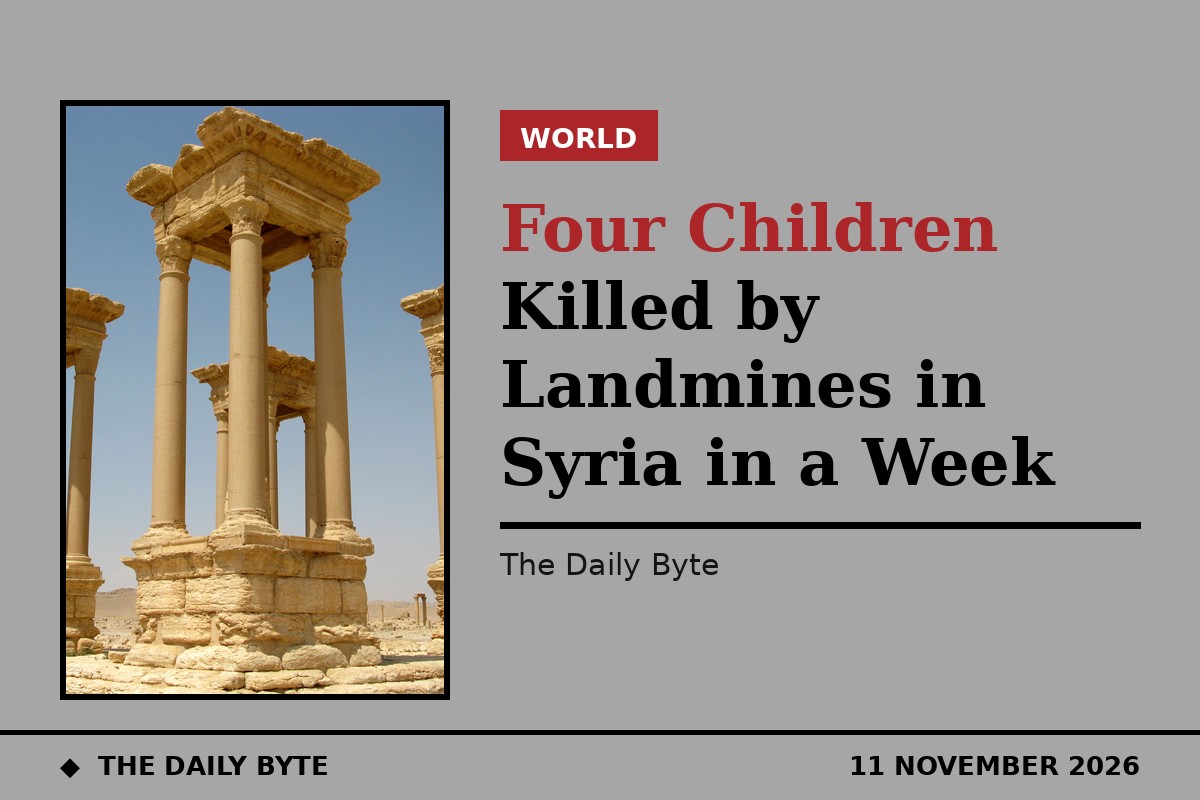
Four children have been killed by landmines and unexploded ordnance in Syria in less than a week, Save the Children said on Tuesday, warning that families returning home after years of war are walking into some of the most heavily contaminated land in the world.
Three children aged between eight and 12 were killed on Monday when an unexploded device went off in rural Palmyra while they were herding sheep, according to local reports cited by the charity. A fourth child was killed last week when a landmine exploded at a school in Hasakah, injuring 14 other people, including children and teachers.
The deaths are double the weekly average of child fatalities from landmines recorded between July and September, based on figures from the United Nations children's agency, UNICEF.
A danger that has grown since the war ended
Landmines and unexploded ordnance have become one of the gravest threats to children across Syria. The UN said in September that 269 children had been killed and 1,616 injured by landmines and unexploded ordnance since December 2024, when the conflict that had lasted nearly 14 years ended and families began returning to their homes.
UNICEF estimates that five million children live in areas contaminated with landmines and explosive remnants of war. More than two-thirds of recorded incidents have happened on agricultural and grazing land, putting farmers, herders and children tending livestock at particular risk.
Figures from the Landmine and Cluster Munition Monitor show Syria has the second-highest number of child casualties from mines and explosive remnants of war anywhere in the world, accounting for 9 percent of all reported child deaths and injuries in conflict zones.
Child casualties in Syria verified by the UN rose from 475 cases in 2023 to 988 in 2025, with explosive ordnance responsible for two-thirds of cases last year, up from around a quarter in 2024, as displaced families return to contaminated areas.
Half a million mines around Palmyra
Local government officials estimate that the Palmyra region alone is contaminated with more than half a million mines, according to local media reports cited by Save the Children. The ancient desert city, where the three children died this week, sits in an area fought over repeatedly during the war.
On 2 November, a child was killed and another injured, along with two adults, when a device exploded in a grazing area in Deir ez-Zor, in the east of the country.
Jeremy Stoner, Save the Children's acting country director in Syria, said children were living with the danger every day. "Children in Syria are playing a deadly game of stepping stones where one misstep will end their life," he said. "Any child killed is one too many. But the fact that hundreds have lost their lives to landmines in less than two years should be shaking up the world to intervene and support clearance and recovery."
One boy's story
Yaser, 15, from Deir ez-Zor, lost a finger and suffered shrapnel injuries to his eye just weeks ago after picking up an object he thought was a pen. "I saw something that looked like a pen. I didn't know what it was. I lifted it and it exploded," he said. He now has blurred vision, is afraid of losing his sight, and his family is waiting to hear about the cost of surgery.
Like many children in Syria, Yaser is no longer in school and works to support his family, earning the equivalent of 15 US dollars a week in an aluminium workshop. Save the Children is supporting him and his family with case management, clothes, hygiene supplies and emergency cash, and plans to refer him for vocational training.
Calls for clearance and funding
Save the Children is calling on Syria's national authorities to redouble efforts to clear mines and unexploded ordnance, and on international donors to fund the equipment needed to mark out and clear contaminated ground.
Mine clearance is a stated priority for the Syrian government, which has set up a National Mine Action Centre under the Ministry of Emergency and Disaster Management. But Save the Children said the funding and resources devoted to the work remain far below what is needed to deal with the scale of contamination, support survivors and teach people about the risks.
The charity is also calling for more funding for victim assistance, including paediatric blast injury training, prosthetics, pain management, physiotherapy, mental health support and inclusive education for children living with life-changing injuries. It has worked in Syria since 2012, reaching more than five million people, including more than three million children.


