Visa and Mastercard Run First International Card Payments in Syria
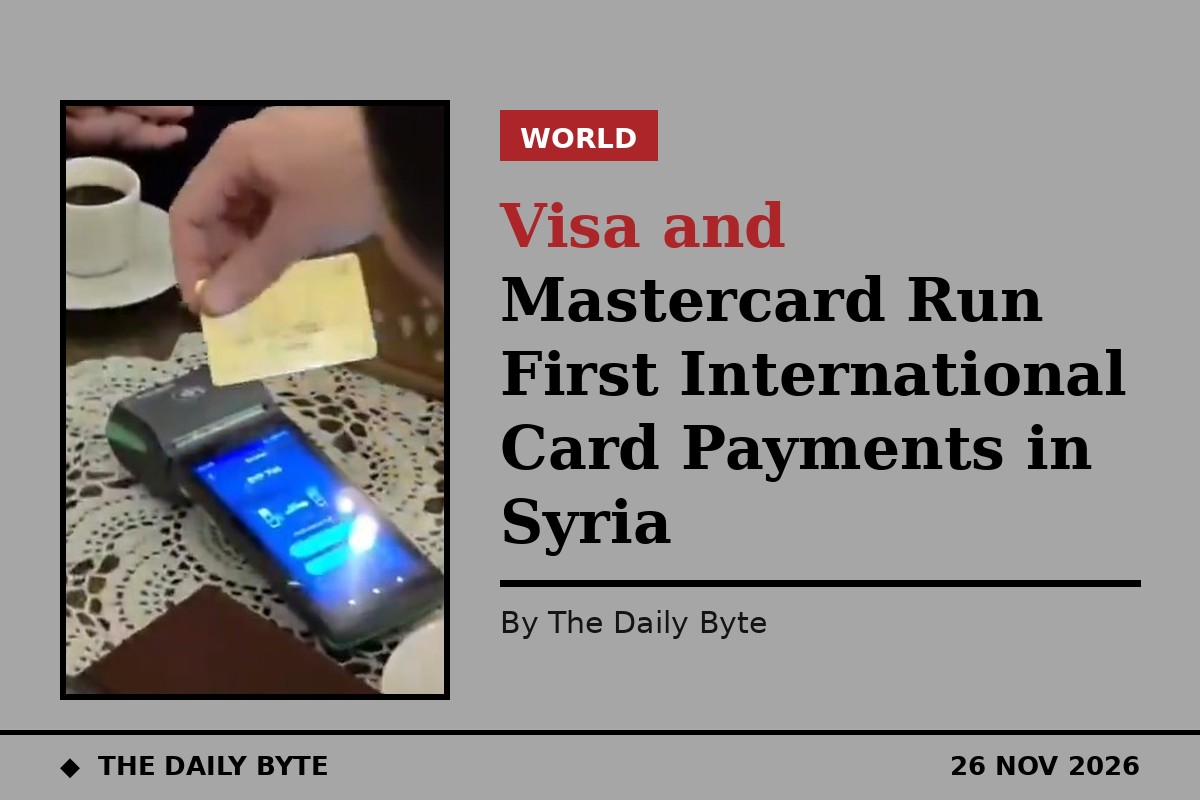
Visa and Mastercard have carried out the first international card payments in Syria, in the clearest sign yet that the country is reconnecting to the global financial system days after Washington removed it from its list of state sponsors of terrorism.
The two payment groups completed separate transactions on Wednesday through arrangements involving Syrian and regional financial institutions. Visa conducted its first live international transaction with Fransabank of Lebanon and Paymera, a Syrian payments company owned by the country's sovereign fund. President Ahmed al-Sharaa took part in the test, making a card payment at a restaurant in Damascus's Old City alongside central bank governor Mohammed Safwat Raslan.
In a video released early on Thursday, al-Sharaa used a Visa card to pay for coffee as he sat with Raslan, Arab News reported. Raslan posted the video on X, writing: "To witness this moment with His Excellency President Ahmad Al-Sharaa, and for the first payment using a Visa card to take place in the heart of Damascus on the day following Syria's removal from the list of state sponsors of terrorism, is, for me, a feeling that is difficult to put into words."
Mastercard completes its own first payment
QNB Group separately said it and Mastercard had completed an end-to-end international card payment. The system will allow Syrian merchants, including hotels, restaurants and government entities, to accept international Mastercard credit cards through QNB point-of-sale terminals. Eligible merchants will be added gradually as part of a phased rollout, subject to regulatory approval.
Visa said it plans to enable international visitors to use their cards in Syria, while QNB said Mastercard acceptance would be extended gradually across eligible merchants. Hotels, restaurants and other businesses serving foreign visitors are likely to be among the most immediate beneficiaries.
Delisting ends a 47-year designation
The transactions came two days after the United States formally removed Syria from its list of state sponsors of terrorism, ending a designation in place since 1979. The decision took effect on Monday after the expiry of a 45-day congressional review period triggered by President Donald Trump's notification to Congress on 8 July.
US Treasury Secretary Scott Bessent said in a statement: "Today's action will help foster additional investment in Syria to promote political and economic stability." Al-Sharaa welcomed the decision, saying: "Syria shakes off a dark stain and tears away a painful chapter of its past to embark on a path of development, reconstruction and rebuilding."
Foreign Minister Asaad al-Shaibani had described the designation before its removal as the "last obstacle" to reconnecting Syria with the international financial and economic system. "There is no longer any obstacle to investment, doing business and rebuilding economic life in Syria," he told Reuters ahead of the decision.
Targeted sanctions remain
Washington had already dismantled its broader sanctions programme while retaining targeted measures against Bashar al-Assad and his associates, human rights abusers, drug traffickers, Islamic State and al-Qaeda affiliates and Iranian proxies. The terrorism designation had nevertheless remained a source of legal and compliance risk for financial institutions considering business involving Syria.
The first transactions are modest in scale, and they do not amount to a broader restoration of Syria's access to international finance. Correspondent banking, trade finance, corporate lending and cross-border investment depend on separate relationships and risk decisions by financial institutions, while targeted US sanctions remain in force. But they show regional banks and global payment networks beginning to commit infrastructure to the Syrian market rather than merely exploring its potential.
Restoring access to international finance has become a central economic objective of al-Sharaa's government as Syria seeks foreign capital and greater commercial links after nearly 14 years of civil war. Rebels led by al-Sharaa overthrew Assad in December 2024.


