Taiwan Warns Canada Over China Trade Risks
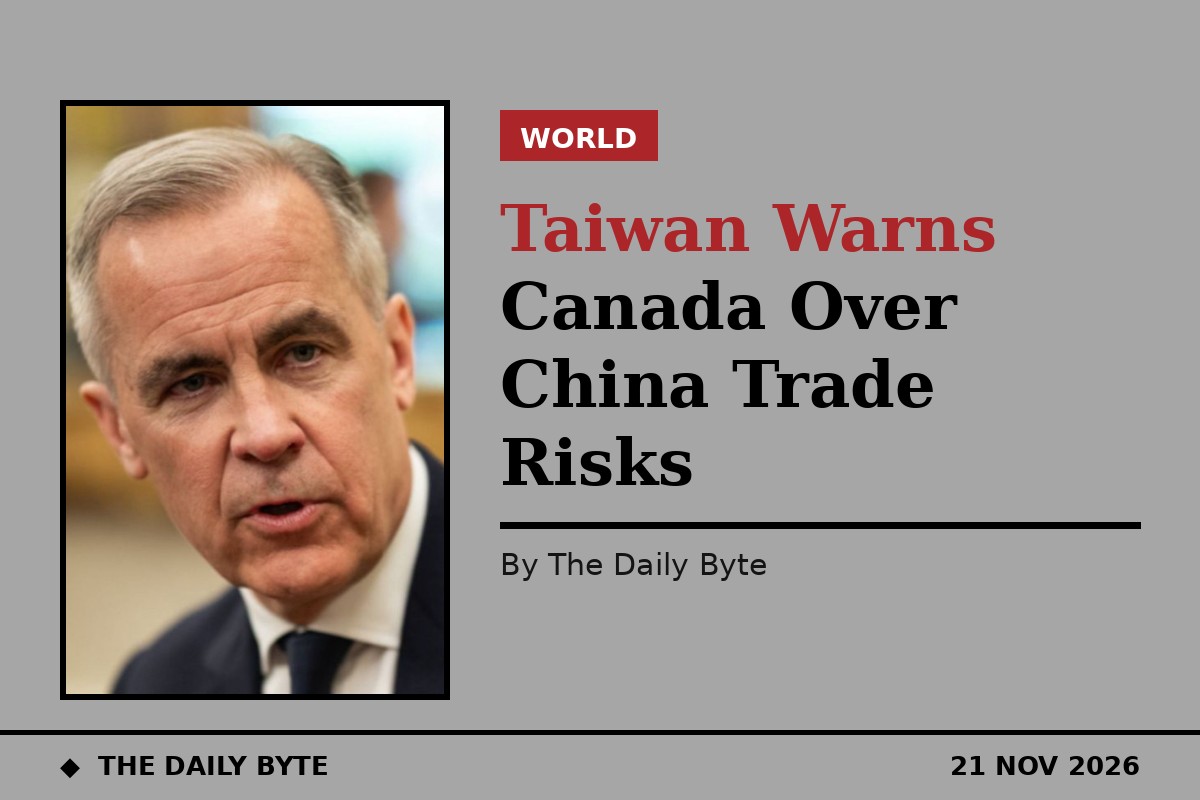
Taiwan's deputy foreign minister has warned that Canada risks exposing itself to the very economic coercion Prime Minister Mark Carney has cautioned against, as Ottawa deepens its trade ties with China. Chen Ming-chi delivered the warning on Saturday in an interview with The Associated Press at the Halifax International Security Forum, days after Carney met Chinese President Xi Jinping in Shenzhen.
"We worry. We worry," Chen said when asked about Carney's efforts to improve relations with Beijing. He said Taiwan had learned the hard way that dependence on China comes with consequences, and he questioned whether Canada should deepen its ties with countries that do not share its democratic values.
"Who do you want to choose as your partners?"
Carney has warned that major powers are using economic integration as a weapon, citing United States tariffs and China's restrictions on critical minerals. He has urged middle powers to diversify their trade relationships so they are less exposed to economic coercion. Chen praised Carney's speech on the subject at the World Economic Forum in Davos, Switzerland, but said the prime minister's own logic pointed in the other direction when it came to Beijing.
"Who do you want to choose as your partners?" Chen asked. "You have your own history. You have two Michaels," he said, referring to former Canadian diplomat Michael Kovrig and businessman Michael Spavor, whose detention in China for nearly three years prompted accusations of hostage diplomacy. The two men were arrested in 2018, shortly after Canada detained Huawei executive Meng Wanzhou on a United States extradition request. They were released in September 2021, the same day Meng returned to China. Beijing denied that their detention was politically motivated.
The Shenzhen deal behind the warning
Chen's warning came days after Carney met Xi in Shenzhen and agreed to additional tariff reductions, as Canada seeks to diversify its trade during the United States president's trade war. Carney has also said Canada could turn to Chinese automakers if negotiations with Washington fail to preserve a viable Canadian auto industry. President Donald Trump has threatened tariffs of 50 per cent on Canadian vehicles and auto parts beginning on 1 January.
Chen warned that Chinese electric vehicles could threaten Canadian manufacturers and pose surveillance risks because of their connected technology, even if the vehicles were manufactured in Canada. Carney has argued that Canada's trade relationship with China differs from Washington's more complicated ties with Beijing, because Canada primarily exports agricultural products, energy and other commodities rather than sensitive technologies such as advanced semiconductors.
Taiwan's own lesson in dependence
Chen said Taiwan had dramatically reduced its economic dependence on China after experiencing Beijing's use of trade restrictions to exert political pressure. "They are very good at weaponizing interdependence," he said. "They are very good at leveraging our dependence to reach political goals."
He pointed to the figures. Taiwan reduced the share of its outbound investment going to China from more than 80 per cent in 2010 to 3.8 per cent last year, Chen said. Its exports to China and Hong Kong fell from nearly 44 per cent of total exports in 2020 to about 27 per cent last year, according to Taiwanese government figures.
Chen also accused Beijing of exploiting a striking photograph from this week's summit in Shenzhen, which showed Xi seated prominently between Trump and Russian President Vladimir Putin, to project China as the world's leading power. "The main idea is to prove not only to his domestic audience that he is the world leader," Chen said. "They are so good at propaganda." He described the summit as "more symbolic than substantial."
Chen said China was intensifying its military operations around Taiwan, despite the potentially enormous costs of an invasion, and warned that Chinese vessels could be rehearsing for a maritime quarantine of the self-governing island.
An olive branch as well
Despite his concerns about Beijing, Chen praised Carney's international leadership and welcomed his commitment to sign a long-delayed trade cooperation arrangement with Taiwan. "We have a high respect of Prime Minister Carney's vision. And we want to be part of this vision," he said.
The warning captures the tension at the heart of Carney's trade strategy. The prime minister is trying to reduce Canada's vulnerability to Washington by building new commercial relationships in Asia, while one of Asia's closest partners of Canada is telling him that the country he is turning to is the one that taught it the costs of dependence.


