Tesla Plans $3.1bn Texas Polysilicon Plant
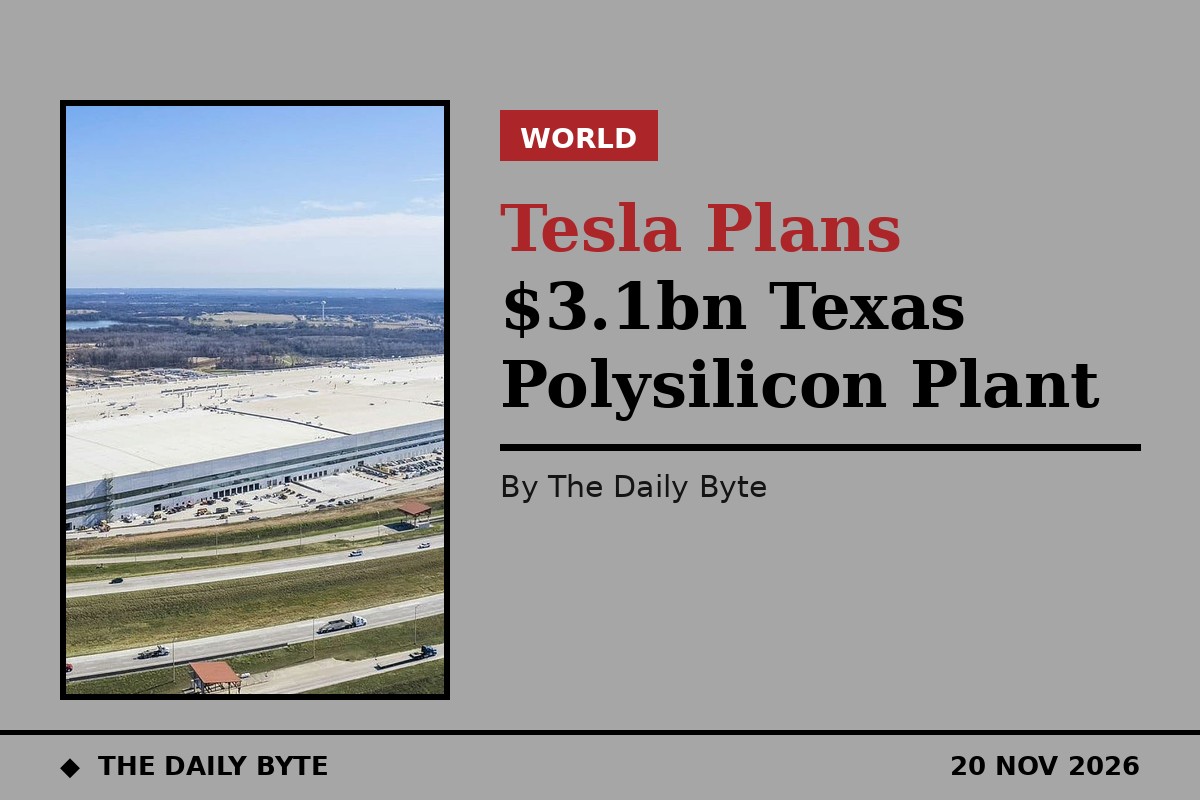
Tesla is planning a $3.1 billion solar-grade polysilicon plant in Texas, according to an application the company filed this week seeking tax incentives for the project.
The facility, planned for Nueces County in southern Texas near Robstown, would create a new domestic source of polysilicon, a material used to make solar panels that is currently produced predominantly in China. The plant would begin operations in 2030 and employ 515 workers by 2032, according to the application filed under the state's Jobs, Energy, Technology and Innovation program.
Tesla describes the plant as the upstream component of its vertically integrated domestic solar manufacturing platform. It would produce ultra-high-purity polysilicon for single-crystal silicon ingots and high-efficiency N-type solar cells.
What Tesla has filed for
The application was filed with the Tuloso-Midway Independent School District and has been published by the Texas Comptroller of Public Accounts. Tesla is requesting a property tax limitation under the state's JETI program, which would cut the project's taxable value for school-district maintenance and operations taxes to zero from 2028 to 2030 and halve it from 2031 through 2040.
The application does not specify the value of the tax break being requested. Tesla said the incentive would be an important factor in its decision on where to build. In its filing, the company said that without the agreement it would not make the proposed investment in Texas, and that it is assessing locations in other jurisdictions.
Steve VanMatre, superintendent at Tuloso-Midway school district, told local news outlet KRIS 6 News that the district was aware of the significant investment Tesla is interested in making, adding: "It is not a guarantee."
Jobs and spending
An economic impact analysis prepared for Tesla by EY puts construction between 2027 and 2030. Of the planned capital spending, $1.5 billion is earmarked for engineering and construction, $1.4 billion for equipment and $183 million for utility infrastructure, with more than 80 percent spent in 2028 and 2029.
Tesla plans to hire 260 workers in 2030, rising to 515 once the plant is fully operational in 2032, at average total compensation of $130,000, according to the analysis. EY estimates the project would generate about $63.5 billion in economic output in Texas through 2065.
Why polysilicon matters
Polysilicon is the raw material at the start of the solar supply chain, refined into ingots, sliced into wafers and built into cells and panels. Almost all of it is made in China, which has left American solar manufacturers dependent on imports and exposed to tariffs and trade disputes.
The timing of Tesla's application comes only weeks before new US tariffs on polysilicon and its derivatives take effect. From 4 December, the US will introduce a 15 percent tariff and a minimum price on imports, a move designed to stimulate domestic production of polysilicon, ingots and wafers.
Tesla has been advancing a plan to build 100 gigawatts of US solar manufacturing capacity by 2028, a target that has drawn scrutiny over whether the goal is achievable. Even with the new plant, analysts note, Tesla would still fall short of a local supply for that target — but the factory would be one of the first large domestic sources of the material.
The tax break is decisive
The filing makes clear that the project is conditional. "A JETI agreement is a compelling factor in the applicant's competitive site selection determination, and in the absence of the agreement the applicant would not make the proposed investment in this state," EY wrote in its analysis.
The filing does not state the plant's production capacity. Using comparable projects as a guide, analysts at PV Tech Research estimate it could mean annual output of around 40,000 metric tons. For now, the proposal remains exactly that — an application, not an executed agreement — and the school district and state must still approve the incentive before construction can begin.


