Tesla China Sales Plunge 66% in October to Four-Year Low
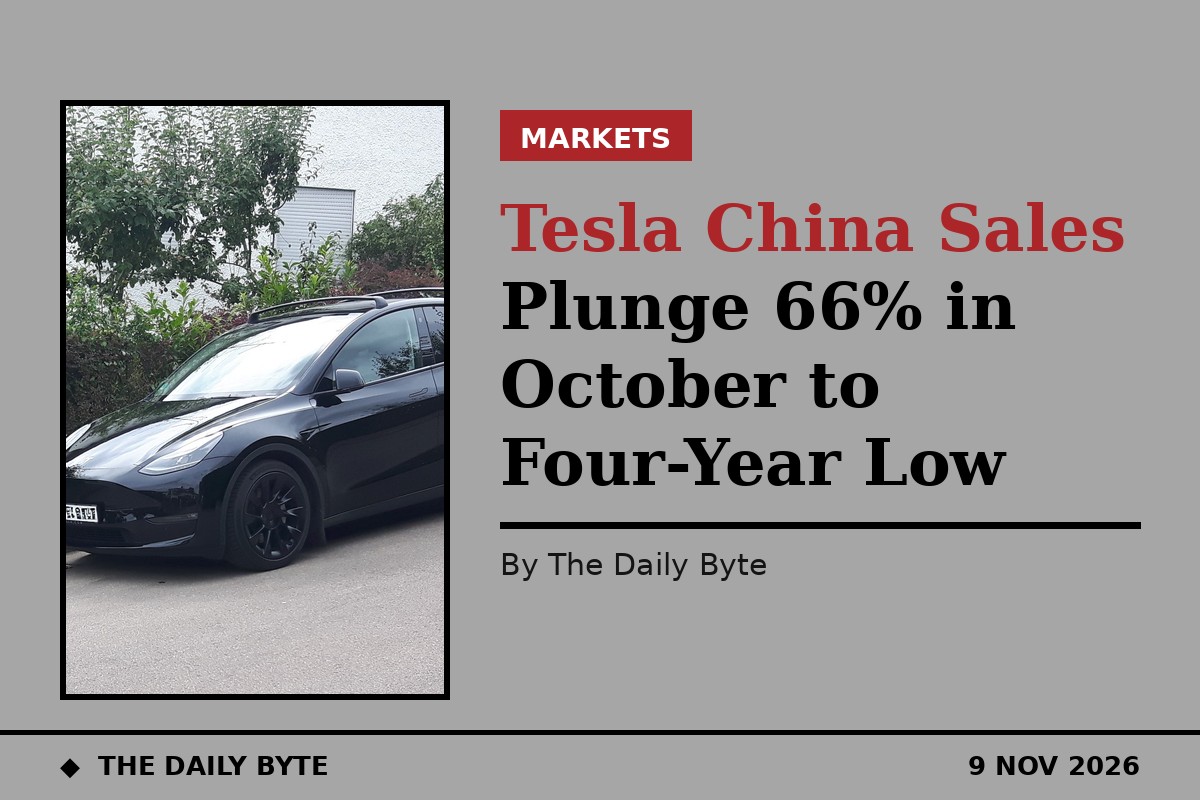
Tesla sold just 8,817 cars to Chinese customers in October, a fall of 66.1 per cent on a year earlier and the weakest monthly retail figure since July 2022, according to data released on Monday by the China Passenger Car Association (CPCA).
The figure, compiled by CnEVPost from the CPCA data, marks the fifth consecutive month in which Tesla's retail sales in China have fallen year on year, and the first month below 10,000 cars since July 2022, when the company sold 8,461. Sales were also down 86.4 per cent from September.
The domestic slump stands in sharp contrast to the headline wholesale number. Tesla's Shanghai factory shipped 67,829 China-made cars in October, up 10.3 per cent on a year earlier, according to preliminary CPCA figures released on 3 November and reported by Reuters. But 59,012 of those cars were exported, a record 87 per cent of monthly wholesale output, leaving only 13 per cent for Chinese buyers. The previous export-share record was 76.01 per cent, set in October 2022.
Losing share in a growing market
Tesla's share of China's new energy vehicle market fell to 0.80 per cent in October, from 2.03 per cent a year earlier and 5.98 per cent in September. In the battery-electric segment its share dropped to 1.15 per cent, from 3.20 per cent a year earlier and 8.48 per cent in September. Both were the lowest since April 2022, when a Covid shutdown halted the Shanghai plant.
The wider market moved the other way. China's passenger new energy vehicle wholesale volume reached about 1.8 million in October, up 12 per cent year on year and 8 per cent on September, with rivals including BYD, Geely and XPeng posting record monthly sales.
Over the first ten months of the year, Tesla's retail sales in China totalled 389,905 cars, down 15.0 per cent on a year earlier, a decline that widened from 11.93 per cent after nine months. Exports accounted for 51.92 per cent of the Shanghai factory's wholesale sales over the period, up from 31.32 per cent a year earlier, and cumulative exports have now overtaken domestic retail sales.
Discounts and financing
Tesla has moved to revive demand. On 30 October it launched a new financing programme in China, cutting the minimum down payment for five-year interest-free loans on selected Model 3 and Model Y variants to 39,900 yuan (about $5,940), roughly half the previous level. The company disclosed on 5 November that 98 per cent of the parts used at its Shanghai factory are now sourced locally.
Some caution is warranted in reading one month. Tesla concentrates deliveries in the final month of each quarter, so October routinely falls from September: wholesale volume dropped 22.7 per cent between the two months in 2024 and 32.3 per cent in 2025. But the year-on-year collapse in domestic retail sales, the fifth in a row, and the loss of market share while the overall market grows, point to a demand problem rather than a calendar effect.
Exports become the release valve
South Korea took about a fifth of the Shanghai factory's exports over the first nine months of the year, according to Reuters, and Tesla has paused new Model 3 orders in Canada, saying high demand has used up its import allocation under the country's quota on China-built electric cars. Whether the October financing offer can rebuild domestic orders will show in the November retail figures, due early next month.
Shares rebound after rough week
Tesla shares rose 4.23 per cent to $358.22 on Friday, recovering after dipping to $347.60 during the session, close to a two-month low. The rebound came as chip stocks led a wider recovery, but the shares remain more than 10 per cent lower on the week and below their 60-day moving average of $368.07. Investors will watch whether Monday's China figures change that tone when US trading resumes.