Tesla rolls out FSD v15 with Reality View
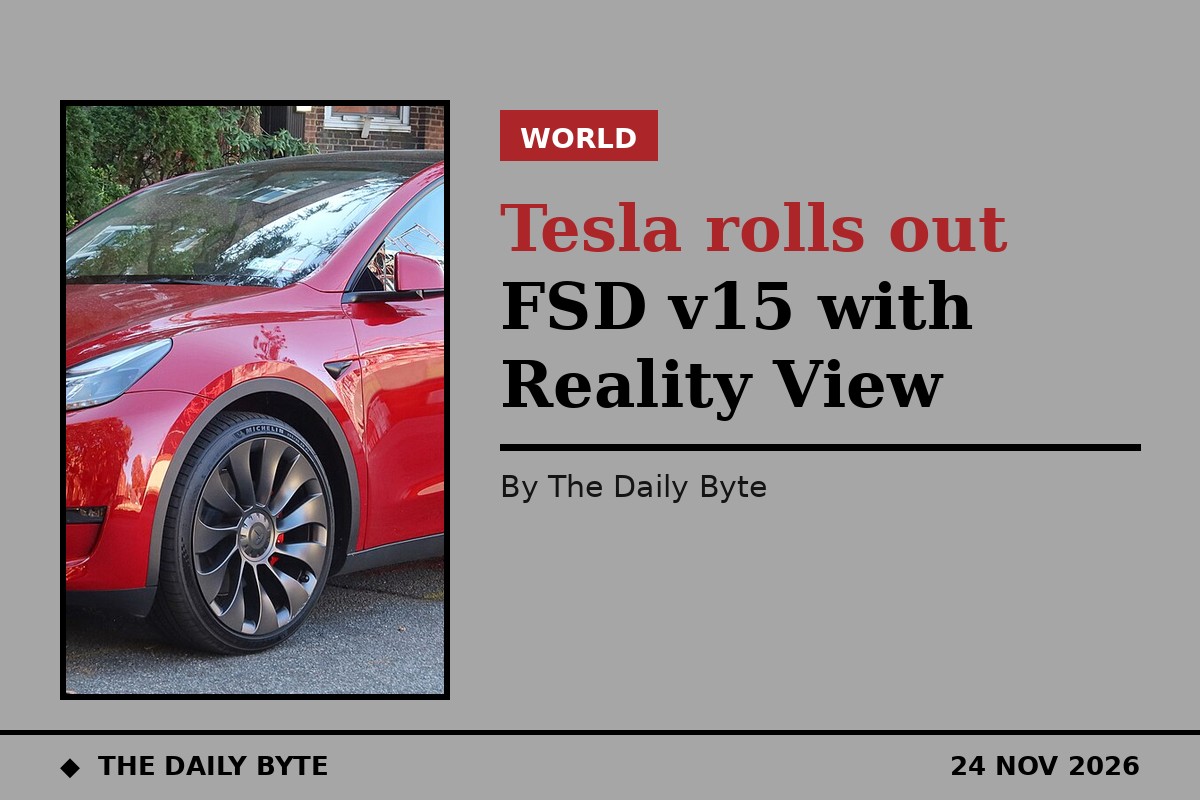
Tesla has started rolling out Full Self-Driving v15, the biggest update to its driver-assistance software in more than a year, with a new live visualisation and a claim of sharply better handling in safety-critical situations. The company announced the rollout on X on Saturday 21 November, saying the release upgrades every part of its end-to-end driving network.
The update is going first to a limited wave of owners, with a wider release expected in December. Tesla chief executive Elon Musk wrote on X that v15 would go to wide release next month, and the company's AI chief, Ashok Elluswamy, confirmed that the first wave was already under way. Tesla has not said which models or countries are first in line, but it has previously told investors that its AI4 computer, also known as Hardware 4, is enough to run the new version.
The most visible change is Tesla Reality View, a live visualisation that shows drivers what the car detects and what Full Self-Driving plans to do next. Tesla describes it as a real-time generative view streamed from a virtual camera above and behind the vehicle, with upcoming turns shown directly in the scene. Drivers can choose a fullscreen view, a map, a split view, or a quiet mode. In the release notes Tesla calls the same feature Tesla Augmented Reality, saying it replaces the separate on-screen model signals with a single end-to-end visualisation that uses less computing power. Musk compared the look to the video game Grand Theft Auto, writing on X: "It is like GTA."
Tesla's headline claim is that v15 handles safety-critical cases 25 times better than the previous version. The release notes make clear what that figure refers to: an upgraded vision encoder, shared between Full Self-Driving, the Robotaxi service and the Optimus robot, which Tesla says was trained on millions of internet videos and improves the critical intervention rate by 25 times. The company has not published the underlying intervention rate, so the improvement cannot be checked independently from the announcement alone.
The rest of the release notes read like a list of the areas where owners and regulators have criticised the system most. Tesla says v15 improves detection of road signs, small animals, road debris and chains, as well as potholes, road details and deep standing water. It promises more natural speed handling in school zones, in bad weather and for each driver profile, and says the car can now slow down when it detects a speed camera. Navigation at the start and end of a trip now learns from fleet route preferences, parking selection draws on personal parking history, and a new Bike Rack Mode lets drivers use Full Self-Driving with a bike rack or similar hitch accessory fitted. Driver monitoring has also changed, with better vision-based attention monitoring when the driver wears a hat or sunglasses, and less strict monitoring in higher-speed driving profiles.
The system remains Full Self-Driving (Supervised), meaning the driver must stay attentive and ready to take over at all times. Nothing in the announcement promises unsupervised driving for owners. That matters, because the gap between Tesla's claims and independent evidence has been the story of recent versions. Electrek, which covered the launch in detail, noted that a 25-fold multiplier without a published baseline is hard to verify, and that the US regulator NHTSA is already looking at reports of Robotaxis speeding in active school zones, on top of an investigation opened in October 2025 into Full Self-Driving traffic-law violations. Investors, meanwhile, welcomed the release: JPMorgan analysts described v15 as further evidence of Tesla's head start in consumer autonomy, and Tesla shares rose sharply on Monday 23 November.
For owners in the first wave, the test now is whether the improvements show up on real roads. If the new vision system really does read signs and spot potholes far more reliably, and if Reality View makes the system easier to supervise, v15 could be the most meaningful step toward autonomy Tesla has shipped in years. If not, it will join a long line of versions that promised more than the first weeks delivered.


