Tesla Self-Driving EU Vote Delayed to 15 December
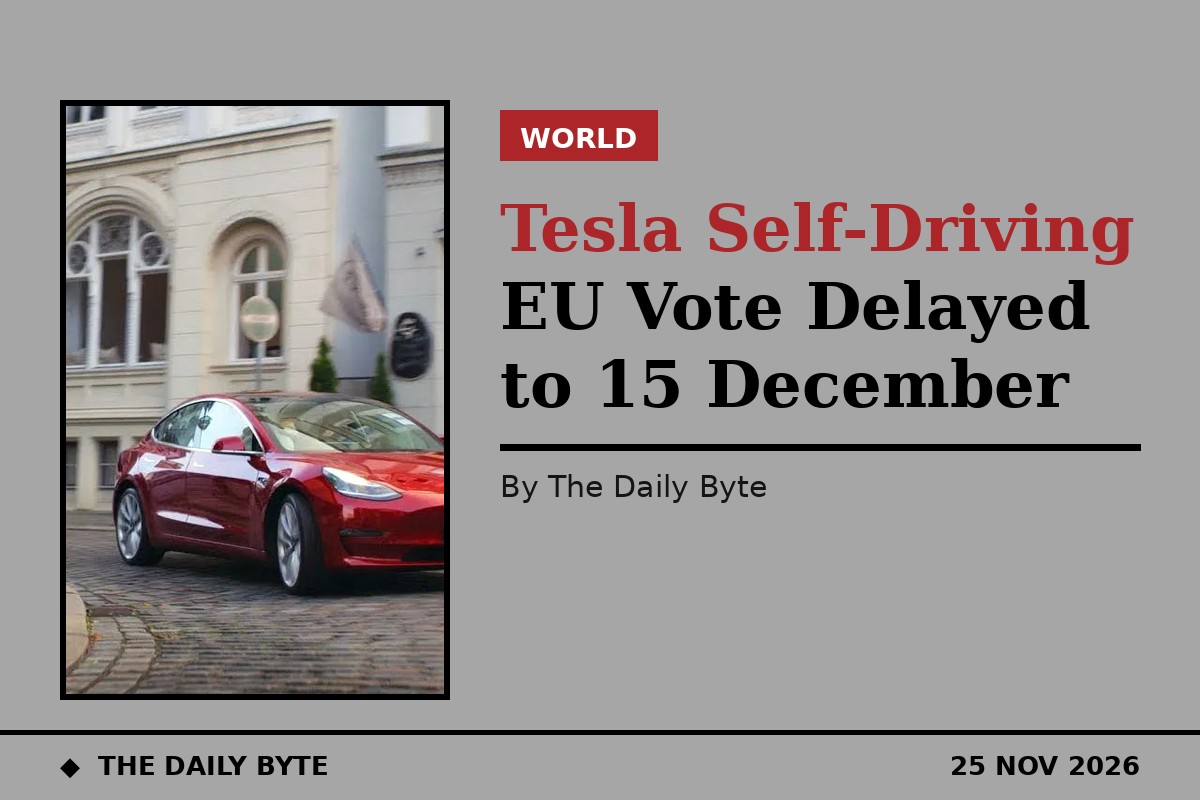
The European Union has pushed back a key meeting on Tesla's assisted-driving system to 15 December, delaying a decision that could determine whether the technology can be sold across the bloc. A European Commission spokesperson confirmed the new date to Reuters on Wednesday, 25 November.
The meeting of the EU's Technical Committee for Motor Vehicles had originally been scheduled for 1 December, according to the Dutch regulator RDW. Belgium's Flanders transport ministry first said it had moved to 7 December, before the Commission clarified that it would instead take place on 15 December. No reason was given for the change.
A vote that has already slipped twice
The committee had been expected to consider, and possibly vote on, Tesla's system at its December meeting, after no vote was held at two earlier meetings. The Netherlands gave the system preliminary approval in April, and nearly a dozen countries have since followed the Dutch lead.
The system, sold in Europe as Tesla Assisted Driving and known elsewhere as Full Self-Driving (Supervised), steers, brakes and accelerates, while the driver is still expected to keep their eyes on the road at all times. Italy is the most populous country to begin a rollout so far.
Twelve countries have recognised the Dutch approval: the Netherlands, Belgium, Croatia, Czechia, Denmark, Estonia, Finland, Latvia, Lithuania, Slovakia, Slovenia and Italy. Together, they account for about 29 percent of the EU's population.
The numbers Tesla still needs
EU-wide approval requires the backing of at least 15 of the 27 member states, representing at least 65 percent of the EU's population. Germany is seen as the most likely next supporter: Tesla agreed to drop the "Full Self-Driving" name in Europe and to cut the system's speed margin from 50 percent to 10 percent above the limit in exchange for Berlin's support, which would take the yes camp to about 47 percent.
Even with Germany on board, Tesla would still need France, or both Spain and Poland, to cross the 65 percent threshold. Sweden has asked the EU to reject the system unless Tesla removes the ability to drive above the posted speed limit altogether.
The stakes go beyond a delay. According to Reuters, an EU-level rejection would invalidate the national approvals already granted, meaning drivers in Italy, the Netherlands and the other countries where the system is already on sale could lose it.
Decision could slip into 2027
A meeting is not a vote: the committee can discuss the file again on 15 December and still push the decision into 2027. Tesla chief executive Elon Musk said on the company's third-quarter call in October that he would be surprised if EU-wide approval took longer than the first quarter of 2027.
For now, European Tesla owners face another wait: two more weeks for a meeting, with no guarantee that the meeting itself will produce a vote.


