Tether Burns $8bn USDT That Was Never in Circulation
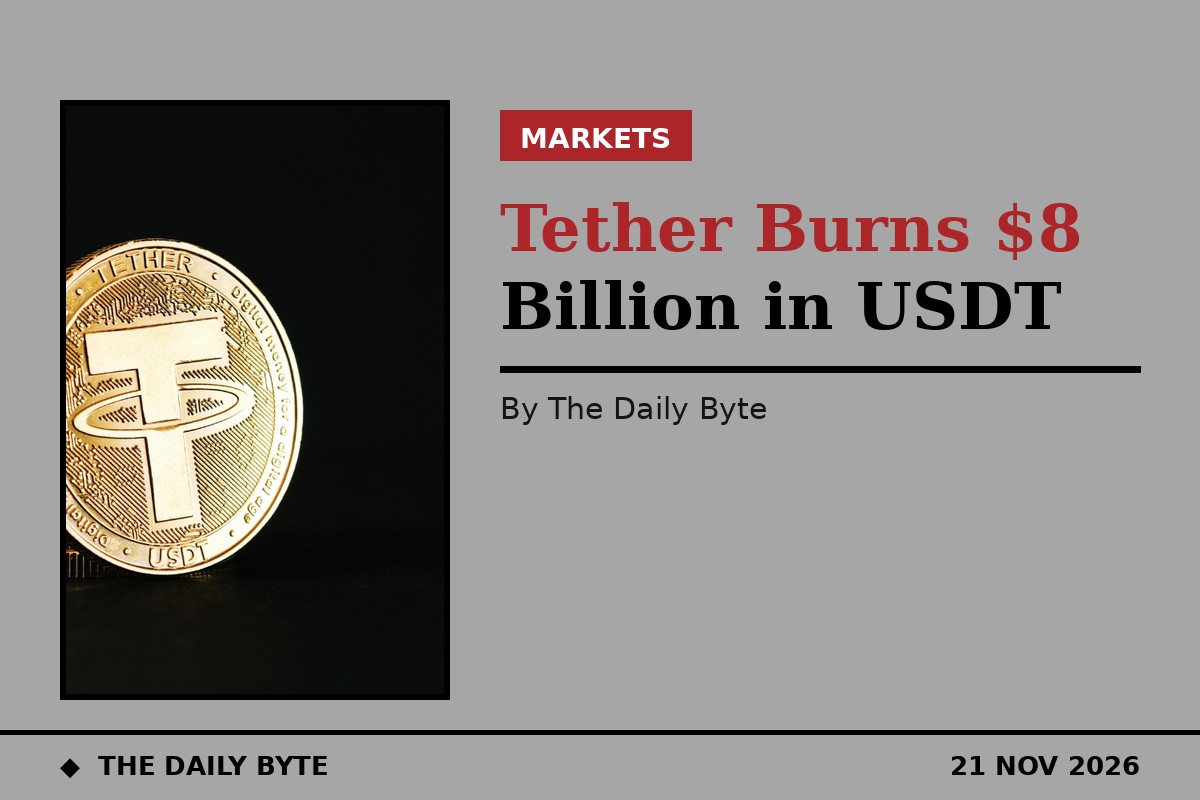
Tether has burned 8 billion dollars worth of its USDT stablecoin over the past 20 days, in a series of large transactions that at first glance look like a stampede for the exits. The reality, according to the on-chain record, is more mundane: the tokens destroyed were unissued inventory sitting in Tether's own treasury, not coins held by customers.
The burns came in three large Ethereum transactions tracked by Lookonchain: 2 billion USDT on 2 November, another 2 billion on 3 November, and 4 billion on 20 November, the largest of the three. Smaller burns over the same period brought the cumulative total to about 8 billion dollars. Whale Alert labelled each of the three large transactions as burned at Tether Treasury.
That label matters. Tether routinely moves authorised but unissued USDT from its treasury to a multisignature address before burning it, as part of managing how much of the token could be issued in future. Destroying unissued inventory reduces the ceiling on future supply. It does not, by itself, mean that holders redeemed 8 billion dollars.
What actually left circulation
The measure that does capture redemptions is circulating supply, and it tells a smaller story. DefiLlama figures put USDT in circulation at about 179.80 billion dollars on 1 November and about 174.77 billion on 21 November, a net decline of roughly 5.03 billion dollars over 20 days. That is a real contraction, and a sizeable one, but it is not the 8 billion figure that travelled around social media.
The wider stablecoin sector is shrinking too. DefiLlama reported total stablecoin market capitalisation at about 281.49 billion dollars as of 20 November, down 1.44 per cent over seven days and 5.88 per cent over 30 days. USDT still dominates the sector, with about 175.09 billion dollars in circulation and a market share of roughly 62.2 per cent. USD Coin, the second-largest stablecoin, holds about 68.80 billion dollars, or 24.4 per cent.
Through the contraction, USDT has held its peg. DefiLlama listed its price at roughly one dollar on 20 November, about 0.10 per cent below its target, despite a 4.23 per cent decline in its circulating market capitalisation over the previous month.
Reserves and lingering questions
Tether's capacity to meet redemptions rests on its reserves. In its third-quarter attestation for 2026, published on 30 October and prepared by BDO, the company reported 191.5 billion dollars in reserve assets against 175 billion dollars in USDT liabilities. That cushion is the company's main answer to the doubts that have followed it for years.
The doubts have not gone away. In November 2025, S&P Global Ratings downgraded its assessment of USDT's stability from 4, described as constrained, to 5, described as weak, citing concerns about reserve asset quality, liquidity, governance and redemption arrangements. Tether disputes that characterisation, but the rating is a reminder that the world's largest stablecoin still carries a credibility question alongside its scale.
For now, the market's verdict is visible in the peg. A stablecoin that was suffering a run would be expected to trade below a dollar by more than a tenth of a per cent. The more useful number to watch is not the burn total but the circulating supply: if redemptions keep running at the recent pace, the sector's contraction will deepen; if they stabilise, the burns will be remembered as treasury housekeeping in a nervous month.